Tokyo to Fukui by E-Bike, Day 6: Over Kurikara and Down the Kaga Coast to a Showa Hotel
Day six took me from Toyama over the border into Ishikawa, past the old Genpei battlefield at Kurikara and around the edge of Kanazawa, then down a long cycling road right next to the Sea of Japan. It ended in the hot spring town of Yamashiro, at a wonderfully old-fashioned business hotel that handed out free stuff like it was going out of style. All in all, it was a mostly flat day of sand, waves, tetrapods, and one very hopeful bird.
Every morning on this trip has started pretty much the same way. I walk out of the hotel, find the Beast parked by the entrance under its silver rain cover, and take the cover off. In my head, I do it in one big swoosh, like a magician pulling the sheet off a car he’s just made appear out of thin air. In reality, it’s a lot more tugging, unhooking, and walking around the bike trying to figure out which corner is stuck, which is probably why nobody has ever clapped. I’m also not sure the Beast enjoys being undressed on the sidewalk in front of strangers every day, but it hasn’t complained yet. Toyama was no different. The cover got folded up and stuffed into the bag, and off we went. The rain from the day before had moved on, too, and there wasn’t a single cloud anywhere to interfere with my ride.
The plan for Day Six was a long ride of about 110 kilometers from Toyama to Kaga, a city in the southwestern corner of Ishikawa Prefecture, right on the border with Fukui. And the best part was that it would be almost completely flat.
You might be wondering why I stopped in Kaga at all, because from there it’s only something like 36 kilometers to Fukui. I probably could have squeezed that in and wrapped up the whole trip on Day Six. The thing is, I didn’t want to roll into Fukui in the evening, tired and hungry, with the sun already gone. I wanted to get there around noon. Arriving in the middle of the day just feels different. The city is awake, you still have the whole afternoon ahead of you, and there’s time to actually enjoy the fact that you made it. It’s also how my Tokyo to Kyoto ride ended back in May, when I got to Kyoto right around noon, so finishing this one the same way felt kind of right. A little tradition, if two times is enough to call it that.
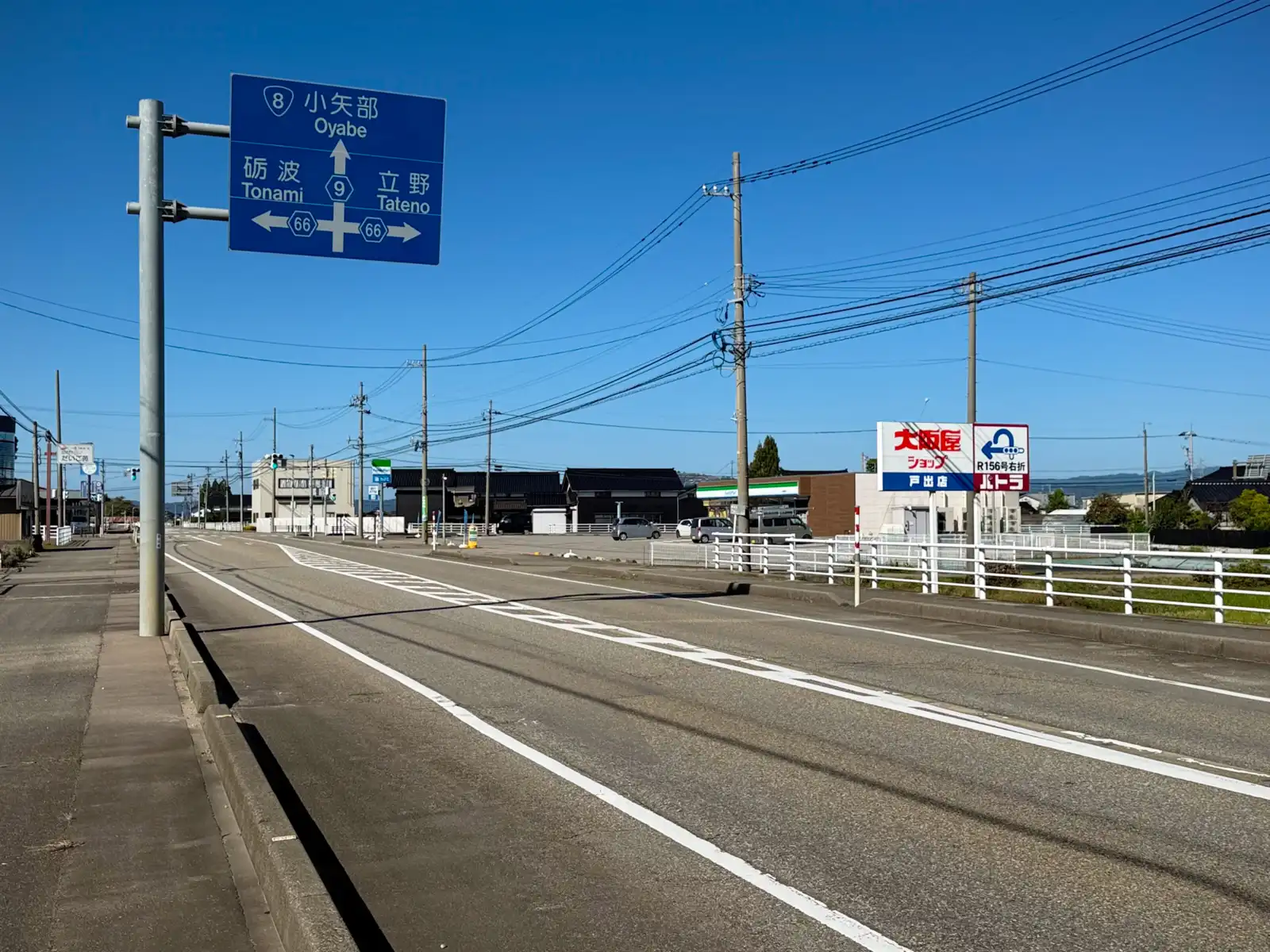
I headed west out of the city on Route 8, the big national road that runs along this side of Japan all the way from Niigata to Kyoto. I’d been following it on and off since Day Four, so by now it felt a bit like an old acquaintance. Not exactly a friend, since it comes with a lot of trucks, but more like a neighbor you nod at.
Somewhere around Takaoka I stopped at a 7-Eleven for a late breakfast. Out of the whole row of onigiri, one big one jumped out at me right away. It had “Hokuriku” printed in huge letters on a bright orange label, with a little outline of the Noto Peninsula next to it, and inside was rice cooked with kelp and a lump of tuna mayo on top. This one is only sold in this region, so you won’t find it in Tokyo, and that pretty much made the decision for me. When you’re on a trip like this, eating something you can’t get back home is half the fun. I ate it standing in the parking lot in the sun, which, if you ask me, is the correct way to eat an onigiri.
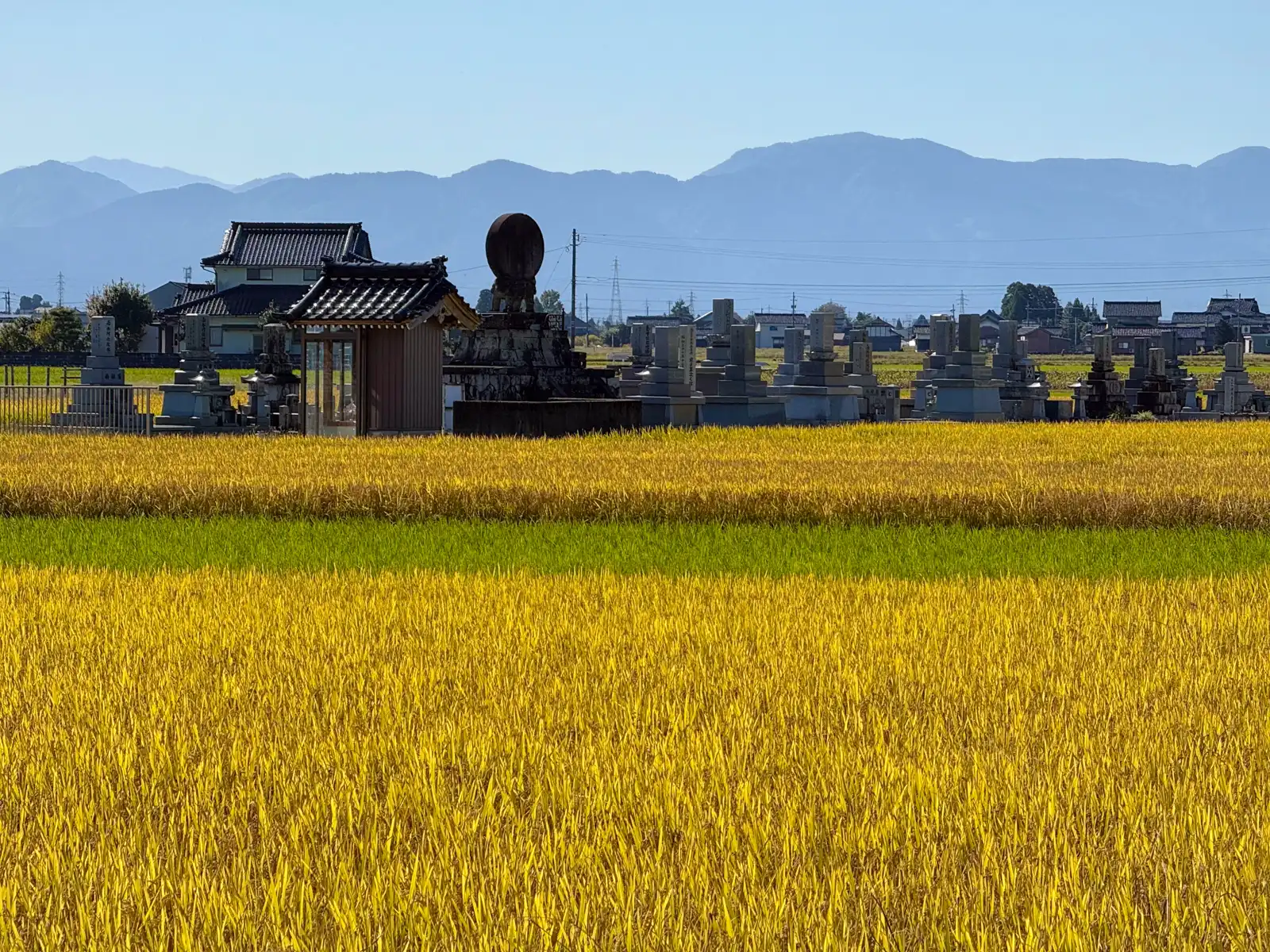
The road west of Takaoka runs through wide, flat farmland, and in the middle of October a lot of the rice was still waiting to be harvested. Some fields were already cut, others were still a deep golden yellow, and every once in a while there’d be a stripe of bright green right next to them, as if someone had run out of yellow paint. Every now and then a small cemetery would show up right in the middle of the fields, with no temple anywhere near it, just a few rows of gravestones surrounded by rice and the mountains far behind them. It’s a pretty common sight in the Japanese countryside, and apparently especially here in Hokuriku. Most of these are shared village graveyards, called kyodo bochi. Before the war, people could put up graves pretty much anywhere, and since the rice fields were where the whole village worked together every day, they were a natural place to keep the family close by.
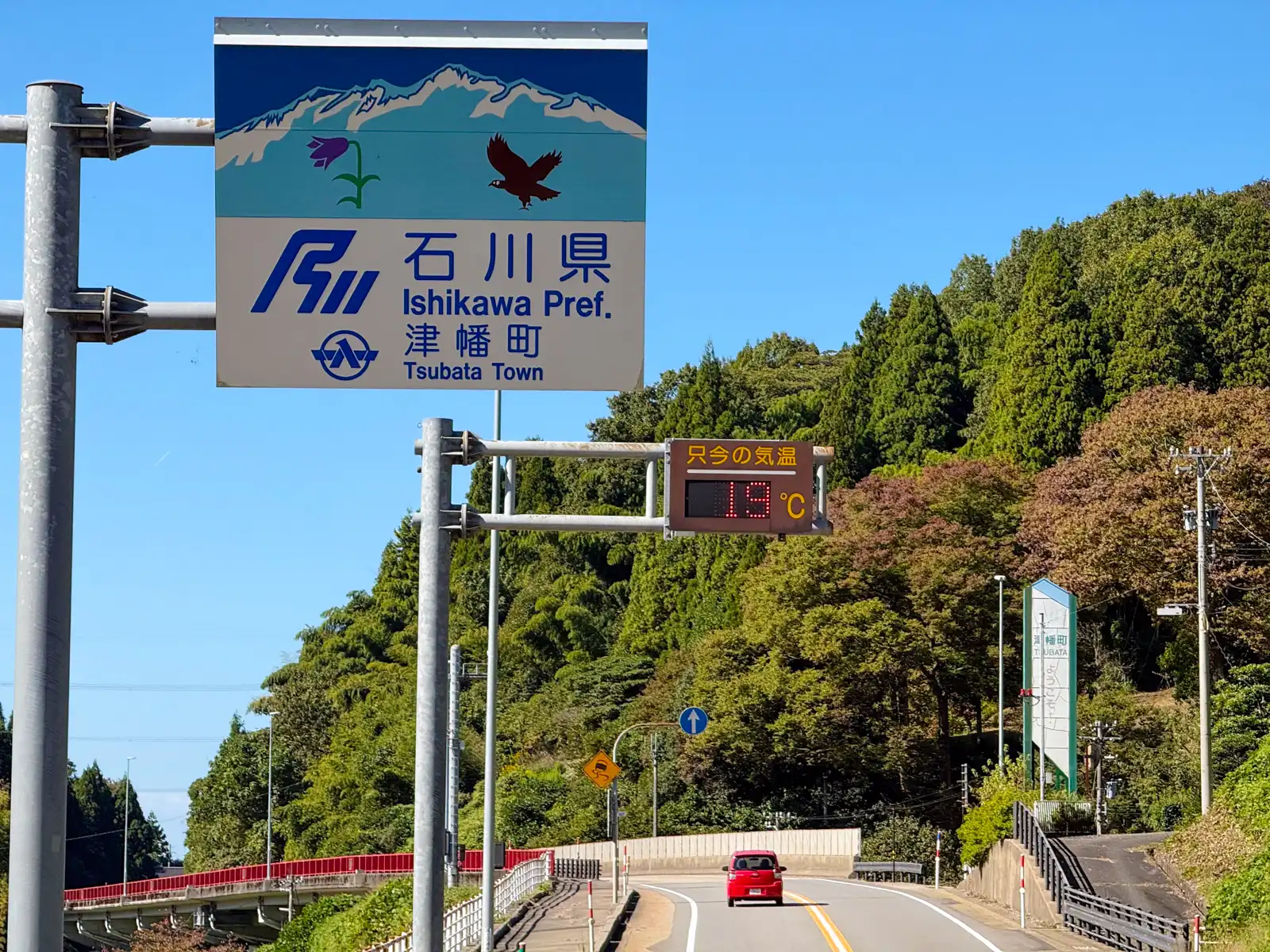
Past Oyabe, the hills start closing in, because this is where Toyama and Ishikawa meet. It was the only real bump of the whole day, and a pretty small one at that. Soon after, a big sign welcomed me to Ishikawa Prefecture and the town of Tsubata. On it are the three things Ishikawa seems most proud of, nature-wise. There’s Mt. Hakusan, the big sacred mountain in the south of the prefecture, then a purple kuroyuri, or black lily, which is the prefectural flower and grows high up on Hakusan, and a golden eagle, the prefectural bird. According to the prefecture, there are only about 300 golden eagles left in all of Japan, and somewhere around 30 or 40 of them live in Ishikawa. I didn’t see any, but the electronic sign right below said it was 19 degrees, which I’ll happily take instead.
Just past the border, at the foot of the hills, is Michi-no-Eki Kurikara Genpei no Sato, which is a pretty dramatic name for a place where people mostly stop to buy vegetables and use the toilet. It makes more sense once you know that the hills above it are the Kurikara Pass, the site of one of the most famous battles of the Genpei War, the big fight between the Minamoto and Taira clans at the end of the 12th century. That’s also where the “Genpei” comes from, by the way. Gen is another reading of Minamoto, and Hei is another reading of Taira.
The battle took place in 1183, on the 11th day of the fifth month, which works out to June 2 on today’s calendar. On one side was Minamoto no Yoshinaka, better known as Kiso Yoshinaka, and on the other was a huge Taira army led by Taira no Koremori, the grandson of the all-powerful Taira no Kiyomori. Yoshinaka’s men attacked at night, and the Taira army, trapped on the narrow mountain ridge, ended up being pushed down into the valley below. It was a crushing defeat, and a month or two later Yoshinaka marched into Kyoto.
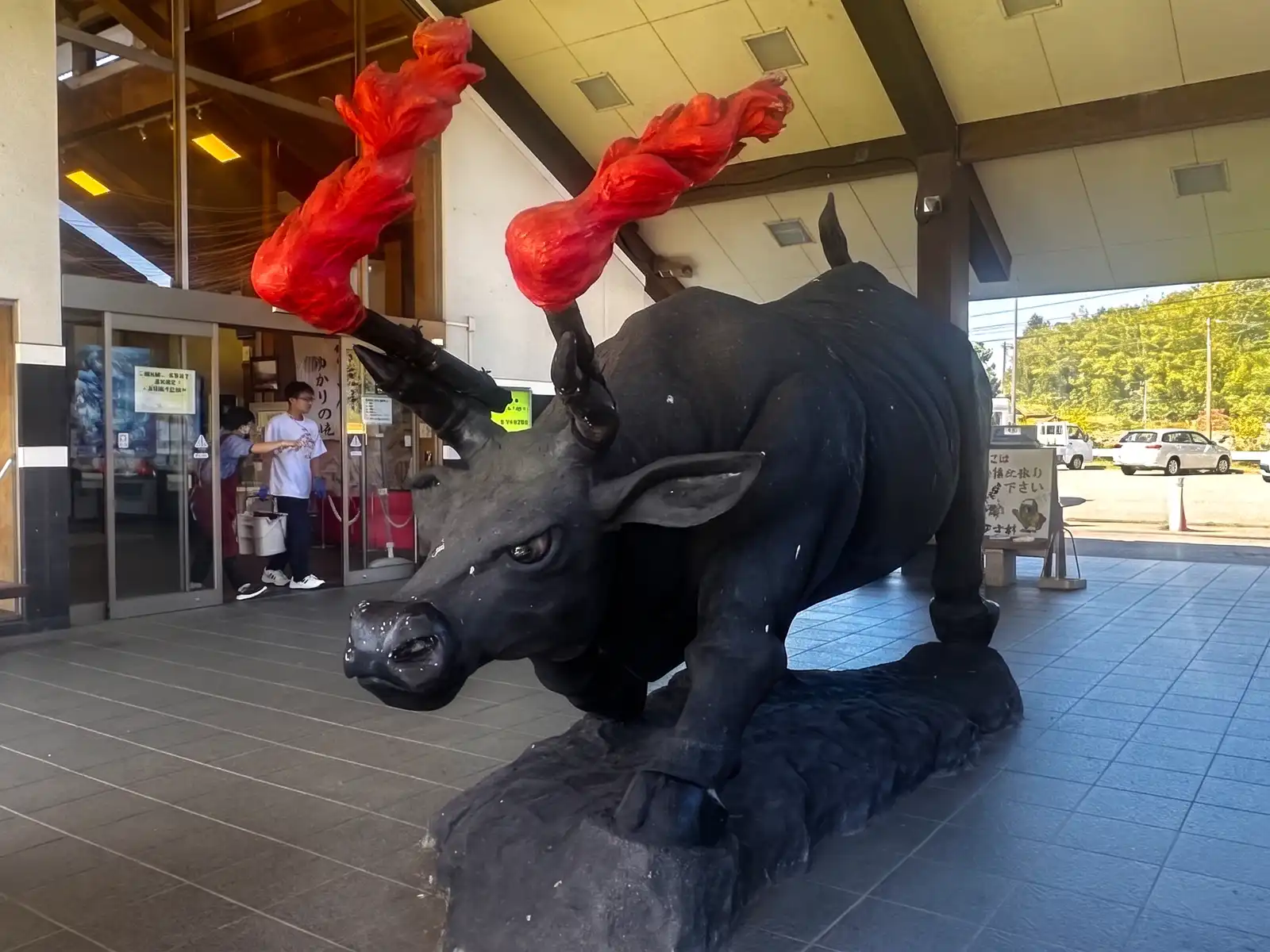
But what this battle is really famous for is something else entirely. Oxen. Yes, oxen. According to the Genpei Seisuiki, a war chronicle written long after the battle, Yoshinaka had torches tied to the horns of four or five hundred oxen and sent them charging into the enemy camp in the dark. It’s a great story, but whether it really happened is another matter. Plenty of historians are skeptical, and the trick looks suspiciously like one used by a Chinese general named Tian Dan about 1,400 years earlier. Still, the roadside station clearly believes in it, because right at the entrance stands a big black ox with bright red flames shooting out of its horns. It looked very angry. Well, if somebody tied burning torches to my head, I’d be angry too.
The roadside station itself opened in 2004, and along with a big parking lot, it has a farm stand, a hot bath, and even rooms where you can stay the night. I did none of that. I only used the toilet. That was my entire contribution to the history of Kurikara. Somewhere up in those hills, 800 years ago, thousands of samurai fought for the future of the country, and here I was, walking out of the restroom and drying my hands on my pants. Not exactly the kind of thing that ends up in a war chronicle.
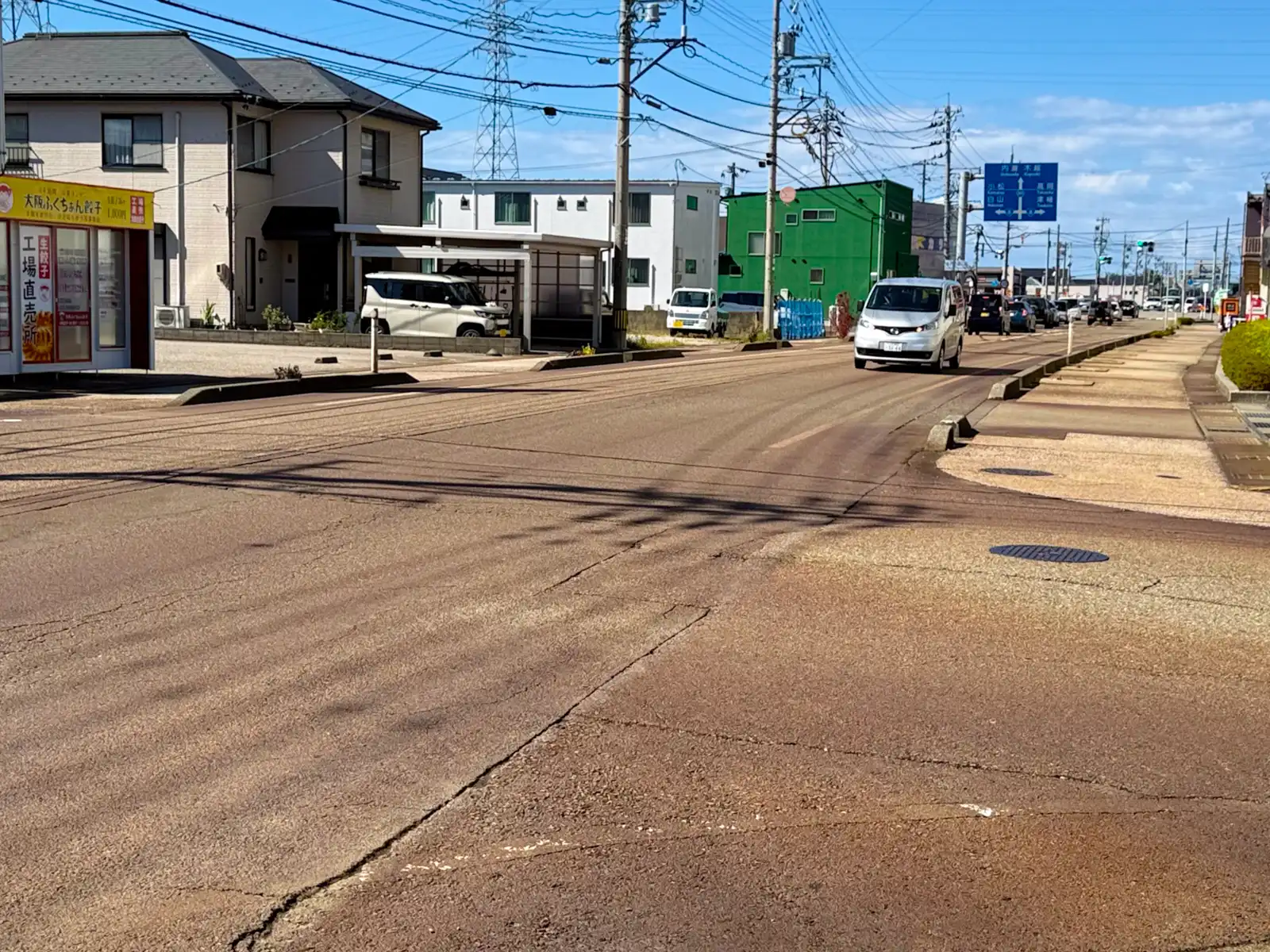
From Tsubata it’s only a short ride down to Kanazawa. I’d love to say I explored the city, but this time I mostly stayed out on its edges. Something I noticed right away was that a lot of the roads in this area had these long brownish, rusty-looking stains running down the middle and along the edges. At first I thought the asphalt was just old and dirty, but those stains are the trademark of snow-melting sprinklers. In winter, small nozzles built into the road spray groundwater onto the asphalt, and since groundwater stays at around 12 or 13 degrees even in the middle of winter, it melts the snow before it can pile up. The very first road like this was built in Nagaoka, Niigata, in 1961, and in Ishikawa alone there are about 390 kilometers of prefectural roads with them, with a nozzle roughly every 1.4 meters. The water does leave its mark, though. In October, with no snow anywhere, it just made the roads look like they badly needed a wash.
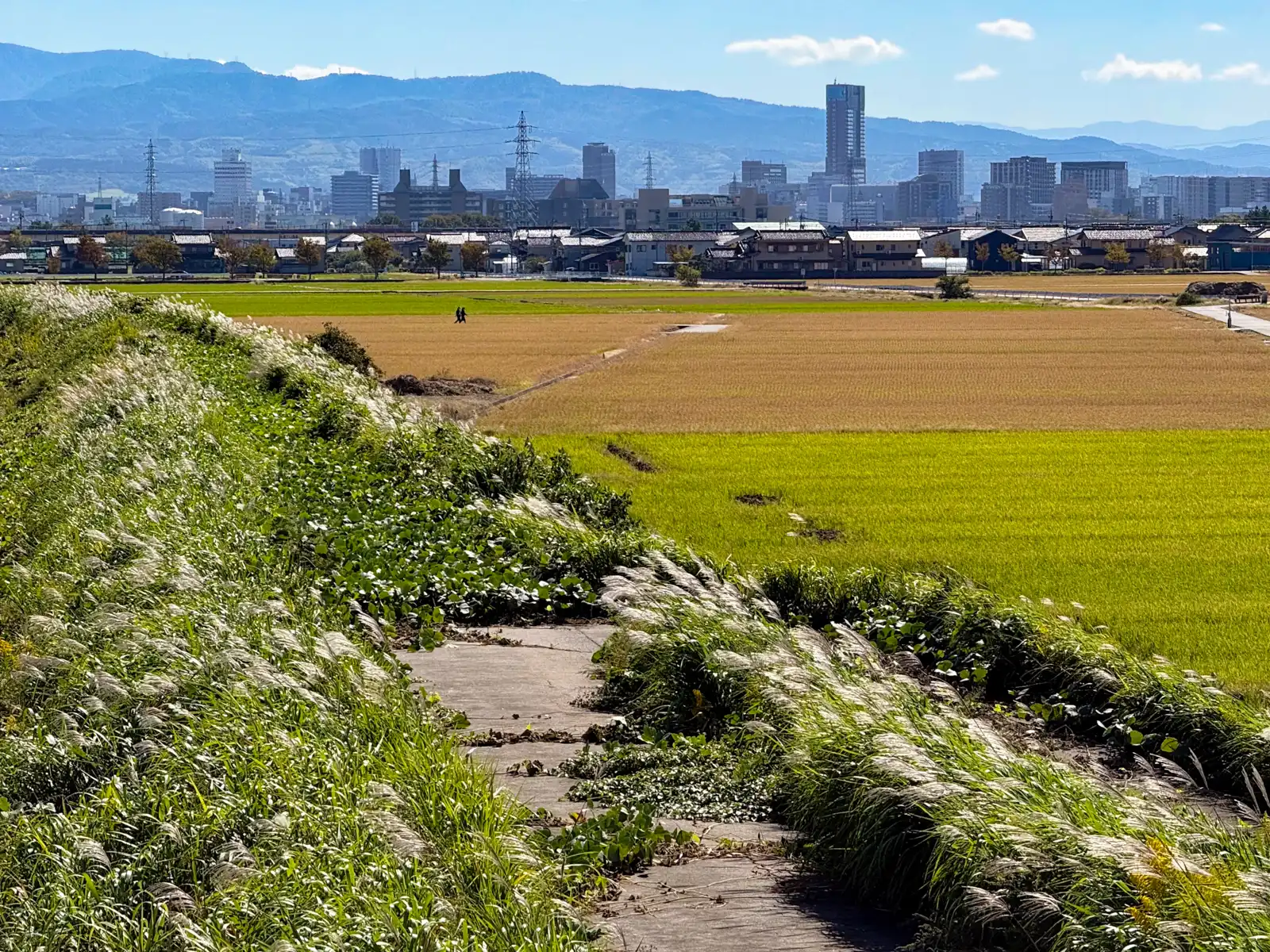
A little further on, I crossed a bridge, and from up there I could see a narrow concrete path running along the bank below, lined with tall susuki grass waving its fluffy silver heads in the wind. Next to it were rice fields, and beyond them the whole Kanazawa skyline, with the mountains behind it. It’s funny how a city looks completely different from the outside. From the middle of it, you think of old samurai districts and tea houses, but from out here in the fields it was just a cluster of towers, a bit like someone had dropped a mini Tokyo into the countryside and walked away.
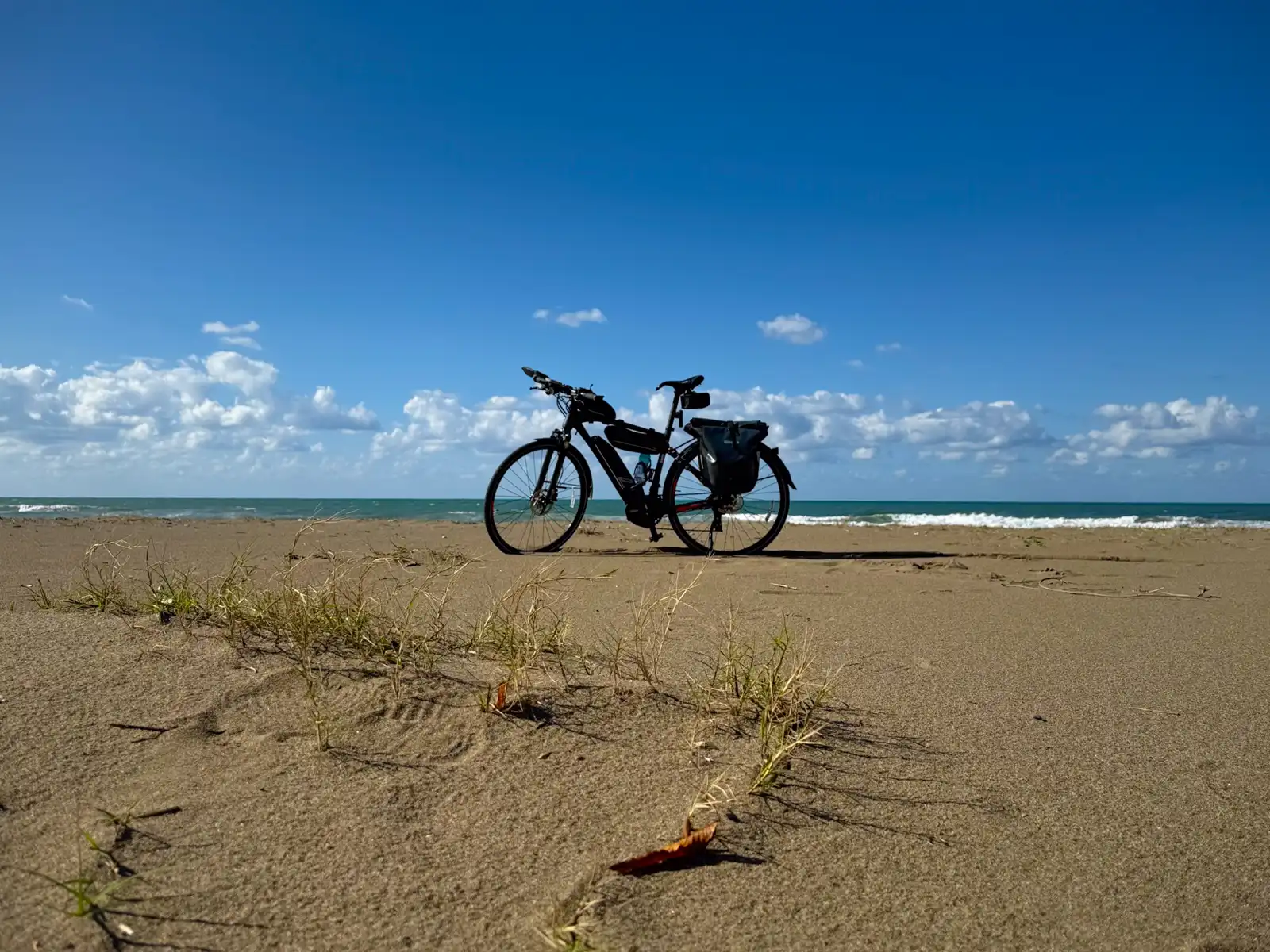
From Kanazawa, I made my way out to the coast, and this was where the best part of the day started. Running south along the shore from Kanazawa to Komatsu is the Kaga Kaihin Cycling Road, officially Ishikawa Prefectural Road 294, a dedicated bicycle path about 25 kilometers long. For long stretches it runs right along the top of the beach, so close to the water that the only things between you and the Sea of Japan are a strip of sand and a few rows of concrete blocks. There’s one part where it goes on like that for what felt like ten kilometers. Just me, the Beast, sand on one side, and the sea on the other, with no cars, no traffic lights, and almost no people. Pure heaven for a cyclist!
The beaches here are completely different from the ones I saw on Day Four, too. Back on the Jade Coast it was all pebbles, but here it’s soft, fine sand that gets into your shoes and somehow stays there for a week. Naturally, I had to drag the Beast down onto it for a photo. It sank in a bit, gave me a look, and then posed like a pro.
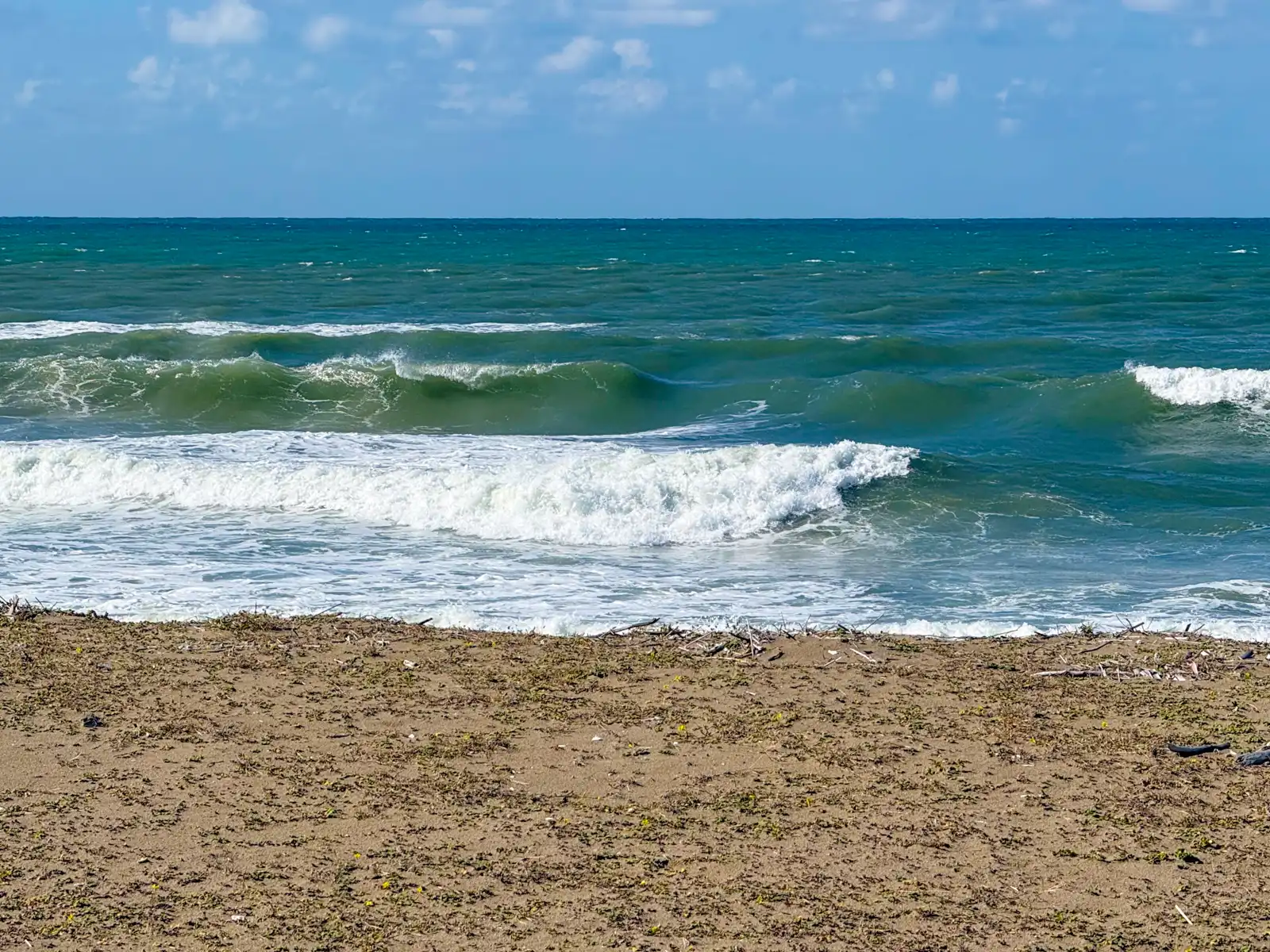
The sky was perfectly clear, but it was windy, so the sea was anything but calm. Big waves kept rolling in one after another, turning the water all sorts of colors, from dark blue far out to a milky green right where they broke.
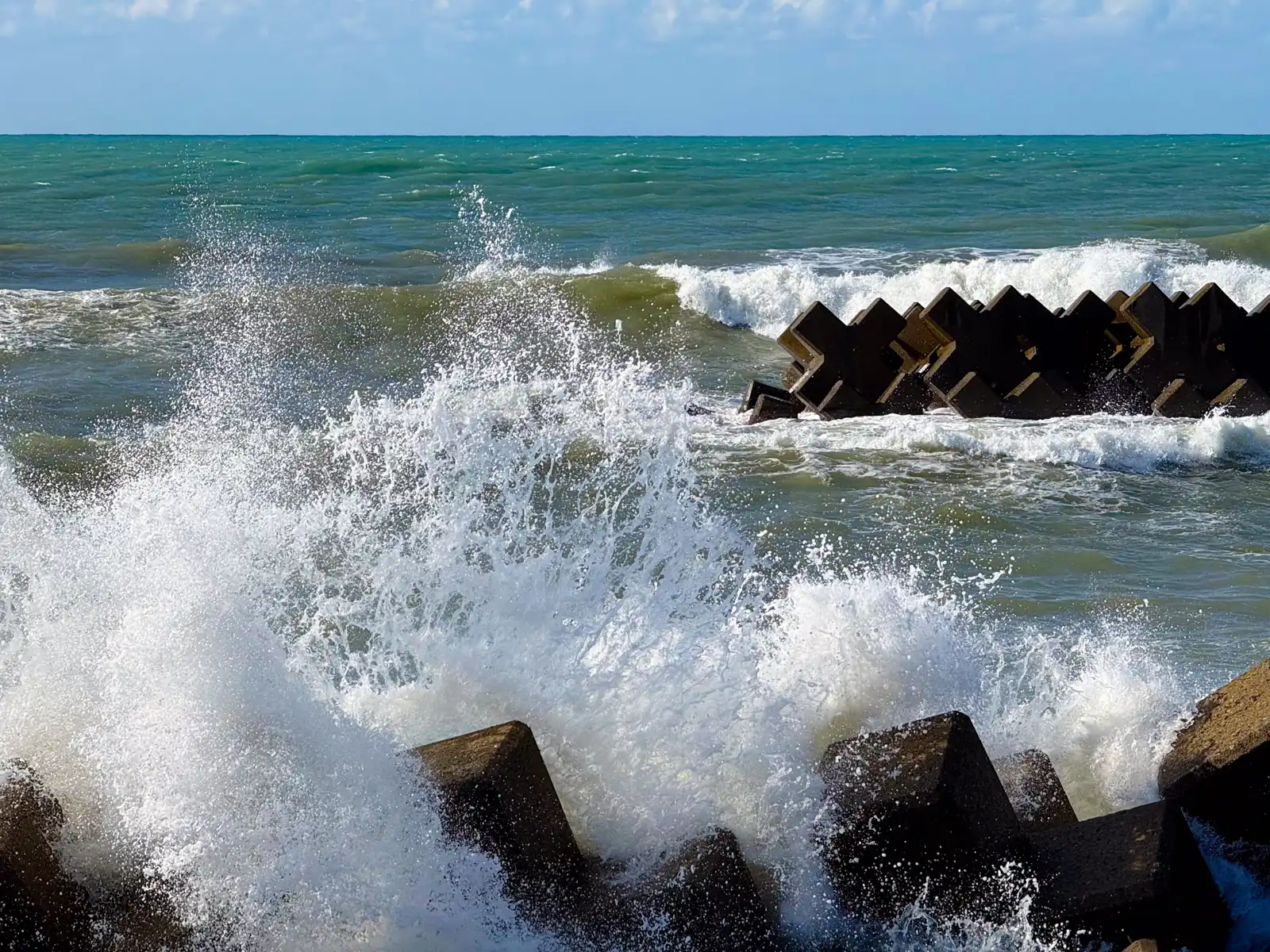
And of course, the tetrapods, or wave-breaking blocks if we’re being precise, were there too, lined up all along the shore, and with these strong waves they were working overtime. Every few seconds a wave would slam into them and explode into white spray. I already knew they were there to protect the coast, but here I could actually see them doing their job, one wave after another. They’re not much to look at, but they sure have a tough job.
I wasn’t completely alone out there, though. Every now and then a big bird of prey would show up and circle slowly right above me. At first I thought it was a hawk, and I wasn’t that far off, since it was most likely a black kite, or tobi, which is part of the hawk family and by far the most common bird of prey in Japan and also the biggest food thief. Anyone who’s eaten a sandwich on the beach in Kamakura or Enoshima knows exactly what I mean. These bastards dive down from behind and snatch food right out of people’s hands, and they’re so good at it that there’s even an old Japanese saying about having your fried tofu stolen by a kite, which basically means losing something you thought was already yours. This one was clearly waiting for me to take out a snack. Every time I stopped, it came back for another look, like a waiter checking whether I was ready to order. Sorry, buddy, but the onigiri was long gone by then.
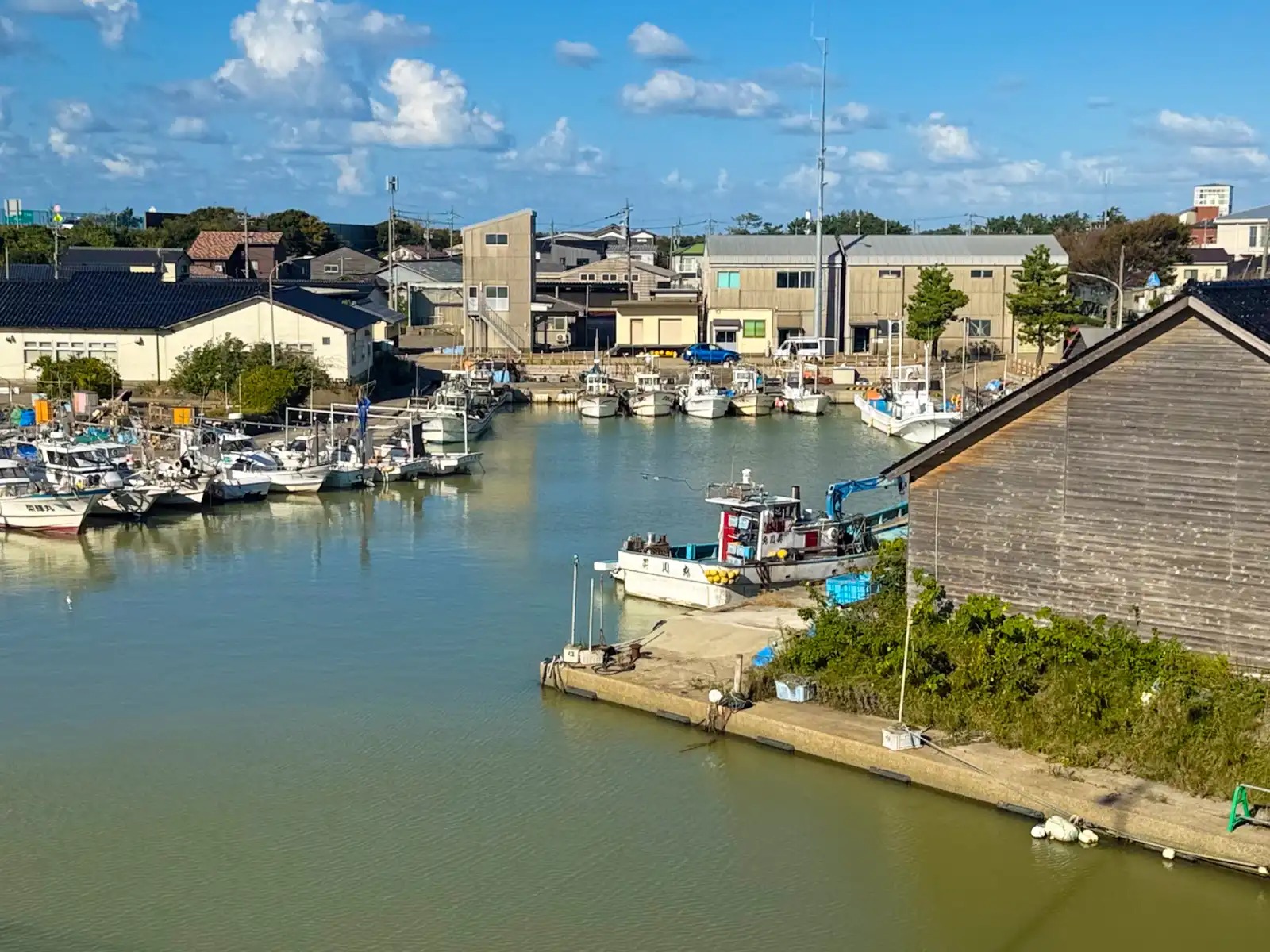
Along the way, the cycling road crosses a few rivers. At one of them there was a small fishing harbor, with boats lined up along both banks and old wooden sheds right on the water. Inside the harbor the water was almost perfectly still, which was funny considering how wild the sea was just around the corner.
By the time I got past Komatsu, the sun was getting low and everything was turning that warm, slightly orange color I’ve come to love on this trip. This is also the time of day when you start noticing strange little things along the road here and there, probably because your brain is too tired to filter them out anymore.
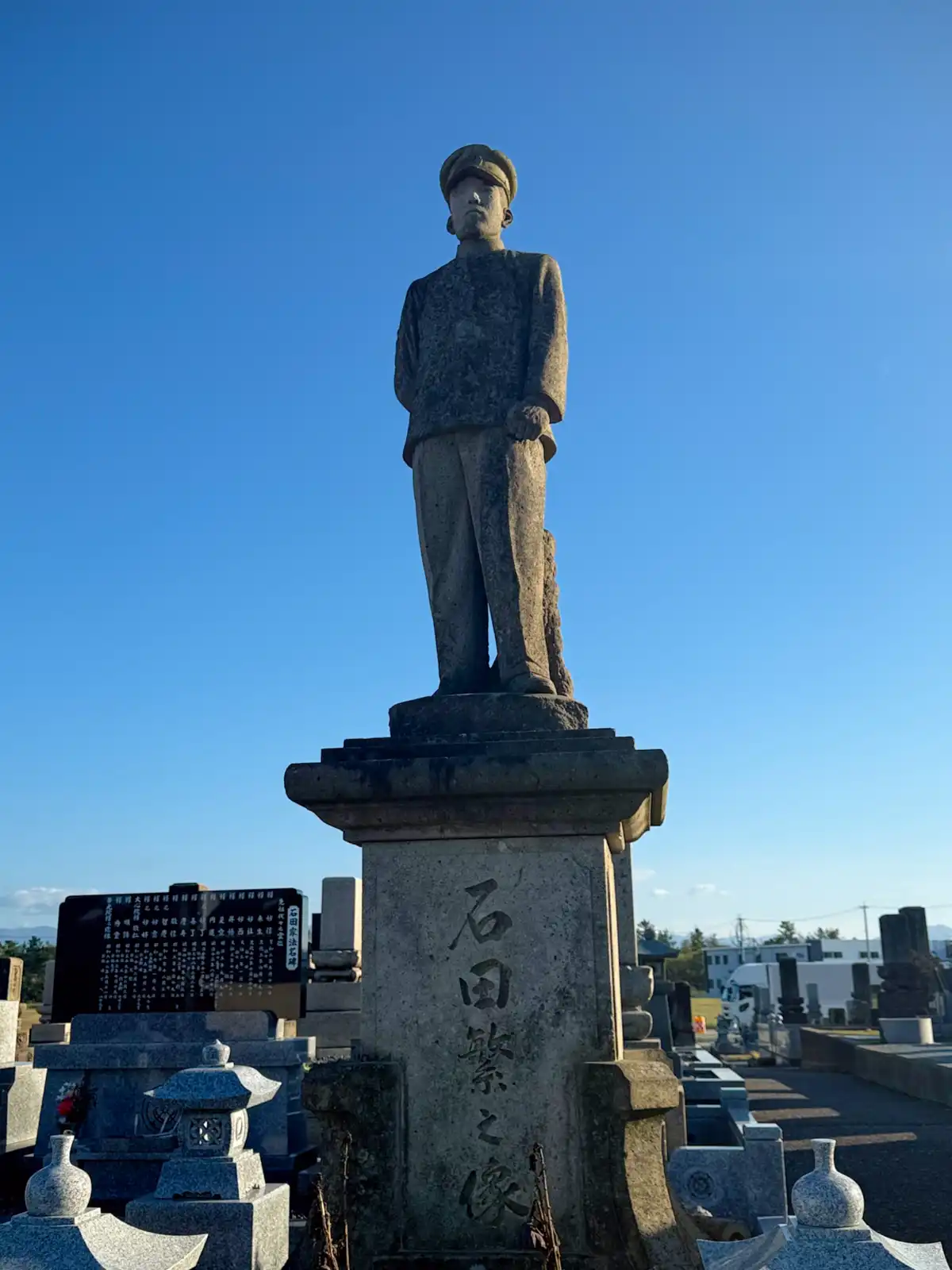
In one cemetery, standing high above the regular gravestones, was a stone statue of a young man in a cap and a buttoned-up uniform, looking out over the fields. Carved into the pedestal were the words “Statue of Ishida Shigeru,” and next to it was a family memorial stone for the Ishida family. I tried to find out who he was, but I couldn’t find anything at all. My guess is that he died young, maybe in the war, and his family wanted him to keep watch over the place. Whoever he was, he’s had a nice view for a long time now.
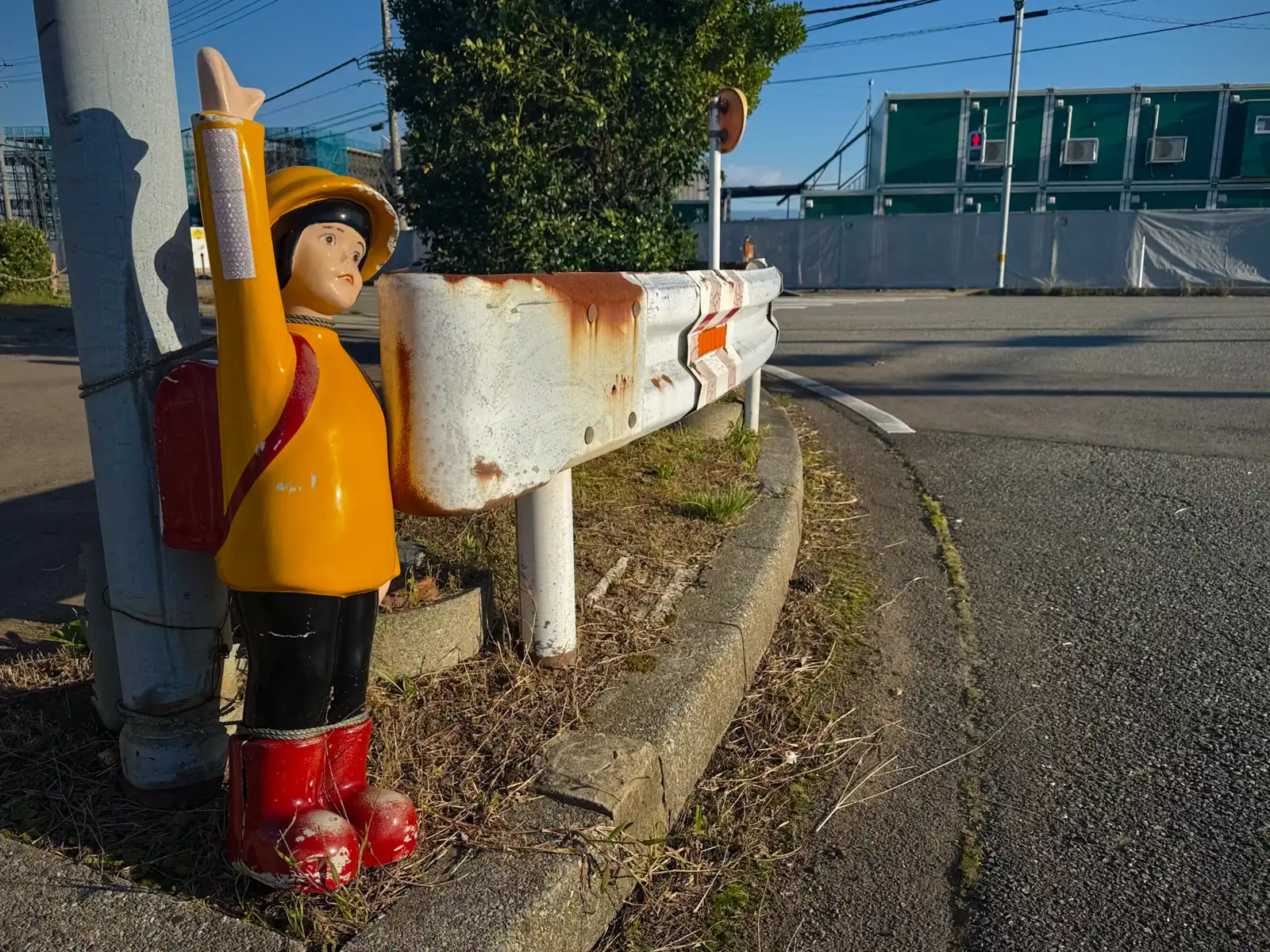
A little later, at a street corner, I was greeted by a much cheerier figure. It was a little schoolkid made of plastic, in a yellow cap and a yellow raincoat, with a red randoseru on his back and one hand raised high, like he was about to cross the road. If you’ve driven around Japan, you’ve probably seen his flat cousin, the famous tobidashi boya, the boy painted on a cutout board who looks like he’s about to dash into the street. That one was born in Shiga back in 1973, and it’s now everywhere. This guy was the 3D version, and judging by the faded paint and the rope tying him to the pole, he’s been standing on that corner for a very long time. He’s still raising his hand and still waiting for the light, and I have to say, that kind of dedication deserves some respect.
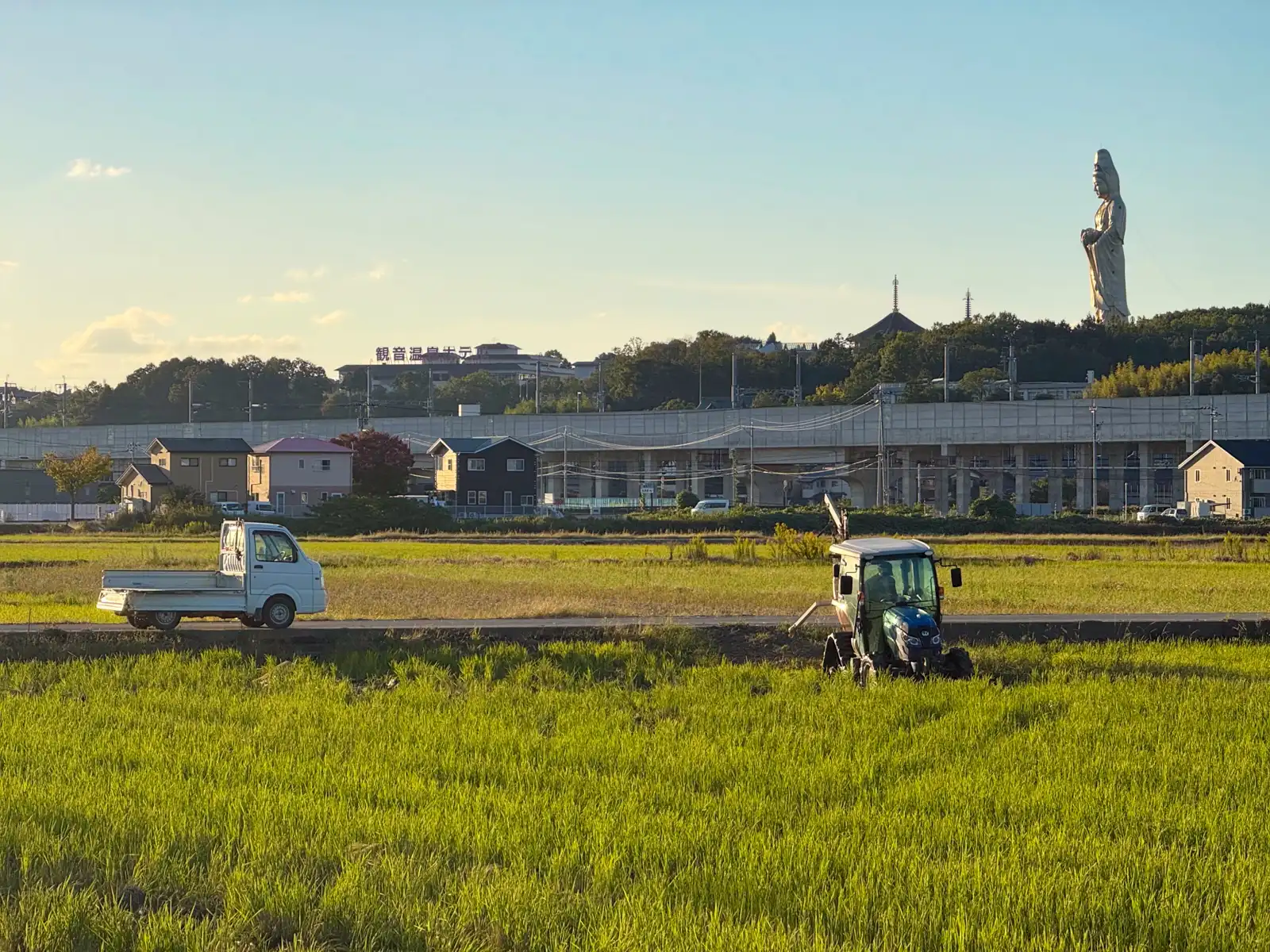
Then, as I was riding past the rice fields near Kaga Onsen Station, a giant pale figure suddenly appeared on a hill above the houses. It’s the Kaga Kannon, a statue of the Buddhist goddess of mercy holding a child, 73 meters tall. In front of it runs the Hokuriku Shinkansen, which has been coming through Kaga since the line was extended to Tsuruga in 2024, so the whole scene was a strange mix of rice fields, a tractor, a white kei truck, a brand-new bullet train viaduct, and a 73-meter goddess watching over all of it. The statue was unveiled in April 1988 as the centerpiece of a big leisure complex called Utopia Kaga no Sato. The amusement park part of it is long gone now, but the Kannon is still there, looking down on Kaga as calmly as ever.
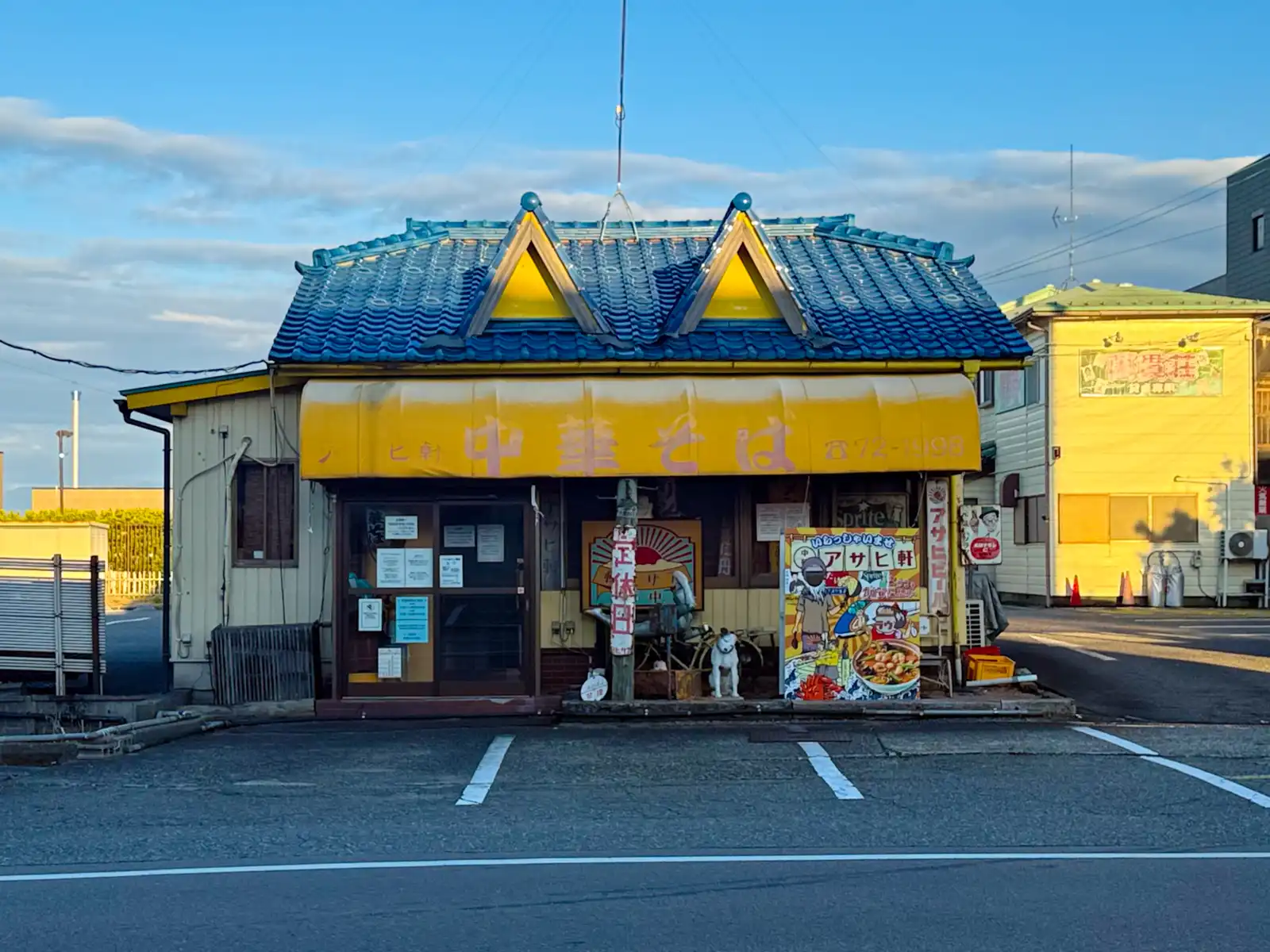
Not far from there, I rode past Asahiken, a little Chinese noodle shop that stood out so much I had to stop and take a picture. It has a bright yellow awning and a blue tiled roof with two little yellow gables on it, and the area in front of the entrance was full of all sorts of stuff, like a white dog figure and one of those colorful boards with a hole cut out where you stick your face in for a photo, this one with a big bowl of noodles painted on it. It just looked so unusual, as if it had been sitting there like that for decades. Judging by the reviews, it’s a local favorite, and apparently the thing to order is the ebi umani soba, noodles topped with a thick vegetable sauce and shrimp tempura.
A few kilometers later, I finally rolled into my stop for the night. My hotel was in Yamashiro Onsen, one of the hot spring towns that make up Kaga Onsen. Legend has it that its hot spring was discovered around 1,300 years ago by the monk Gyoki, who saw a three-legged crow healing its wounded wing in the water. These days the town is full of big ryokan, but I was staying at the Sun City Hotel Yamashiro, which is very much not a big ryokan.
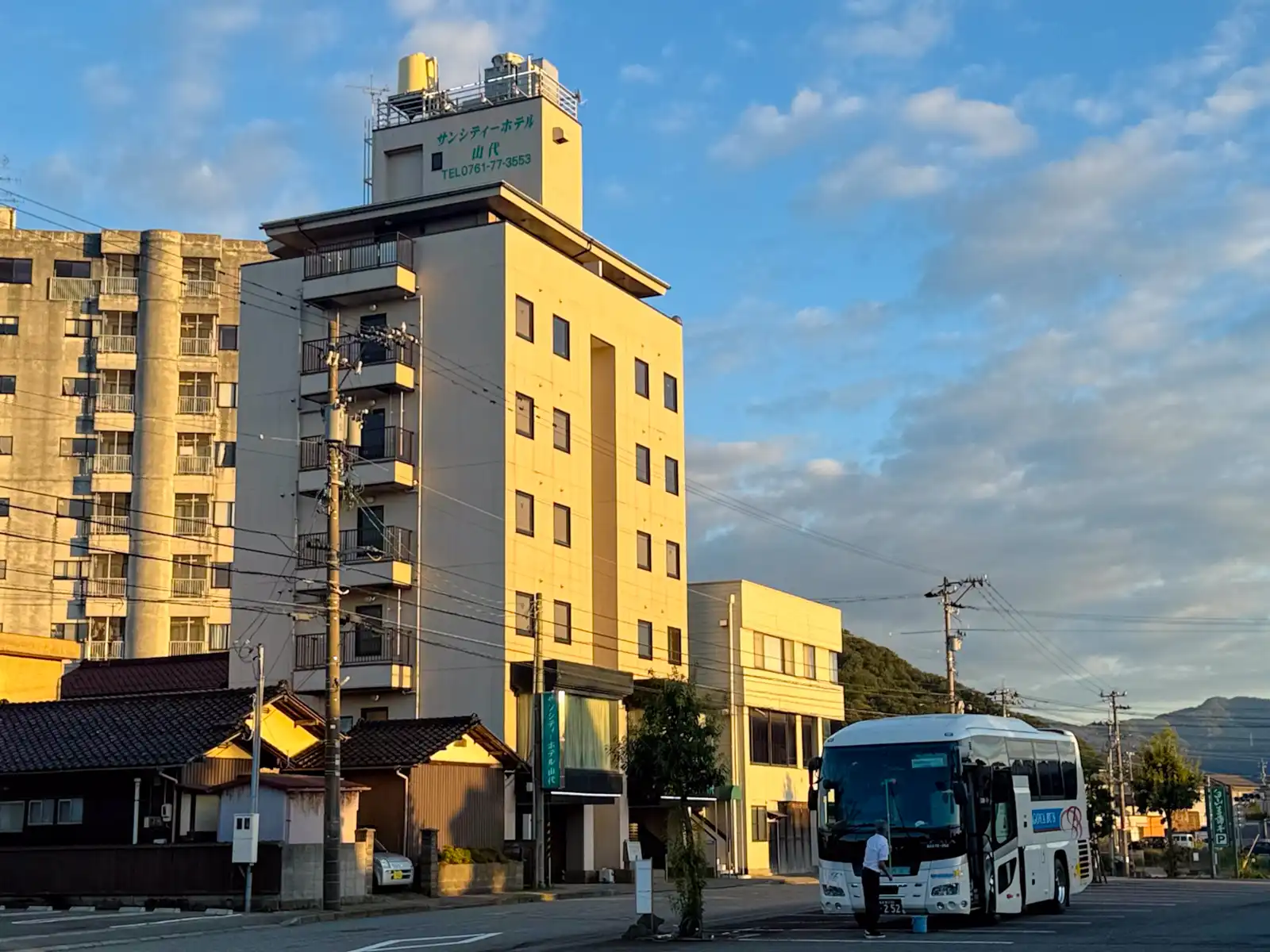
If you’ve ever stayed at a slightly outdated business hotel in Japan, one with a strong Showa vibe, you’ll know exactly what I mean. For those who haven’t, the Showa era ran from 1926 to 1989, and “Showa vibe” is shorthand for a certain look that a lot of buildings from the 70s and 80s still have. Think brown and beige everything, slightly heavy curtains, and a general feeling that the place was very modern once and then just stopped. The entrance had this big round glass door that looked like a revolving door but didn’t revolve, so I stood in front of it for a second wondering if I was supposed to push it or wait for it to start spinning. The reception was up on the second or third floor, I can’t remember which.
A funny thing I’ve noticed at hotels like this is that the receptionist sometimes looks a bit tense when a foreigner walks in. You can almost hear them thinking, uh-oh, here comes the English. But as soon as I say something in Japanese, like “chekku-in desu” or “yoyaku shite imasu,” you can see the relief on their face, like a student who just found out the test was canceled.
This hotel might have looked like it was stuck in 1985, but the list of free stuff it offered was surprisingly long. Free laundry machines. Free rental bicycles. Free umbrellas, a free iron, and even a free trouser press. There was a free massage chair, free DVD rental, a corner full of free comic books, and a free exercise machine, one of those steppers where you push your feet up and down and go absolutely nowhere. Since the rooms only have showers, they’ll even lend you a bath set to take to Yamashiro’s big public bath, which according to the hotel is about seven minutes away on one of those free bikes. And of course, free Wi-Fi (which was surprisingly fast). They even offered a free breakfast, but I didn’t sign up for it, because I was planning to leave before they’d start serving it.
Then there was the pillow menu, a whole poster of six different pillows you could borrow for free. Endless fiber, pipe, low-rebound, low-rebound chips, and two different kinds of “marshmallow” pillows, one that’s “touch” and one that’s “fit.” I have no idea what the difference is.
My favorite, however, was in the lounge. Next to the vending machines, a rice cooker, a couple of microwaves, and a toaster, there was a little shaved ice machine with bottles of syrup in four different colors and a handwritten sign that said, more or less, “Kakigori, help yourself!” Free kakigori, in the middle of October, in a business hotel. Whoever came up with that idea deserves a raise.
When I first walked into my room in the late afternoon, the sun was shining straight through the window blinds, which felt very fitting for a place called Sun City. And right there on the desk was… tadaa! A heavy glass ashtray, which is the ultimate tell-tale sign of a Showa hotel. Case closed. Next to it, the phone had a sticker explaining that you could extend your check-out for 800 yen an hour, with a helpful English translation underneath that read “¥800 Derhourforforoneroom.” Try saying that three times fast.
What’s fun about places like this is that they really do feel like stepping into an old movie. The lobby is a little too quiet, the lights are a little too dim, and the person at the front desk might wear a very serious face the whole time. Everything about it feels slightly suspicious, but I assure you it’s absolutely not. It’s like the opening scene of a B-grade Japanese horror movie, where the main character checks in, says something like “what a nice, quiet hotel,” and the camera slowly zooms in on the receptionist, who may or may not have been dead since 1987. Every time I walked down the corridor, I half expected a pale girl with long black hair to be standing at the far end of it while the ceiling lights flickered on and off.
Ghosts or no ghosts, it was a really good stay. The room was extra clean and quiet, and the staff were properly friendly. In the evening I went to a nearby supermarket and a convenience store to stock up on dinner and snacks, then spread my things out on the bed and planned the last day. Tomorrow would be the final leg, straight into the heart of Fukui. Six days ago, Fukui had felt impossibly far away, and now it was just one ride away. I fell asleep on one of those marshmallow pillows. I still don’t know which one.