Tokyo to Fukui by E-Bike, Day 5: A Rainy Rest Day at the Toyama Glass Art Museum
Day Five was the first day of the trip with no riding at all. With rain in the forecast from morning till night, the Beast stayed parked at the hotel while I spent the day in a café and then at the Toyama Glass Art Museum, with a whole floor of some of the wildest glass art I’ve ever seen.
The forecast for Day Five had said rain in Toyama from morning till night, which was the whole reason I’d booked two nights at the hotel. In the end, the rain turned out to be a lot gentler than it sounded, more of a steady, on-and-off drizzle than a real downpour. Still, a whole day in the saddle in it didn’t sound like much fun, and I’d already promised the Beast a day off, so I wasn’t about to go back on that now.
So here’s a fair warning before we go any further. If you came here hoping for more tunnels, mountain passes, and long stretches of coast like in the last few days, I’m afraid you’re going to be a little disappointed, because there’s no riding in this one at all. Instead, you’ll have to sit through a whole afternoon of glass art with me. I promise it’s a lot more colorful than it sounds.
For once on this trip, the plan from the night before actually happened more or less the way I’d imagined it. I found a café at the station and spent a good part of the day fiddling with AI on my MacBook, and every now and then just watching people outside shaking their umbrellas. After four days of riding pretty much from morning until it got dark, sitting still for that long felt kind of strange, and I kept getting this restless feeling that I was supposed to be somewhere.
At some point, though, I decided it was time to do something a bit more Toyama, preferably somewhere not too far away. The obvious choice was the Toyama Glass Art Museum. It’s in Nishicho, in the older part of downtown, about 1.5 kilometers south of the station, so it was a bit of a walk.
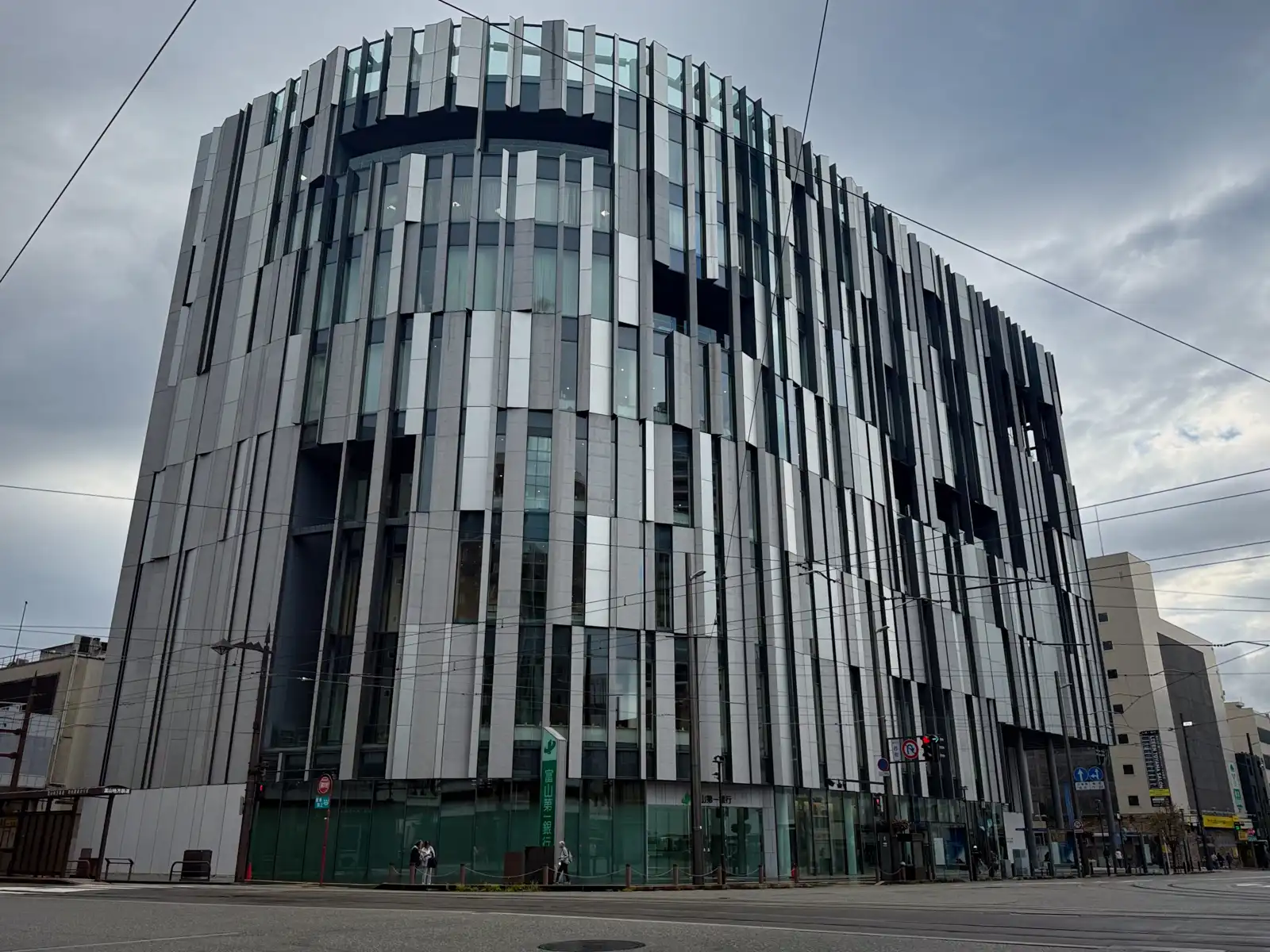
The building the museum is in is called TOYAMA Kirari, and it’s pretty hard to miss. From the outside it’s a big, rounded block covered in roughly 1,000 tall panels of glass, aluminum, and granite, all set at slightly different angles so each one catches the light a little differently. Kirari is a Japanese word for a quick sparkle or glint, so the name sums it up well. The idea was to make the outside look like the Tateyama mountains, the big range that stands behind the city, and on a sunny day I’m sure the whole thing glitters. Under a heavy grey sky it looked a bit more serious, but it still stood out from everything else on the street. It was designed by Kengo Kuma, one of the best-known Japanese architects today, who also worked on the design of the National Stadium in Tokyo for the 2020 Olympics. The museum only takes up part of the building, though. It also houses the main branch of the city library, a café, a museum shop, and on the ground floor, a bank, which explains the green Toyama Daiichi Bank sign by the entrance.
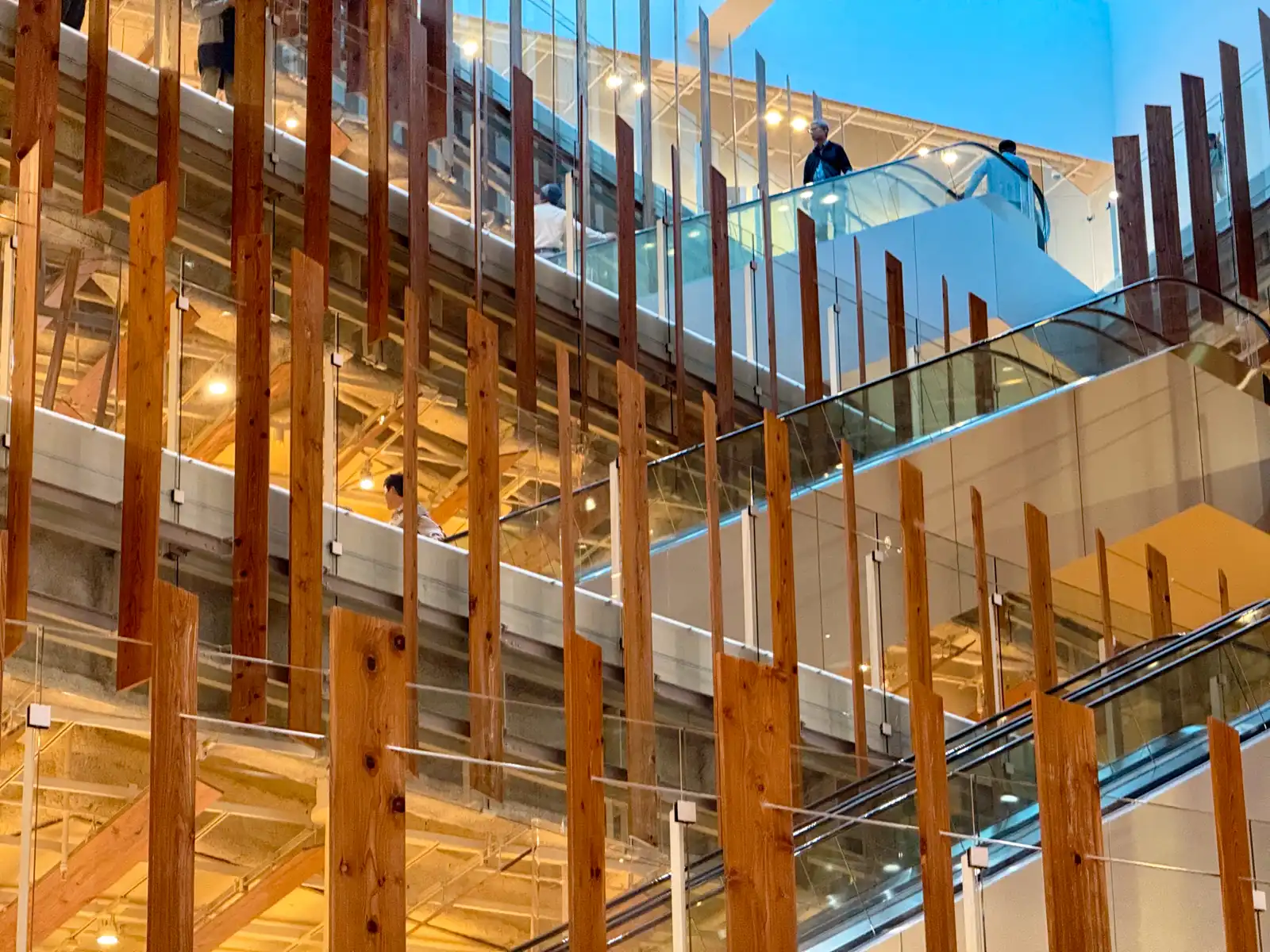
The outside is nice, but it’s the inside that really impressed me. As soon as you walk in, everything turns warm and wooden. A huge atrium cuts up through the middle of the building at an angle, all the way from the second floor to the sixth, and it’s lined with long, thin wooden boards hanging at all sorts of angles. These louvers are made of cedar grown in Toyama Prefecture, mixed in with glass and mirrors. At the very top there’s a skylight. Kuma’s idea was for the light coming down through that slanted opening to feel like sunlight filtering through a forest, and it certainly works.
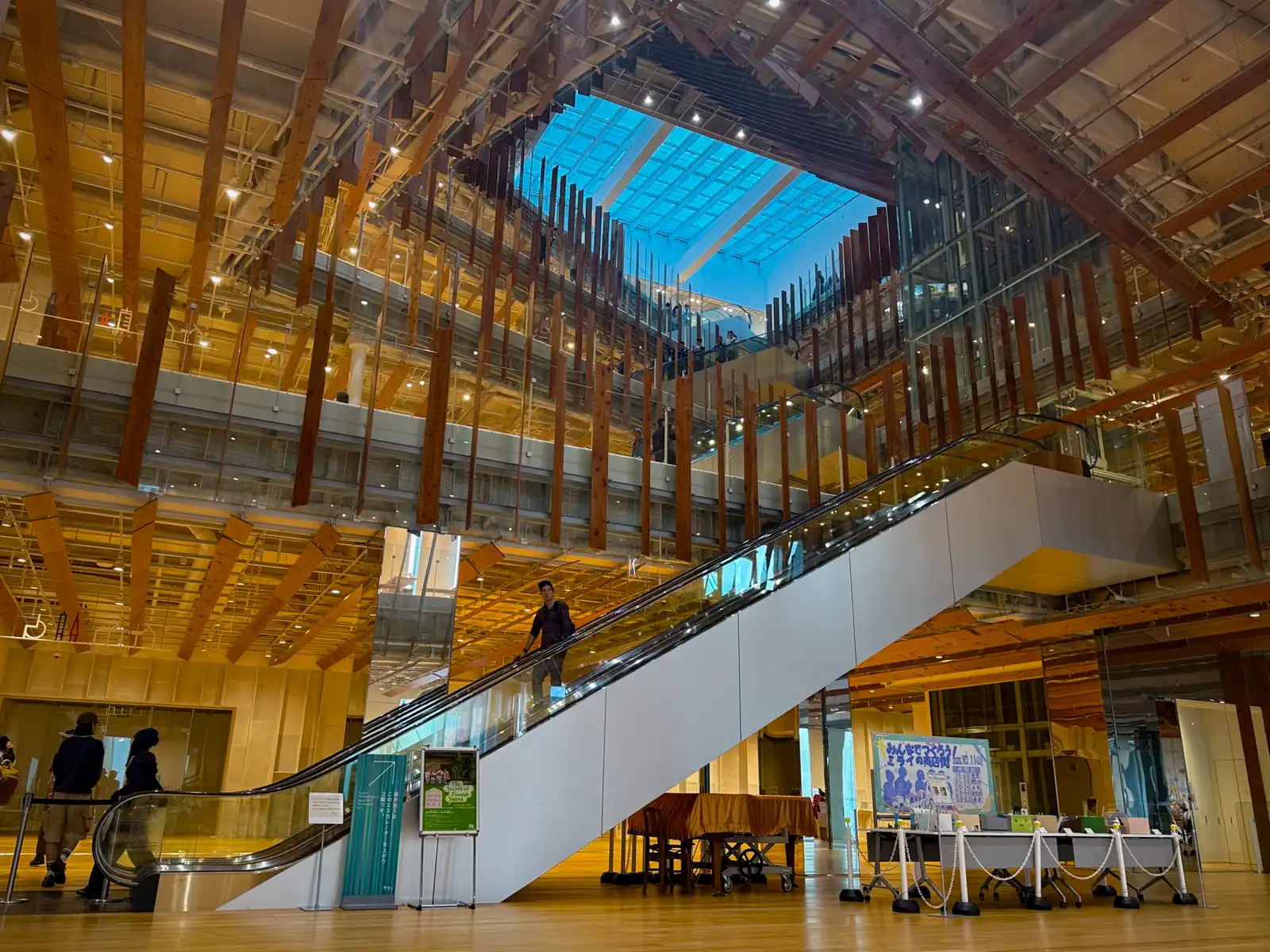
Escalators zigzag up through the atrium from floor to floor, and as you ride them, the view changes every few meters. One moment you’re looking through a curtain of wooden boards, and the next you can see across the whole building, with people riding up and down the other escalators like in some kind of very calm, very wooden version of a train station. On the walls of the public areas between the second and fourth floors there’s also free-to-see glass art, a collection of about 50 works by artists with ties to Toyama, so even if you never buy a museum ticket, you still get to see quite a bit.
From the top of the escalators, looking back down, you can see right into the library, with long rows of bookshelves and people sitting at tables between them.
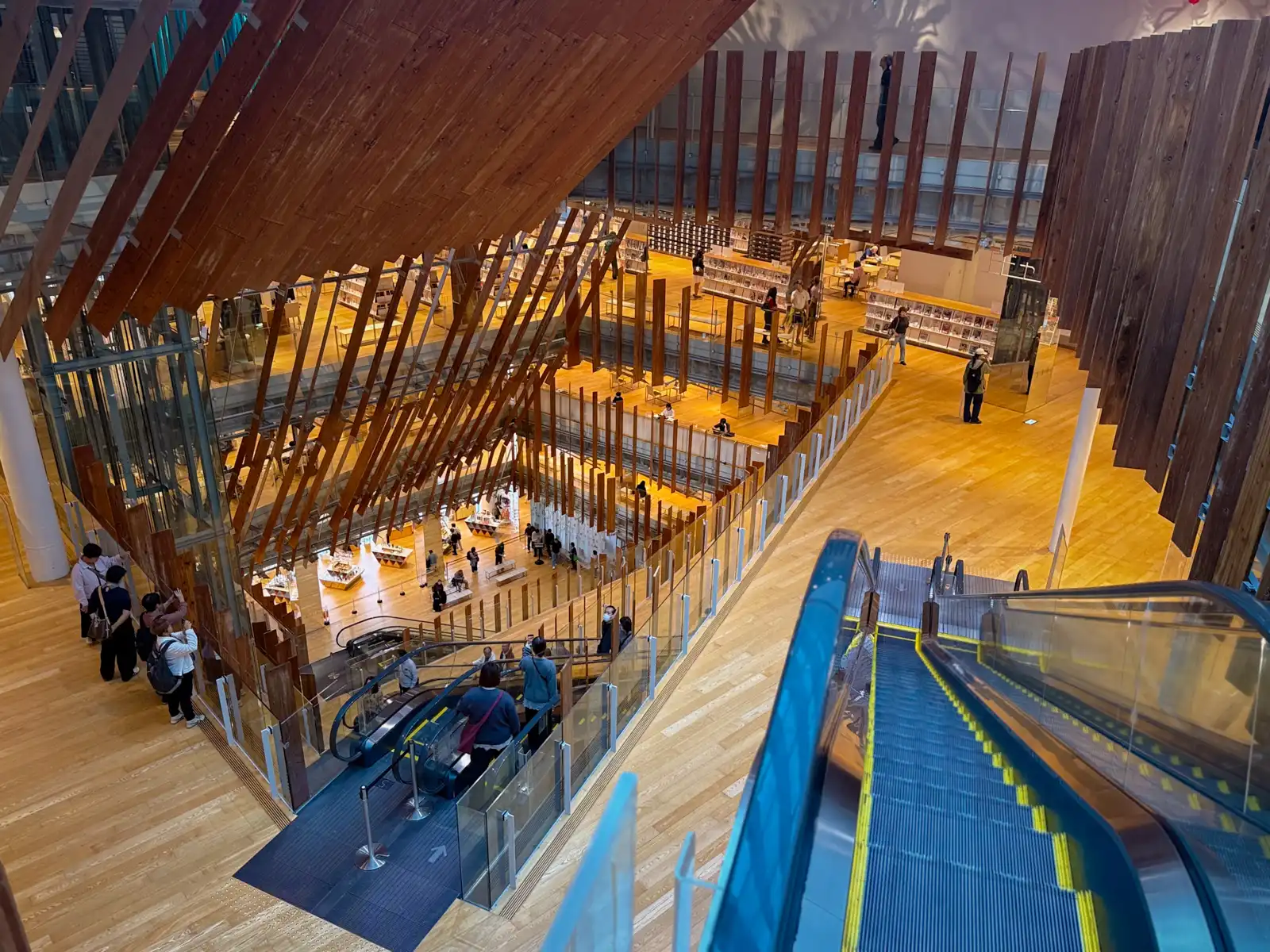
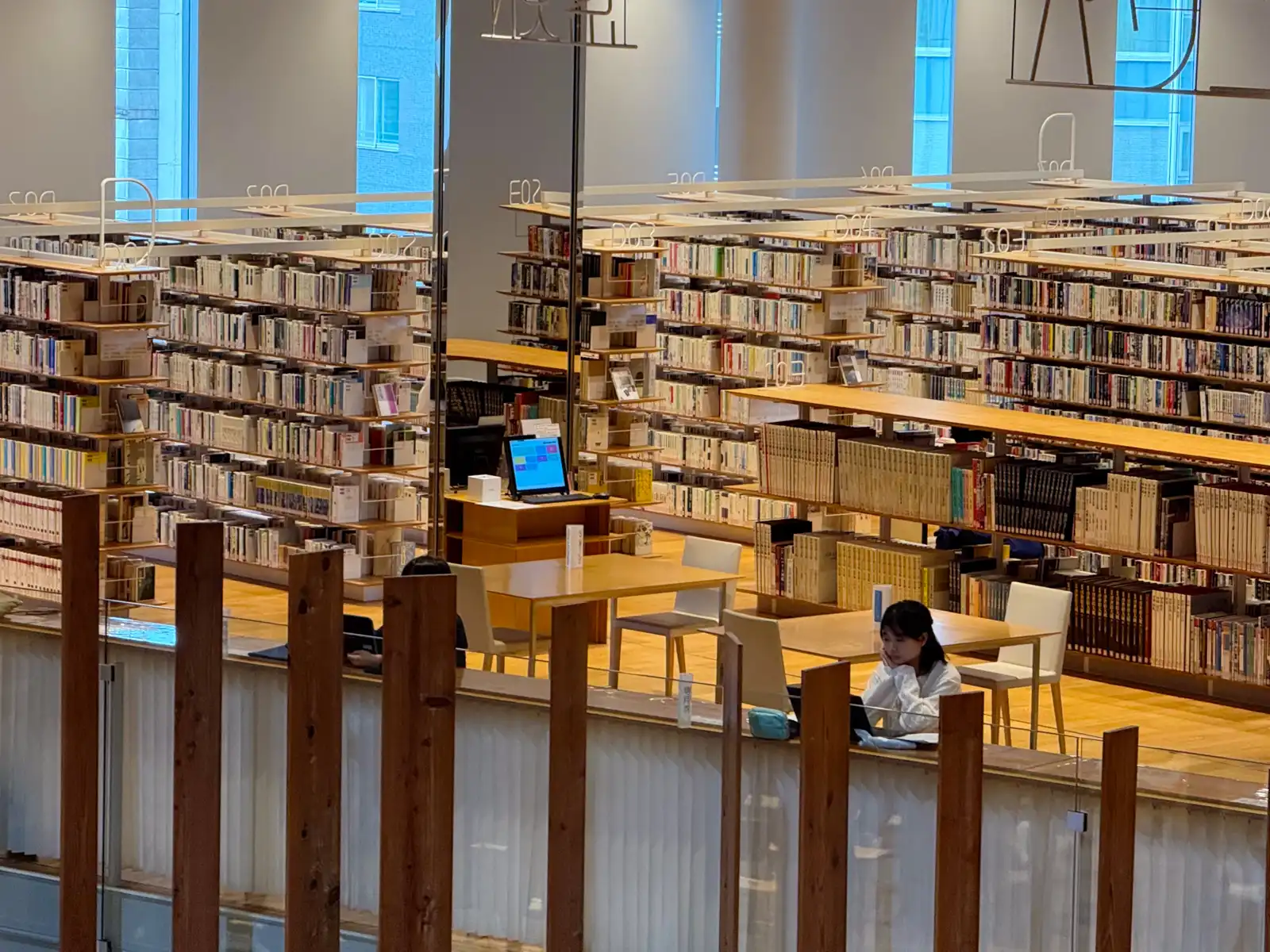
The library spreads over several floors around the atrium. You don’t need a ticket to go in, so anyone can just walk in, grab a book, and sit down. When I was there, people were reading, studying, or tapping away on their laptops at the tables, and with all that wood and soft light around them, it looked like the most comfortable place in the whole city to wait out a rainy day.
You might be wondering why Toyama, of all places, has a whole museum just for glass. It actually goes back to medicine. For more than 300 years Toyama has been famous for its traveling medicine sellers, the Toyama no kusuriuri, who went around the country leaving boxes of medicine in people’s homes and then came back later to refill them and get paid only for what had been used. That’s a lot of medicine, and in the Meiji and Taisho periods, a lot of it went into glass bottles. Making those bottles grew into a proper local industry, and Toyama became one of the biggest producers in Japan, with more than ten glass factories around the station area before the war. Then, in 1985, the city decided to bring that glass history back in a new form and started building itself up as a city of glass art, training glass artists, supporting studios, and putting glass art around town. The museum, which opened in 2015, was basically the grand finale of that whole project.
The museum’s permanent exhibits are on two floors, the fourth and the sixth. I started with the fourth. This is where the Collection Exhibition is, a rotating selection of around 20 pieces from the roughly 400 works of contemporary glass the city has collected over the years. They swap them out a couple of times a year, so what you see depends on when you go. When I was there, most of what was on display was by Japanese artists, and some of the pieces were surprisingly big. Large objects that looked incredibly fragile, with thin glass walls and edges that seemed like they’d crack if you breathed on them too hard. Interestingly, the first thought that popped into my head wasn’t really about art at all. It was more like, okay, beautiful, but what happens to all this when there’s an earthquake?
Actually, it’s not a silly question in this part of Japan. On New Year’s Day in 2024, the big Noto Peninsula earthquake shook Toyama City at upper 5 on the Japanese scale, and the museum stayed closed for about two weeks while everything was checked. On the Noto Peninsula itself, the glass art museum on Notojima island in Ishikawa wasn’t so lucky, and 24 of its works were damaged. I didn’t notice any special safety measures around the pieces here, though I suppose the good ones are the ones you don’t notice. The building itself does at least have a steel frame with a vibration-damping structure. Beyond that, I decided to trust that the people who work here have thought about this properly, and went upstairs.
The sixth floor is where things got a bit crazy, in the best way. The whole floor is called the Glass Art Garden. The place is filled with installations by Dale Chihuly, an American artist who’s probably the biggest name in contemporary glass. There are five of his big installations up here, all from 2015, made for this museum and named after Toyama. Everything is blown glass, but there’s something I only found out after my visit. Chihuly himself hasn’t actually blown glass since the late 1970s. In 1976 he lost the sight in his left eye in a car accident in England, and then in 1979 he dislocated his shoulder while bodysurfing, which meant he could no longer hold the glassblowing pipe. Since then he’s worked more like a director, drawing and planning the pieces and leading a big team of glassblowers who actually make them. For some of the works here, his team even worked together with glassblowers at the Toyama City Institute of Glass Art.
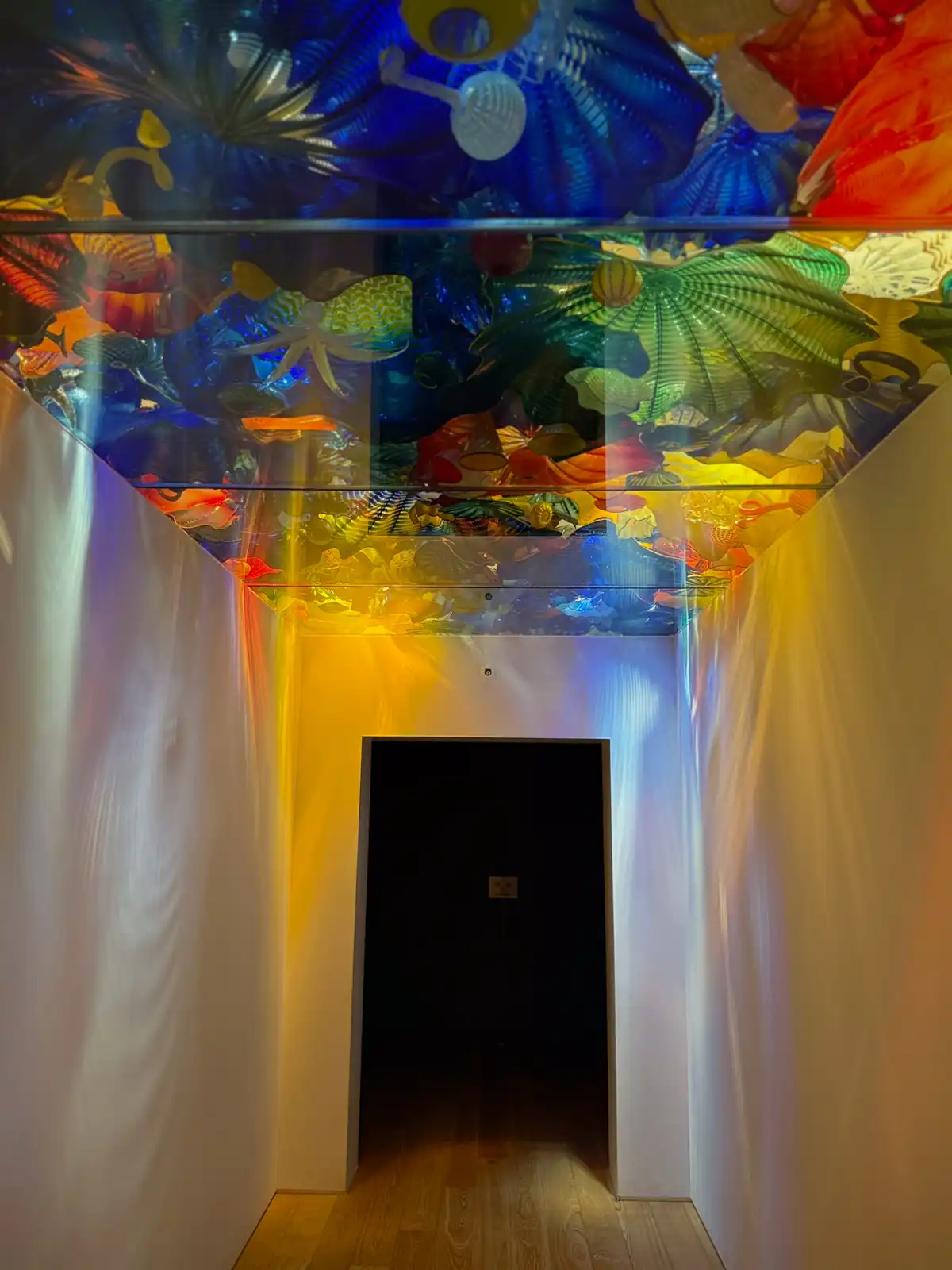
The first one that really got me was the Toyama Persian Ceiling. You walk into a narrow white corridor, look up, and the whole ceiling is packed with glass. There are big wavy discs in blue, green, orange, and yellow, with little starfish, shells, and octopus-like shapes tucked in between them. Since it sits under a skylight, the light comes down through all that colored glass and spills onto the white walls in soft patches of blue and orange. It felt a bit like standing at the bottom of a very colorful aquarium, looking up at whatever was swimming by overhead.
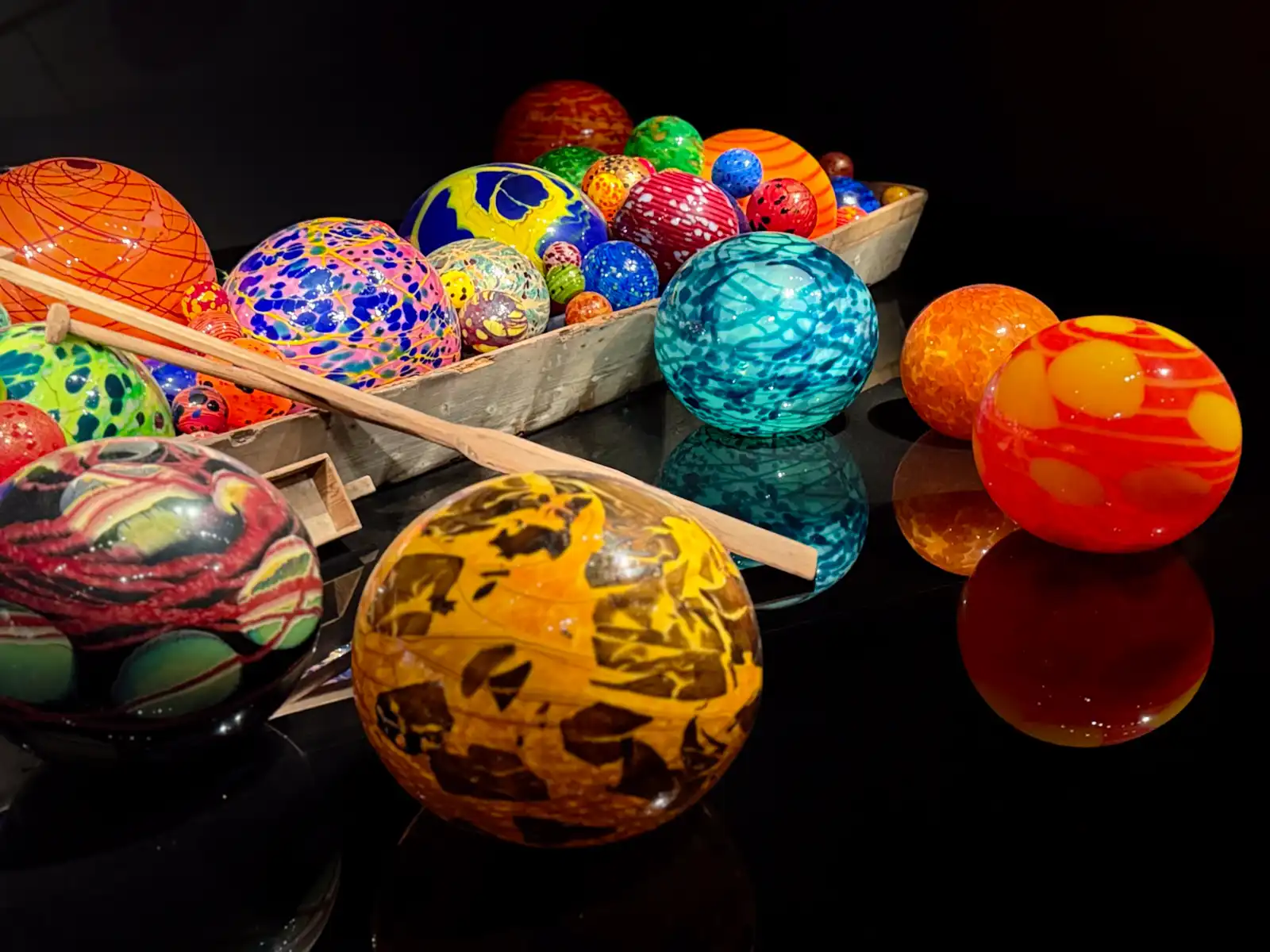
Next was the Toyama Float Boat, a long wooden boat piled high with glass balls of all sizes, with more of them scattered around it on a shiny black base, so each ball has its own reflection underneath. Every single one has a different pattern, spots, swirls, stripes, splashes of color, so it looks a bit like someone tipped out a sack of giant marbles. The boat itself is a sasabune, a type of boat that was actually once used for fishing on the Jinzu River here in Toyama, and 95 of the 117 glass floats were made locally at the Toyama Glass Studio in June 2015. These floats have a nice Japanese story behind them, too. As a kid in Tacoma, Washington, Chihuly used to find old Japanese glass fishing floats that had drifted all the way across the Pacific and washed up on the beaches of Puget Sound. Years later, in 1991, he started a whole series of giant glass floats and named it after Niijima, an island south of Tokyo known for its glass.
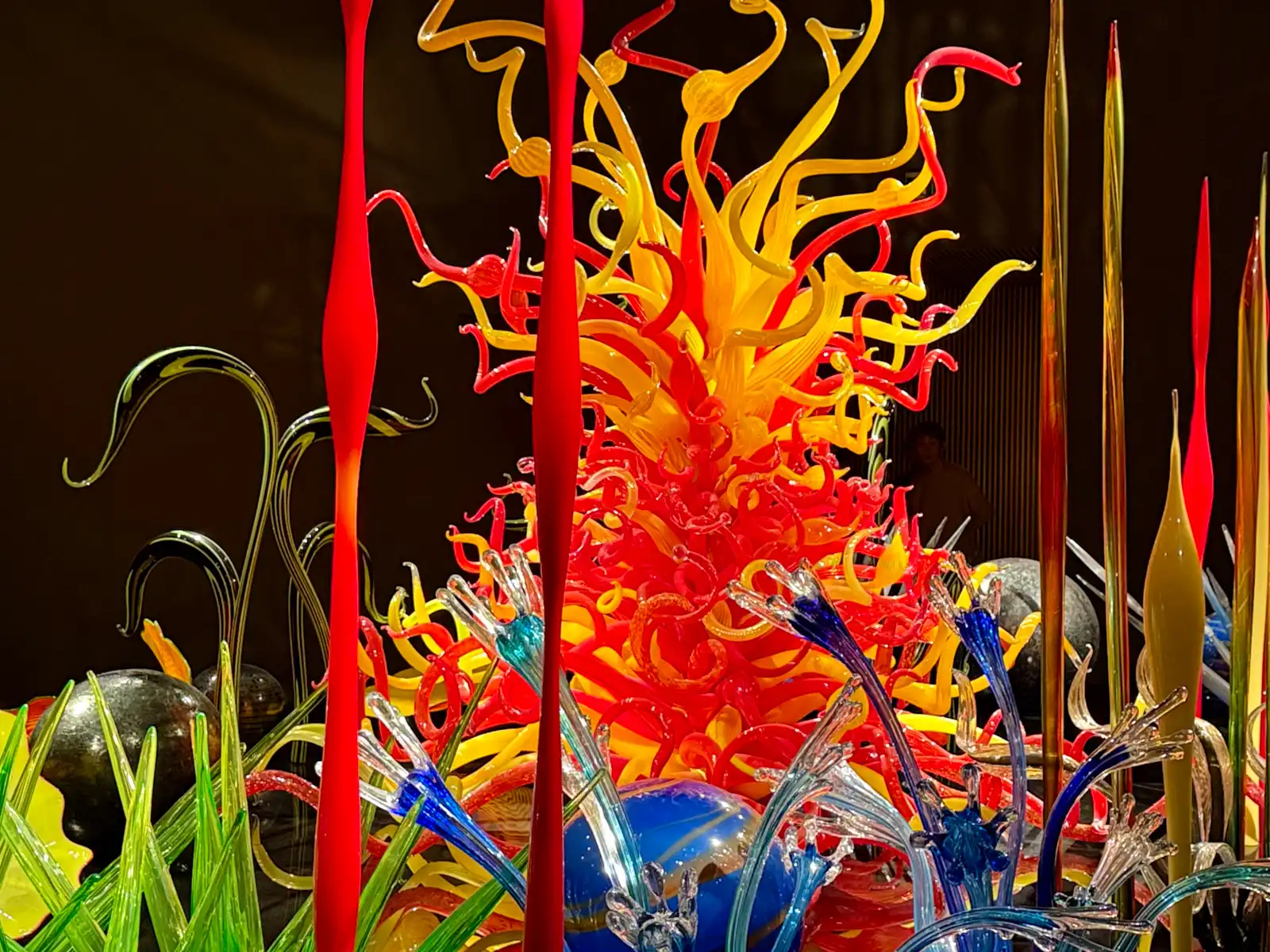
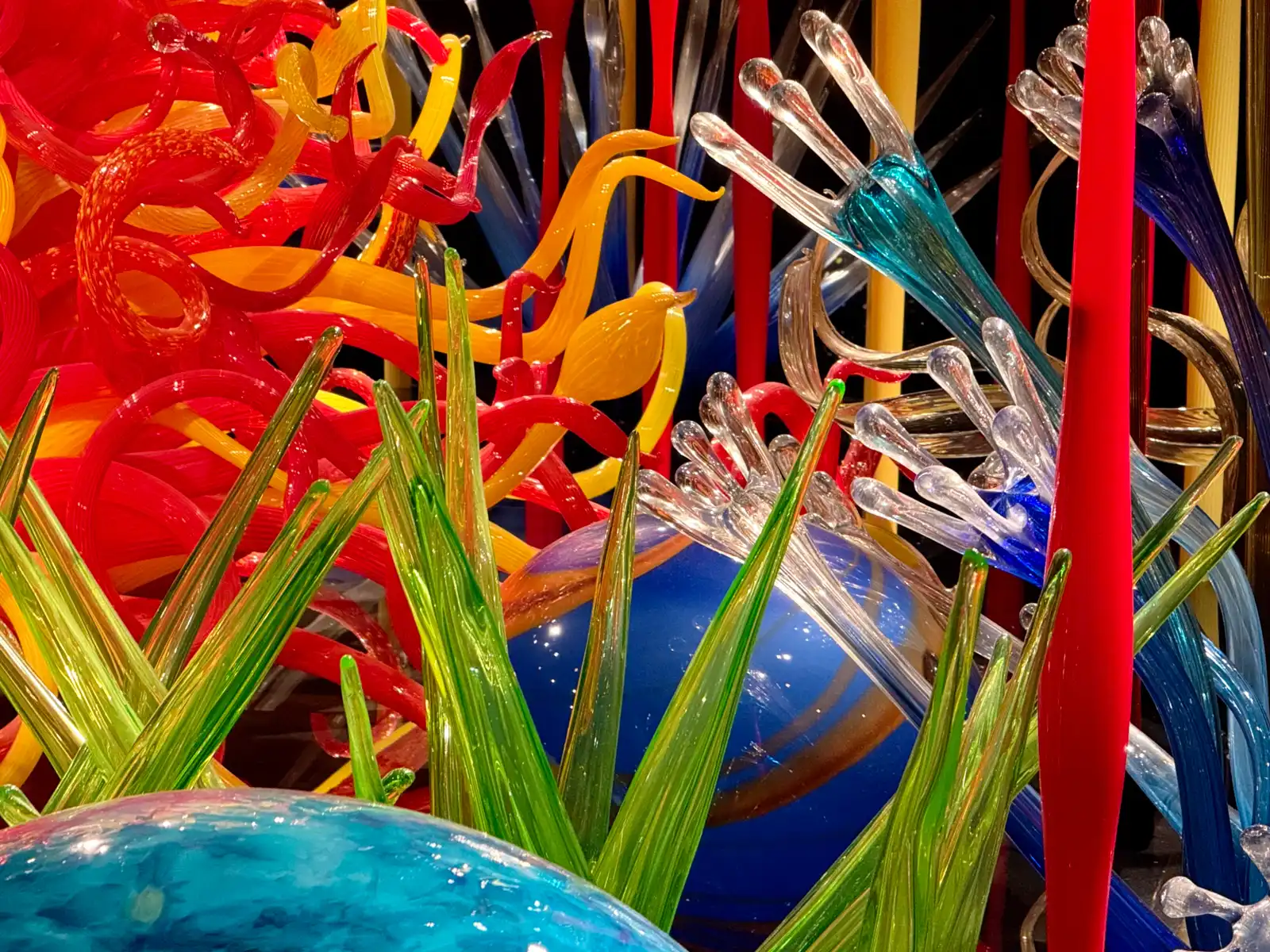
And then came the last room, with the Toyama Mille Fiori, which was easily the highlight of the whole museum for me. Mille fiori is Italian for “a thousand flowers,” and it’s basically a garden made entirely of glass, about 9.4 meters wide, 5.8 meters deep, and 2.8 meters tall.
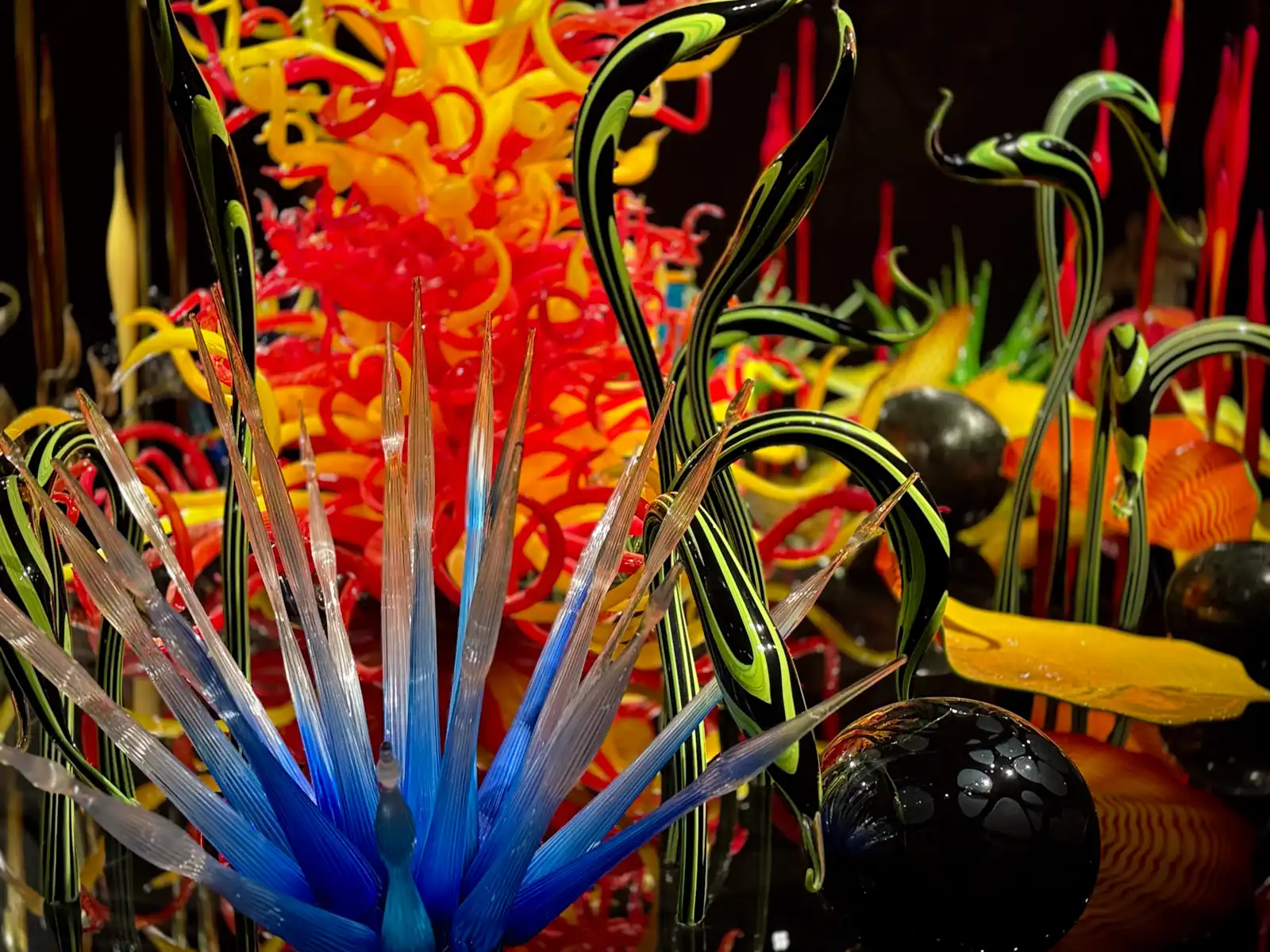
There are tall red stems standing up like reeds, spiky blue bursts that look like sea urchins, bundles of bright green grass, dark speckled balls, wide flower-like bowls in orange and yellow, and in the middle, huge tangled towers of red and yellow curls that look a bit like flames (or maybe a pile of very excited noodles). The whole thing sits on a black, mirror-like base, so everything is doubled underneath, and the room around it is kept dark, which makes the glass look like it’s glowing from the inside. Chihuly has said the series was inspired by his mother’s garden back in Tacoma.
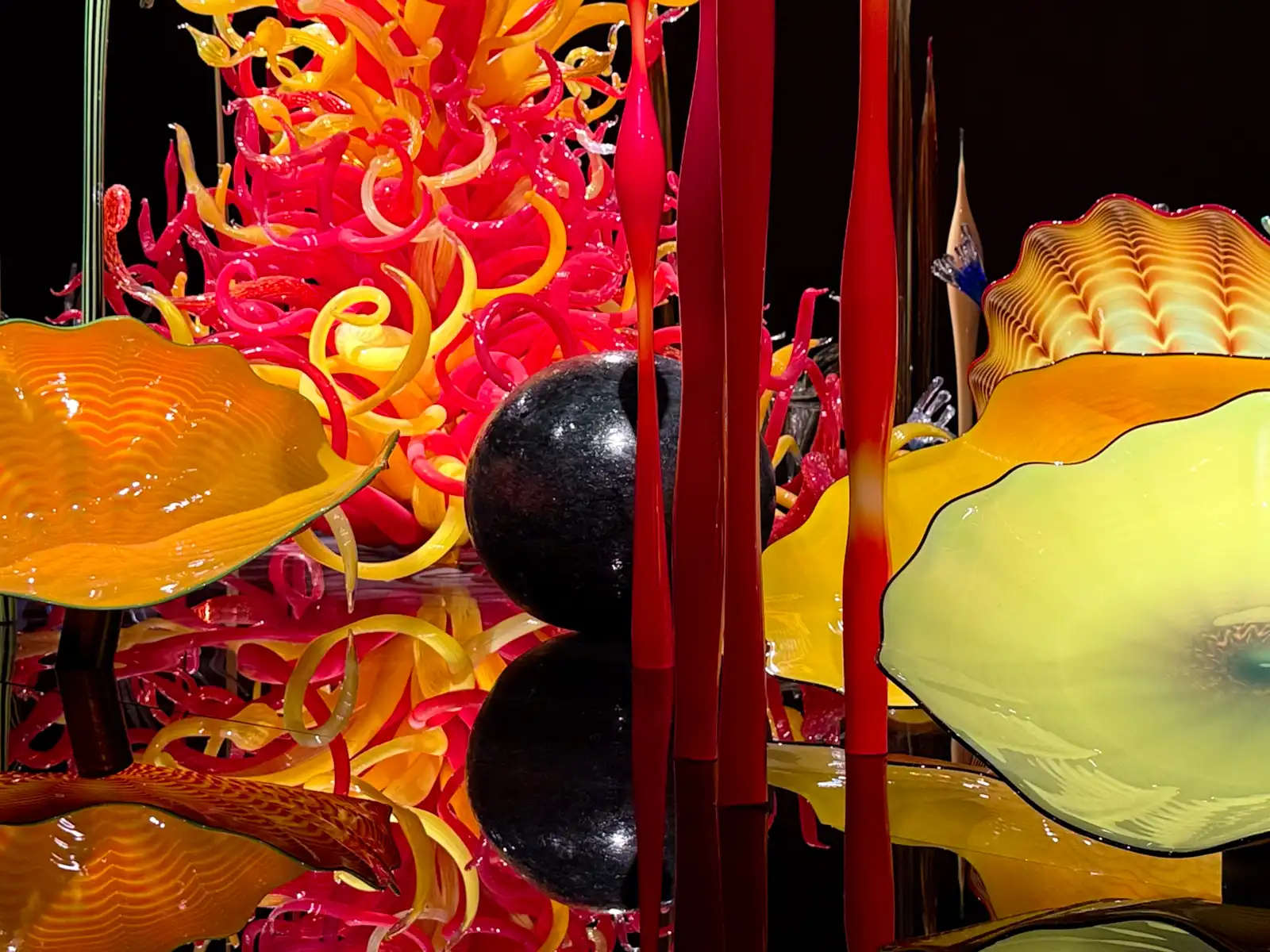
I walked around it really slowly, because every few steps I found something I hadn’t noticed before. It’s honestly hard to believe that every one of those pieces started as a blob of molten glass on the end of a pipe. Needless to say, I took way too many photos. The ones below are the ones that made the cut, and believe me, it was not an easy selection.
It was still drizzling a bit when I walked out of the museum, and I headed back toward the station. I spent the evening back at the hotel with a map open, working out the route for the next day, which would take me out of Toyama and further along toward Fukui. For a day that was supposed to be about doing nothing, it ended up being one of the more memorable ones of the trip so far. I didn’t ride a single kilometer, but I got more color in one afternoon than in the four days before it put together. As for the Beast, it got a whole day of doing absolutely nothing, and I’m sure it appreciated that, even if it never says so.