Tojinbo: Ancient Cliffs, a Drunk Monk, and a Dinosaur in a Lab Coat
The cliffs of Tojinbo got their name from a monk who was pushed off them, and they appear in a suspicious number of Japanese TV murder mysteries. I certainly didn’t expect to find a dinosaur in a lab coat right next to them. These are my notes from a sunny but very windy morning on the Fukui coast.
Tojinbo is probably the most famous set of cliffs in Japan. For a lot of people it’s also closely linked to TV suspense dramas, where it shows up again and again whenever a story needs a dramatic ending. The classic scene goes something like this: the detective finally catches up with the culprit right at the edge of the cliff, with rough waves crashing below, there’s a bit of shouting, and then it all ends in a tearful confession. Sounds familiar? Well, I finally had a free day in Fukui after a week of riding up from Tokyo and lucky me, the sky was completely clear, ideal for going there and seeing the place for myself.
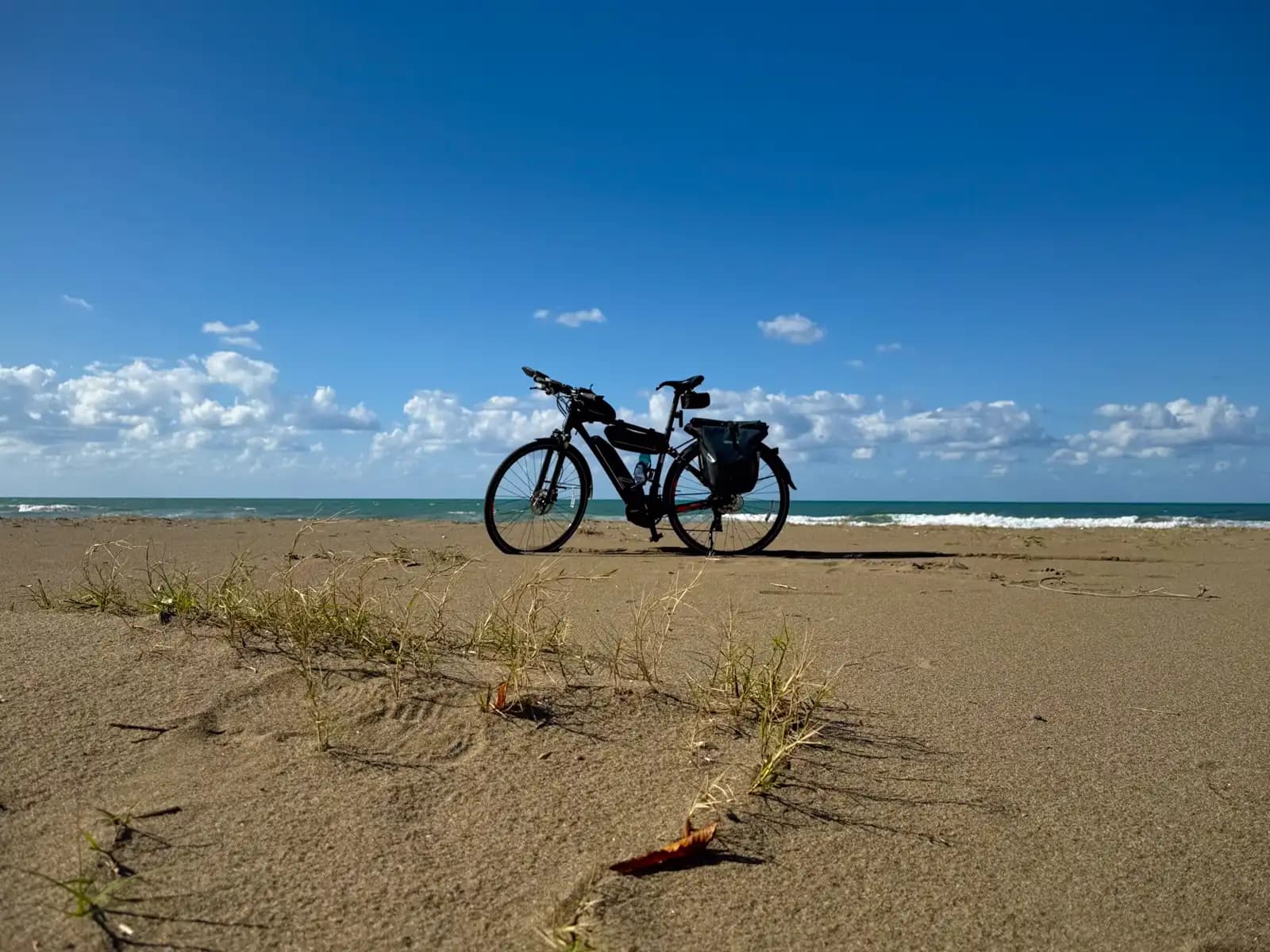
I left the hotel near Fukui Station early and rode north. Most of the way to the coast is just open rice fields and completely flat, so I thought it would be an easy ride, but no, the wind had other plans. It was blowing hard (and when it blows, it always does so right into my face), so I spent a good part of the roughly 30 kilometers pedaling at a slight angle while muttering things I won’t repeat here. Closer to Mikuni the fields ended and the road started to climb. Tojinbo sits on a low plateau above the sea.
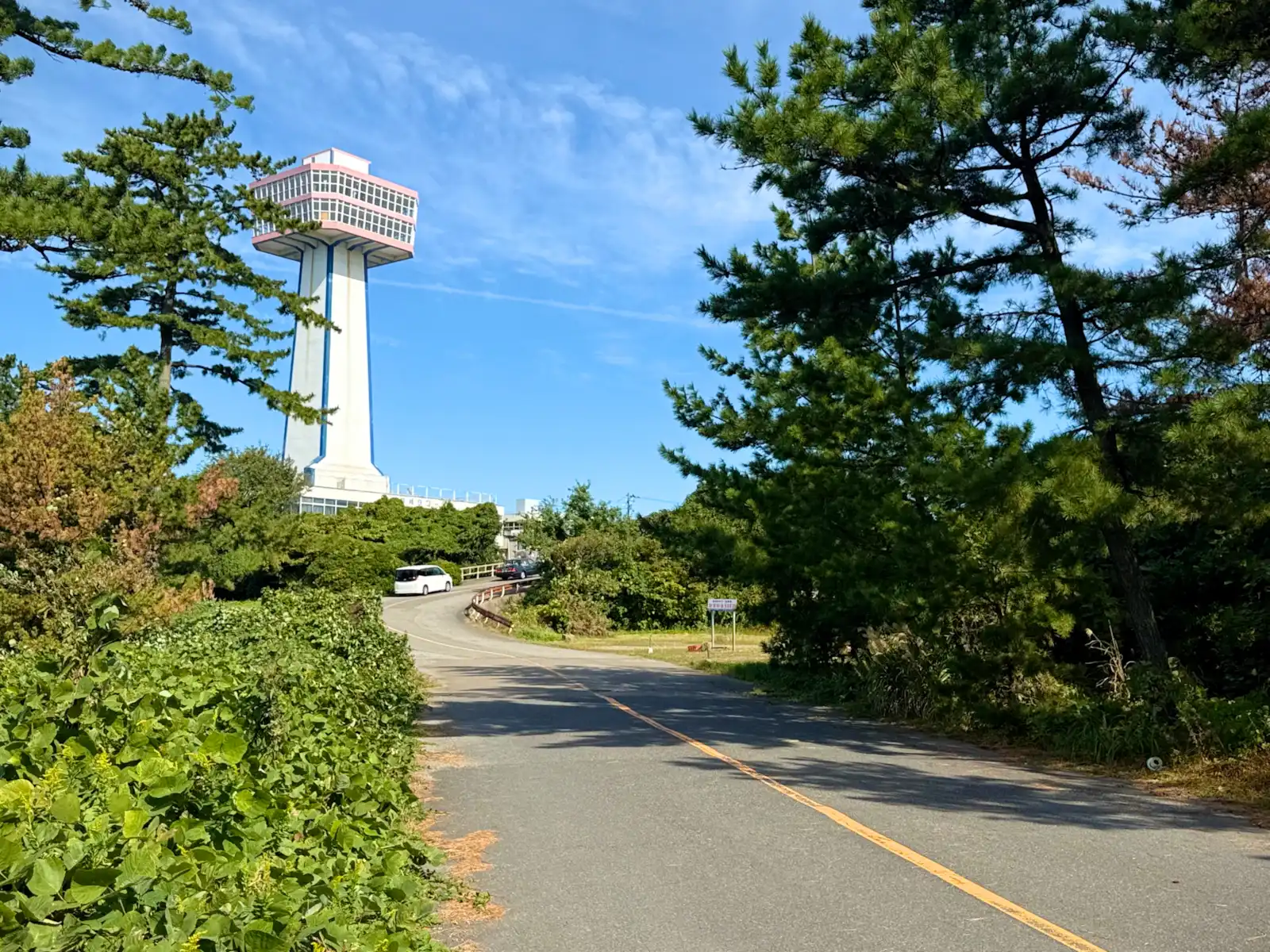
Interestingly, the first thing that appeared above the pines was not a cliff as one would have expected. Instead, I was welcomed by Tojinbo Tower, a tall, almost brutalist white column with a pink and blue box on top. The thing looked like it was beamed in straight from 1964 (and as it turns out, it actually was, but more on that in a bit). I was thinking of going up but decided to save it for later. I parked the Beast at a parking lot down the road and walked off wondering if the wind would tip it over while I was gone.
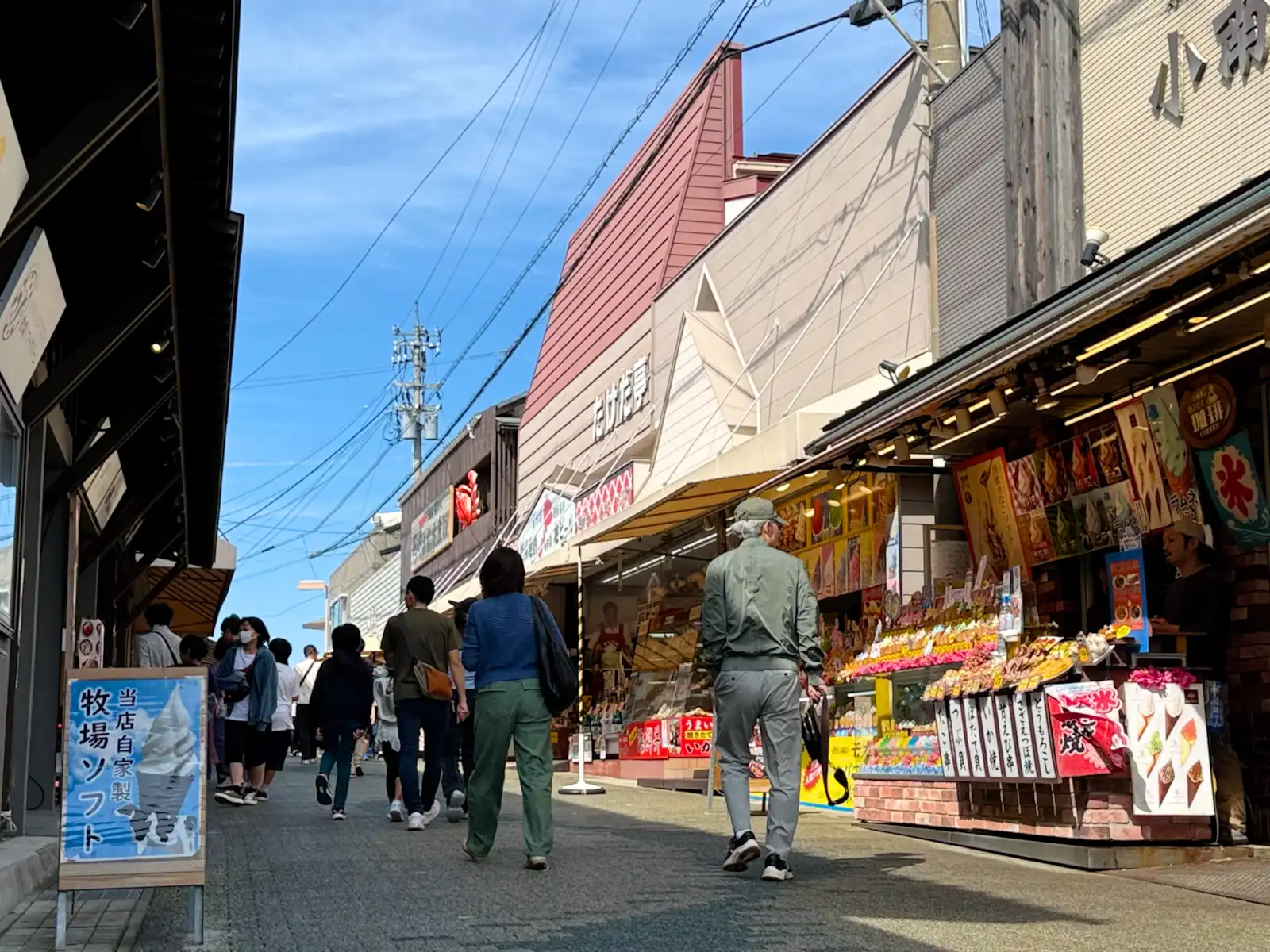
From there a single street leads down toward the sea. The whole atmosphere there instantly reminded me of Enoshima. Small shops and restaurants on both sides, selling grilled seafood, souvenirs and toys, with big fake red crabs hanging off the storefronts to lure people in. Like in a lot of seaside towns, soft serve ice cream is everywhere, advertised among other things by a giant plastic cone sticking out above one of the roofs. And Fukui being Fukui, there was also a pink balloon dinosaur standing in front of a shop selling soba. Oh, and a bit further down I passed the IWABA CAFE (its round logo will look suspiciously familiar to anyone who has ever ordered a frappuccino, except it’s not green).
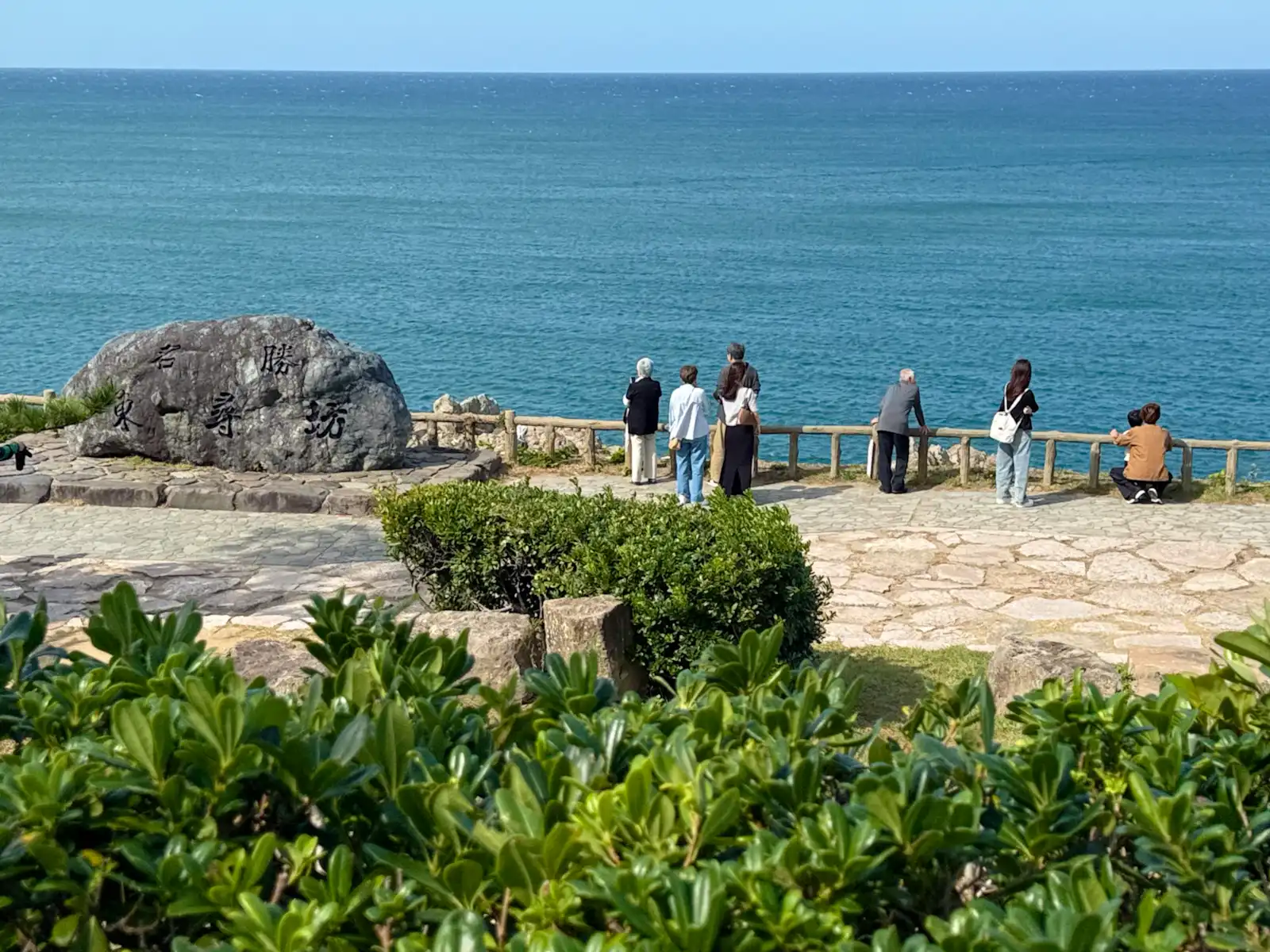
The shops end at a set of stairs going down, and at the bottom the street opens up into a big open space paved with flat stones, a sort of plaza right on top of the cliffs. And there it is. Just past a low wooden fence the cliffs begin, a huge jagged mass of grey stone that runs out toward the water and drops sharply into the sea. Even this early there were already people wandering around out there, like little toy figures against all that stone. Next to the fence there a big boulder carved with 名勝 東尋坊, “Place of Scenic Beauty, Tojinbo”.
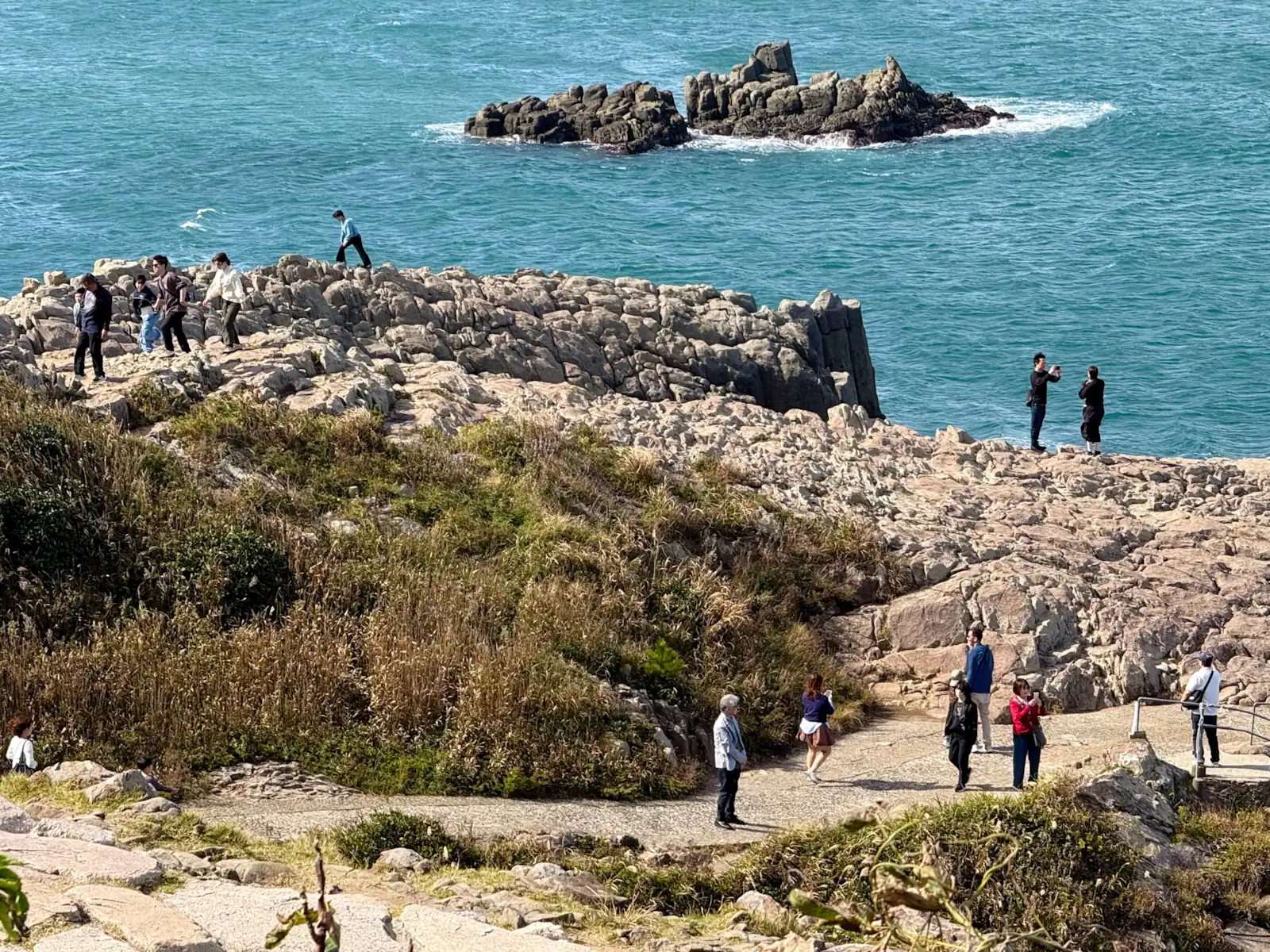
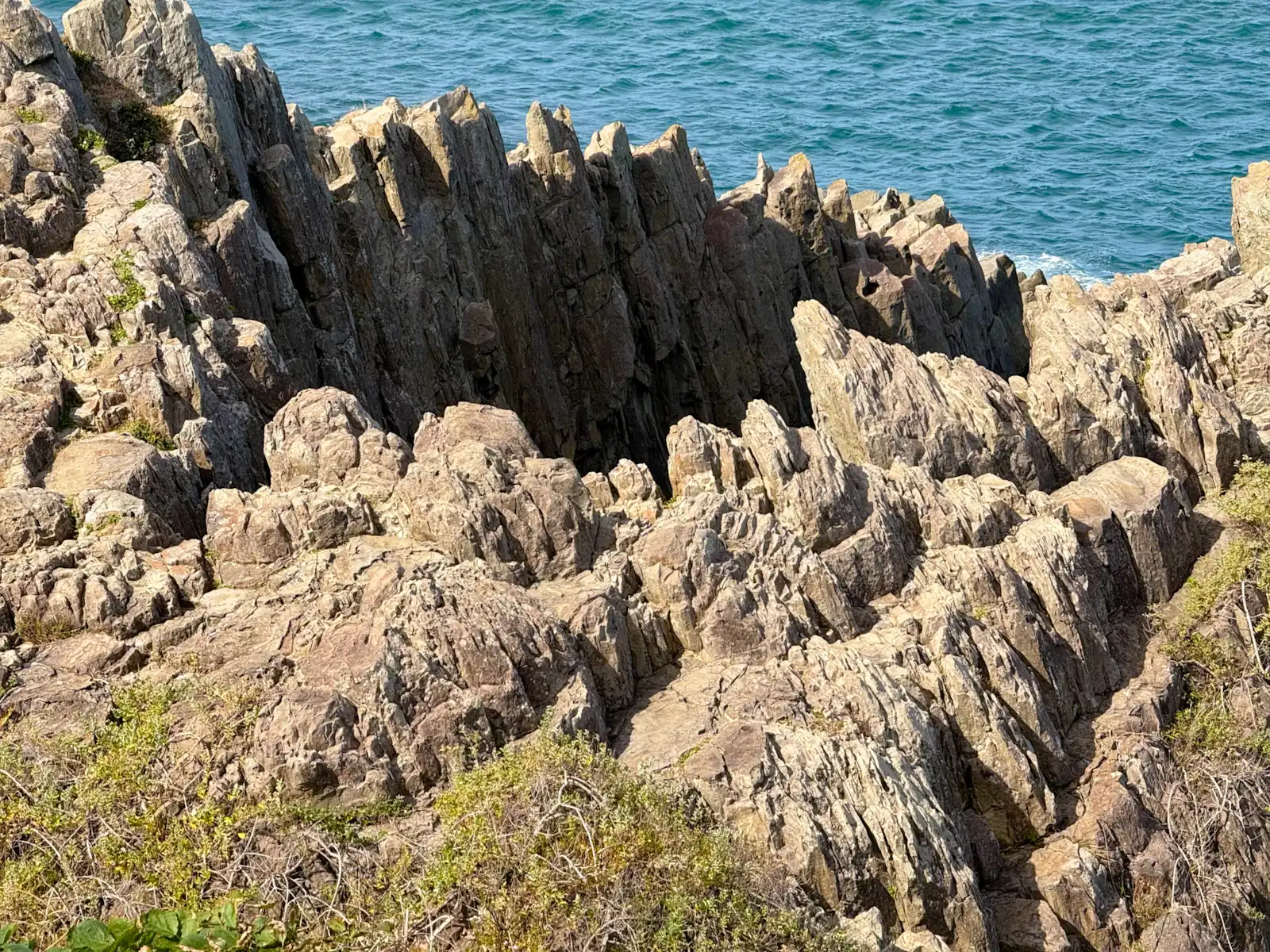
The rocks at Tojinbo look almost too neat to be natural, as if somebody had sculpted them on purpose. Instead of the usual rounded boulders, the whole shore is made of thousands of stone columns packed tightly together. Most of them stand up straight, while others lean or lie on their side. From what the signs say, around 12 to 13 million years ago magma cooled slowly here, shrank and cracked into five- and six-sided pillars, then much later the sea washed away the softer rock around them. The cliffs run for about a kilometer and reach roughly 25 meters at their highest. The whole area is part of the Echizen-Kaga Kaigan Quasi-National Park, which covers this stretch of coast from Fukui up into Ishikawa. They have been a national Natural Monument and Place of Scenic Beauty since 1935, and, according to the local tourism people, there are only three places like this in the world. They even have a name for it, the “three great columnar joint sceneries of the world”. The other two on the list are Mount Kumgang on the Korean Peninsula and the west coast of Norway.
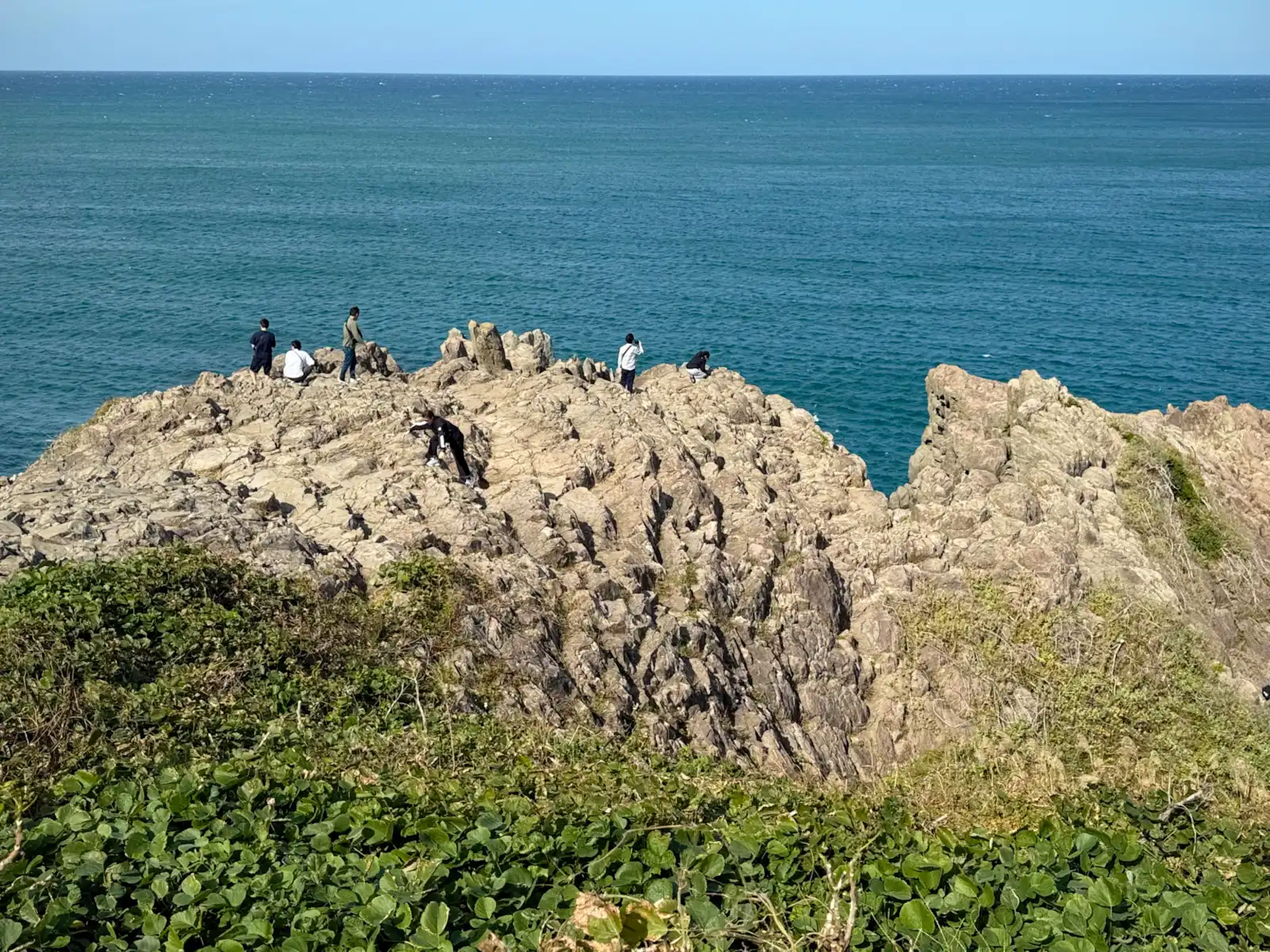
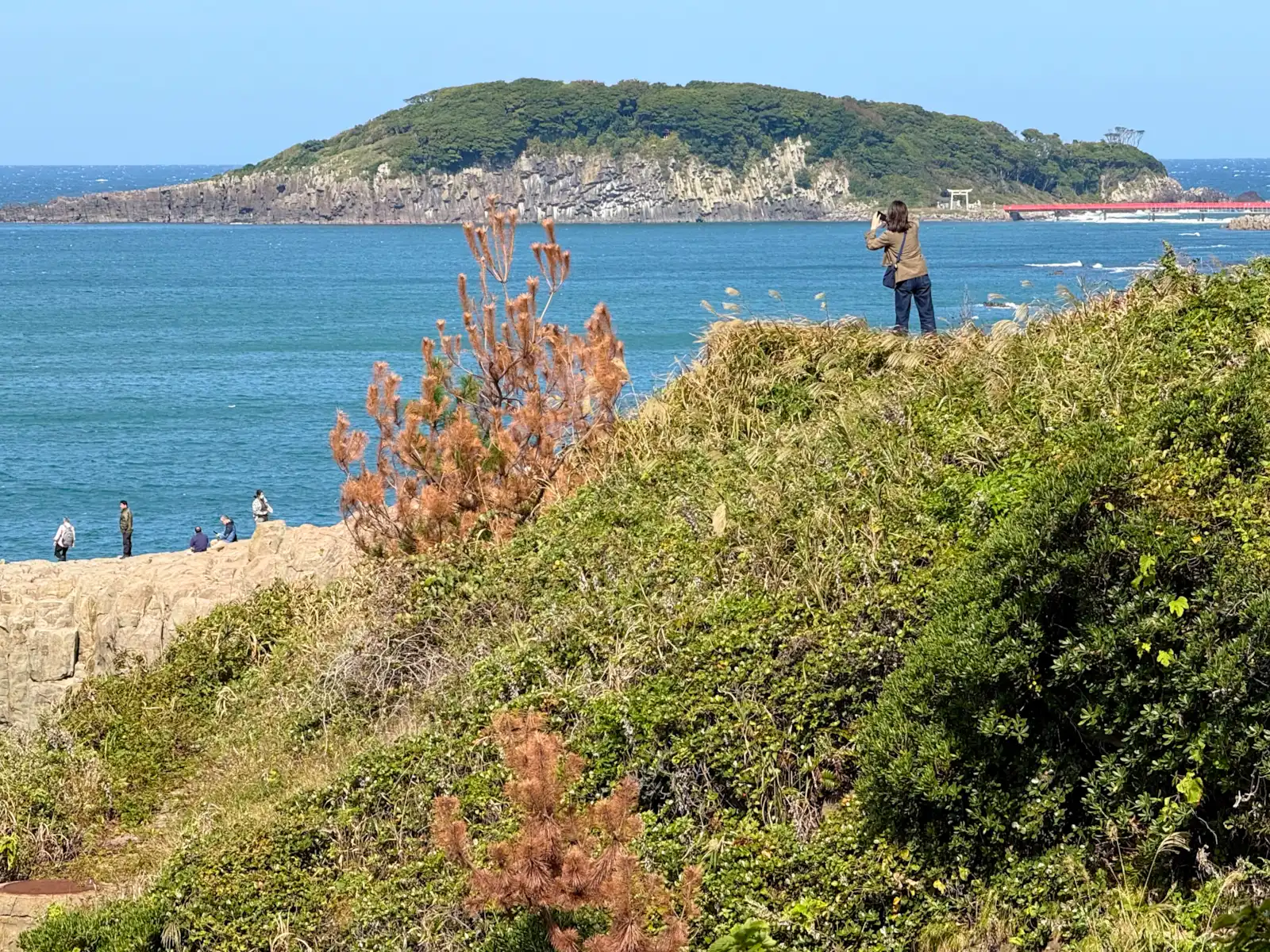
Surprisingly (or maybe not), there were many people walking and crawling on all fours around on top of all this. The fence only covers the viewing area. On the rocks there are no railings or anything protective at all, so visitors climb out as far as their nerves allow, sit down near some slightly dangerous edge, take selfies for Instagram and climb back. From the viewing area you can also see Oshima off to the right in the distance, a round green island connected to the mainland by a long red bridge.
The name of this place comes with a story too, but it’s not a cheerful one. Tojinbo is said to have been a monk at Heisenji, a large temple in Katsuyama. He was strong, violent and disliked by pretty much everybody. One day the other monks invited him on a sightseeing trip to the Mikuni coast, poured him sake until he was so drunk he could barely stand. And then, just like that, they threw him off the cliff. His anger supposedly turned the sky black, and in one version of the tale the sea raged for 49 days. So the most famous cliffs in Japan are named after a murder victim who was also the villain of the story. Quite an achievement, if you ask me.
Tojinbo has been a filming location for movies and suspense dramas for decades, and the cliff-edge confession is such a familiar scene that even the Fukui tourism website uses it to introduce the place. Standing there I could see why directors keep coming back. The place is basically a ready-made set. The cliffs look dramatic from any angle, and with the sound of the waves below, you don’t even need a soundtrack.
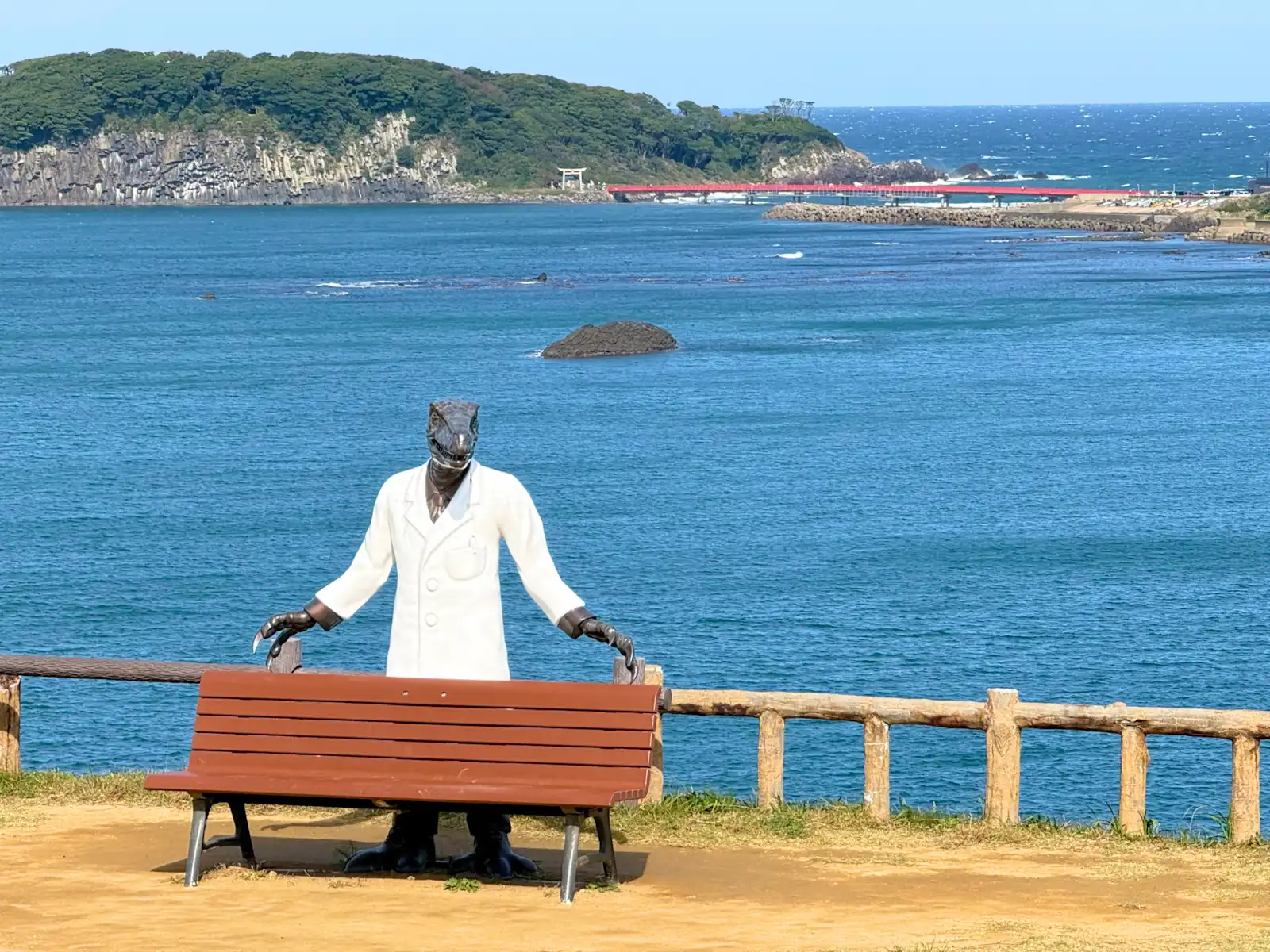
Most visitors seem to hang out around that central part, but I like side quests, so I left the crowds behind for a bit. I walked along a path past an old stone statue in a small wooden shelter, half covered by bushes, and then out onto a wide lawn with hardly anyone on it. And then, over by the fence, I spotted someone very familiar. A guy in a white lab coat, just standing there and looking straight at me.
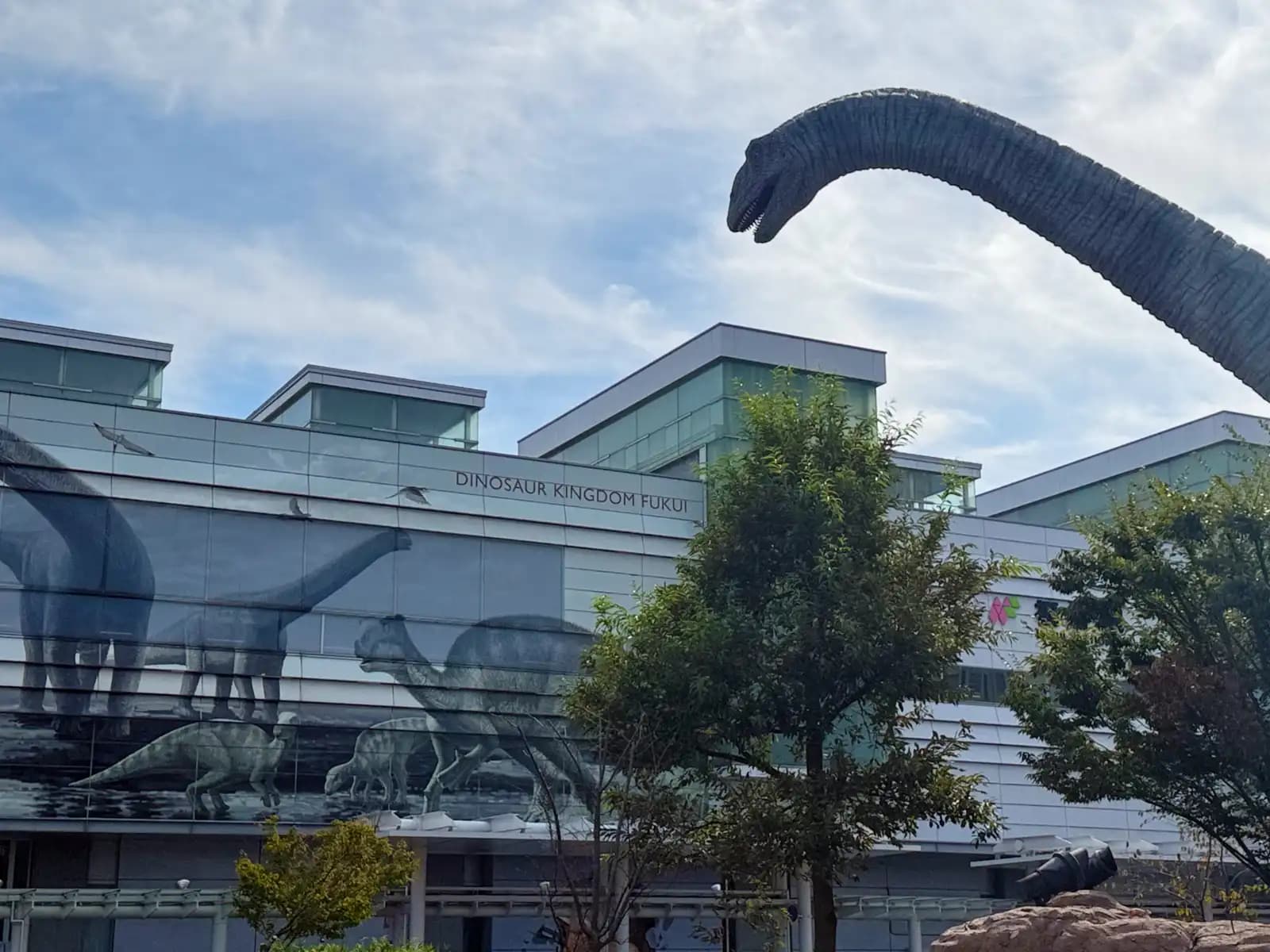
Ha, the dinosaur doctor! He is the same character I had met on a bench near Fukui Station the evening before, except this one had left his snorkel mask at home. Here he stands behind a bench as if he’s waiting for somebody to sit down so the lecture can begin.
A few steps away, under the pines, I saw a lone phone booth with a green payphone inside, which looked a bit out of place here on top of the cliffs. Next to the phone somebody had placed a small tray full of ten-yen coins, a telephone card, a Bible and a tiny glass bottle with a purple flower in it. The coins are there so that anybody can make a call, even with empty pockets. But why would a phone booth be here, of all places? There’s a sad reason for that. Tojinbo has long had a reputation as a place where people in despair come to end their lives, and since 2004 a retired policeman named Yukio Shige has been patrolling these cliffs with a group of volunteers, stopping to talk to anyone who looks like they need help. A newspaper clipping taped up inside the booth told of an anonymous person who keeps leaving coins there, nicknamed after Gekko Kamen, a masked hero from an old TV series. So, somebody keeps that tray filled for strangers they will never meet.
I walked back to the plaza and took a path along the edge of the cliffs in the other direction, and that is where I got some of my favorite shots of the day. With all that wind the waves kept crashing into the gaps between the rocks, forming white foam everywhere, and the water looked dark blue in some spots and green in others. Silvery susuki grass was waving over the slopes, pretty much the only hint that it was autumn.
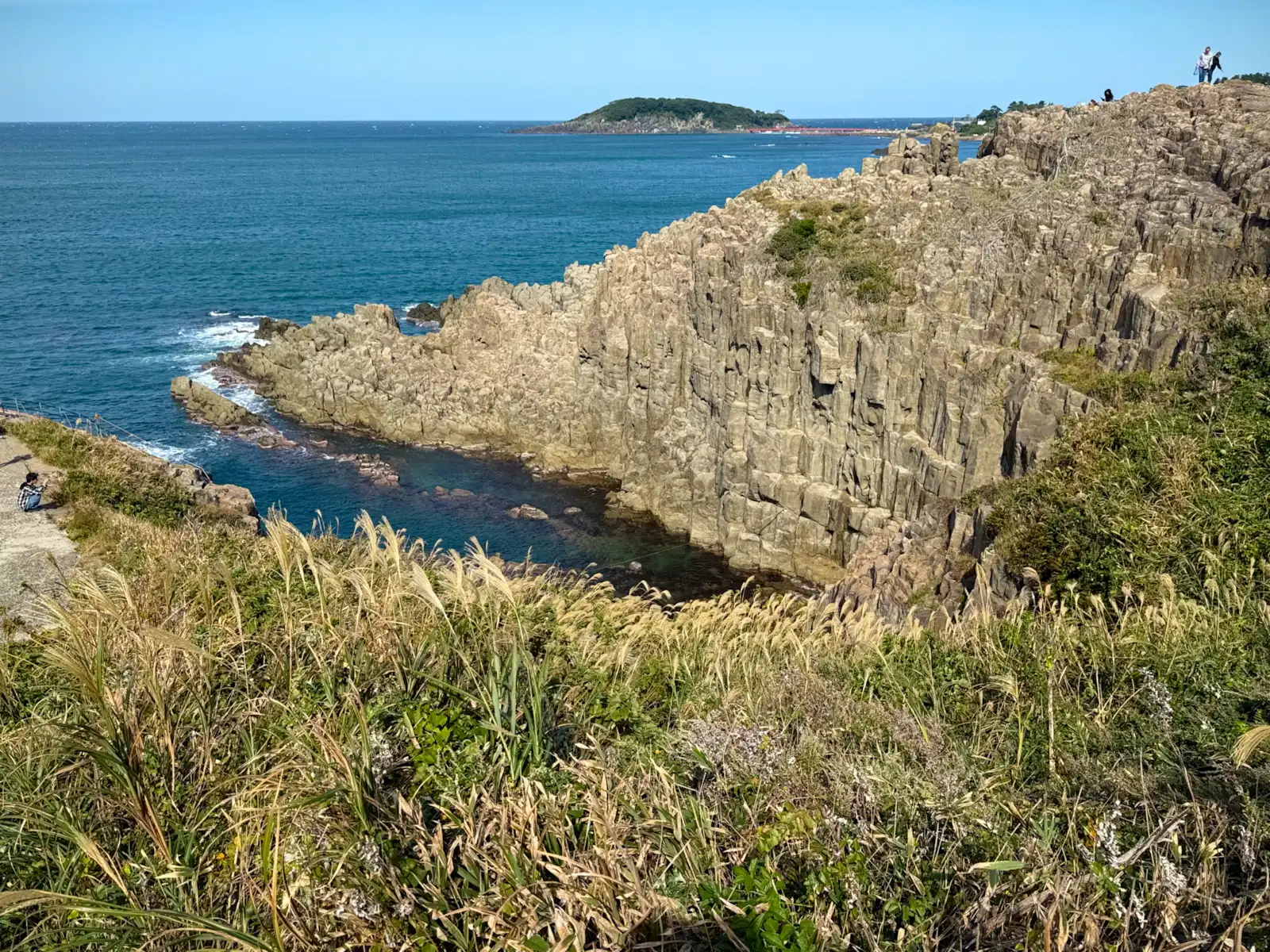
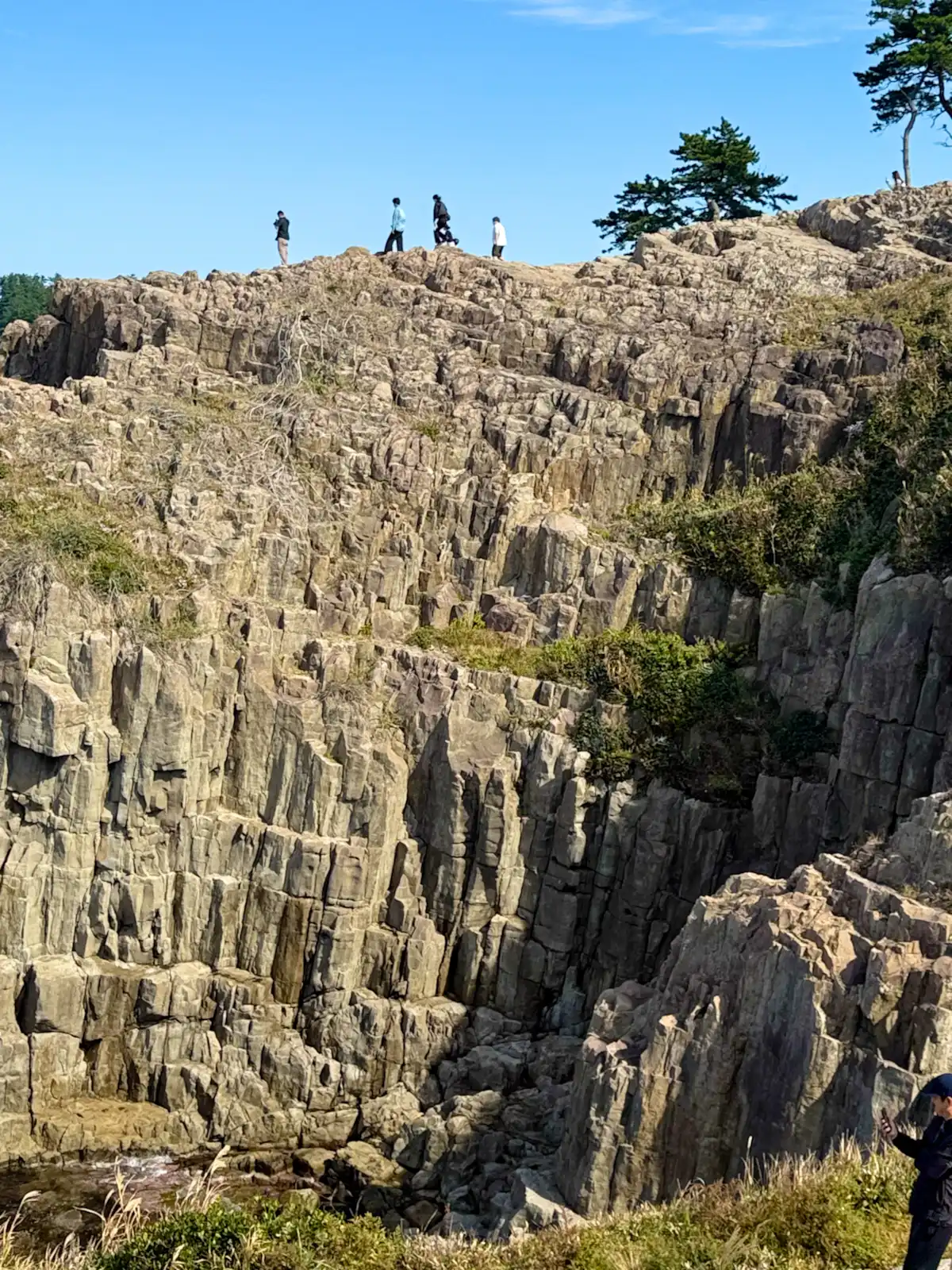
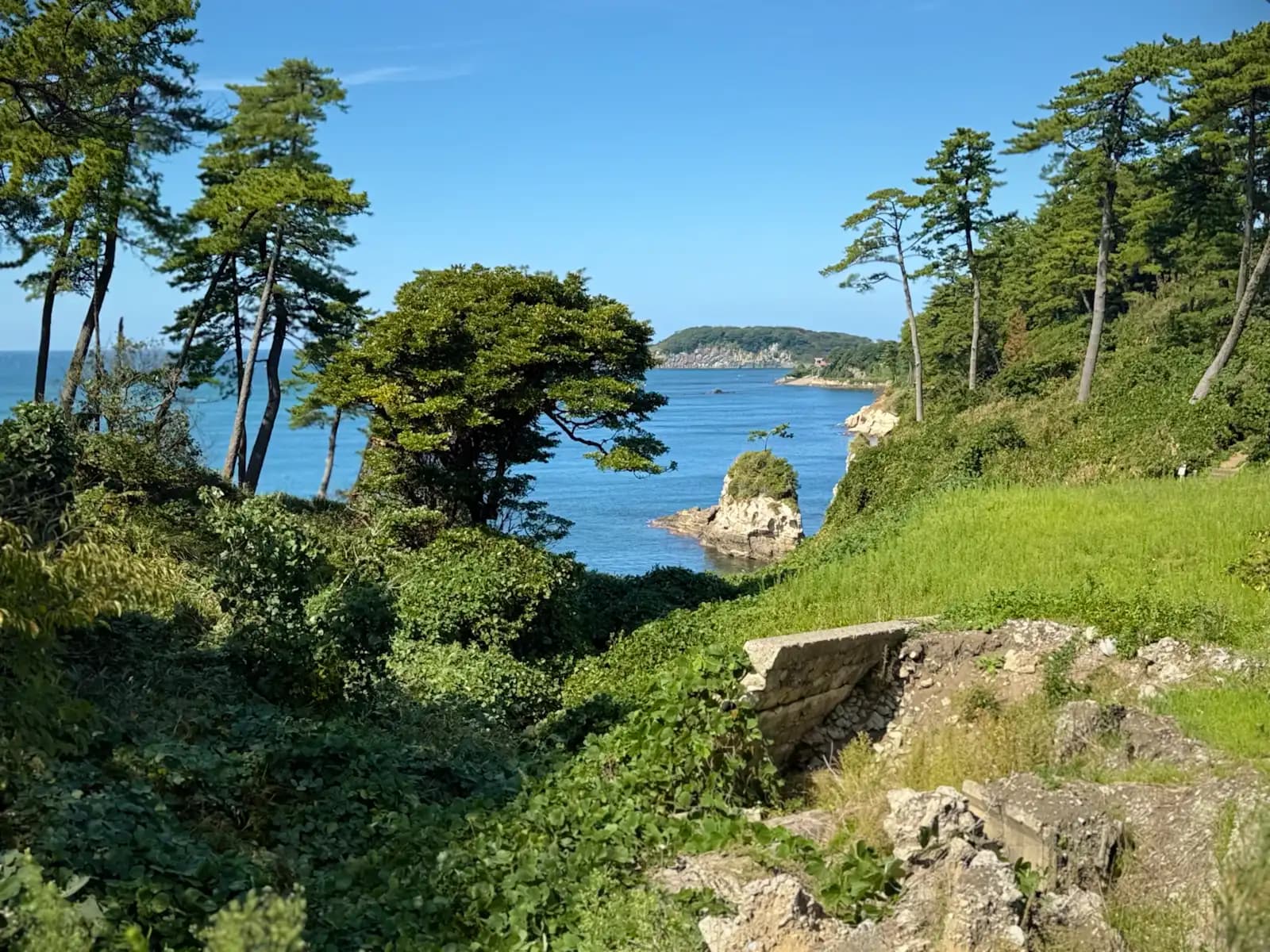
Further along the columns get taller and the path gets closer to the drop. Pines grow straight out of the rock wherever they find a crack, and one square pillar stands completely on its own in the water with a little garden on top (which I thought was a perfect composition for one of those old sumi-e paintings). That one is my favorite rock there.
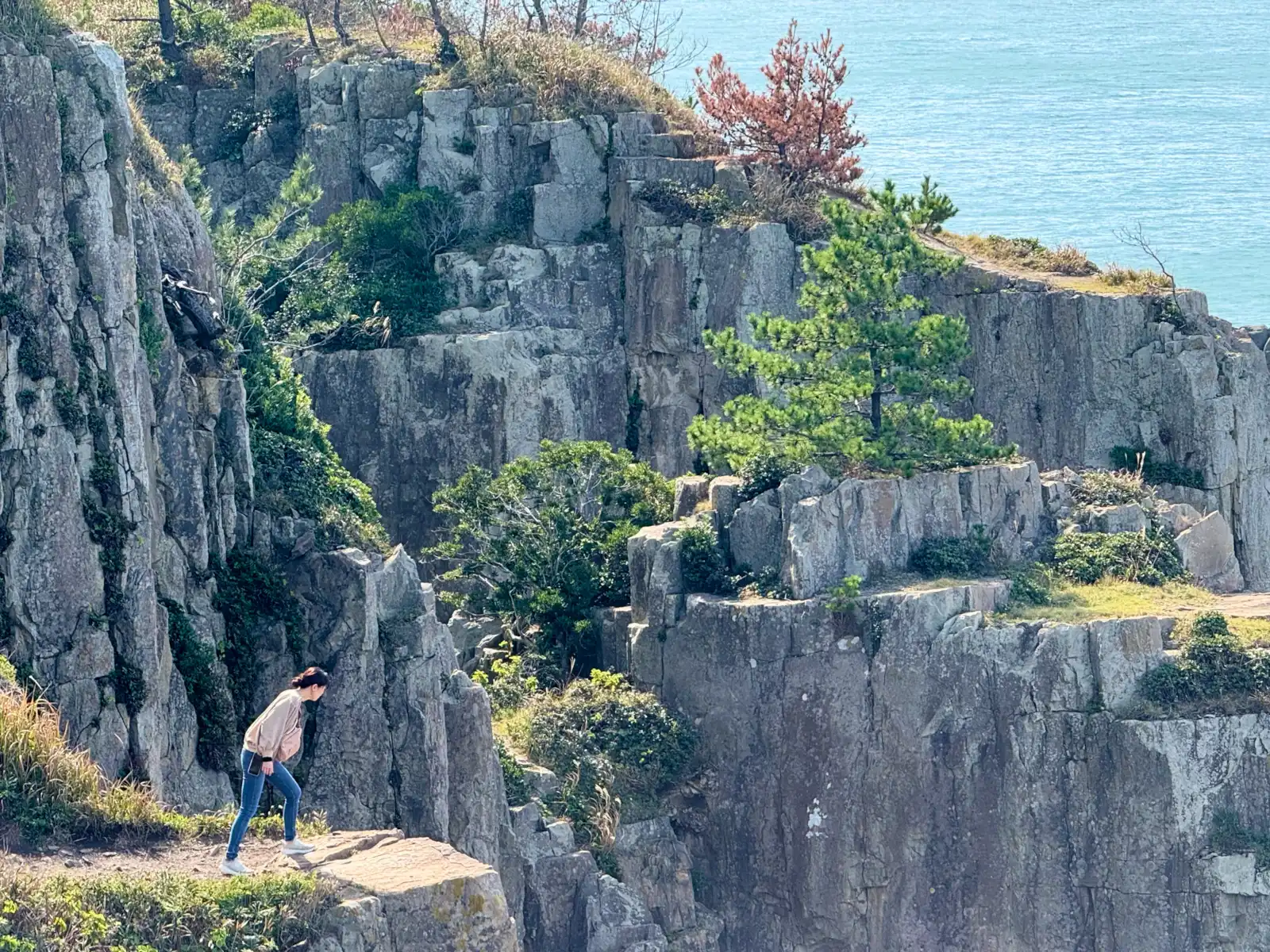
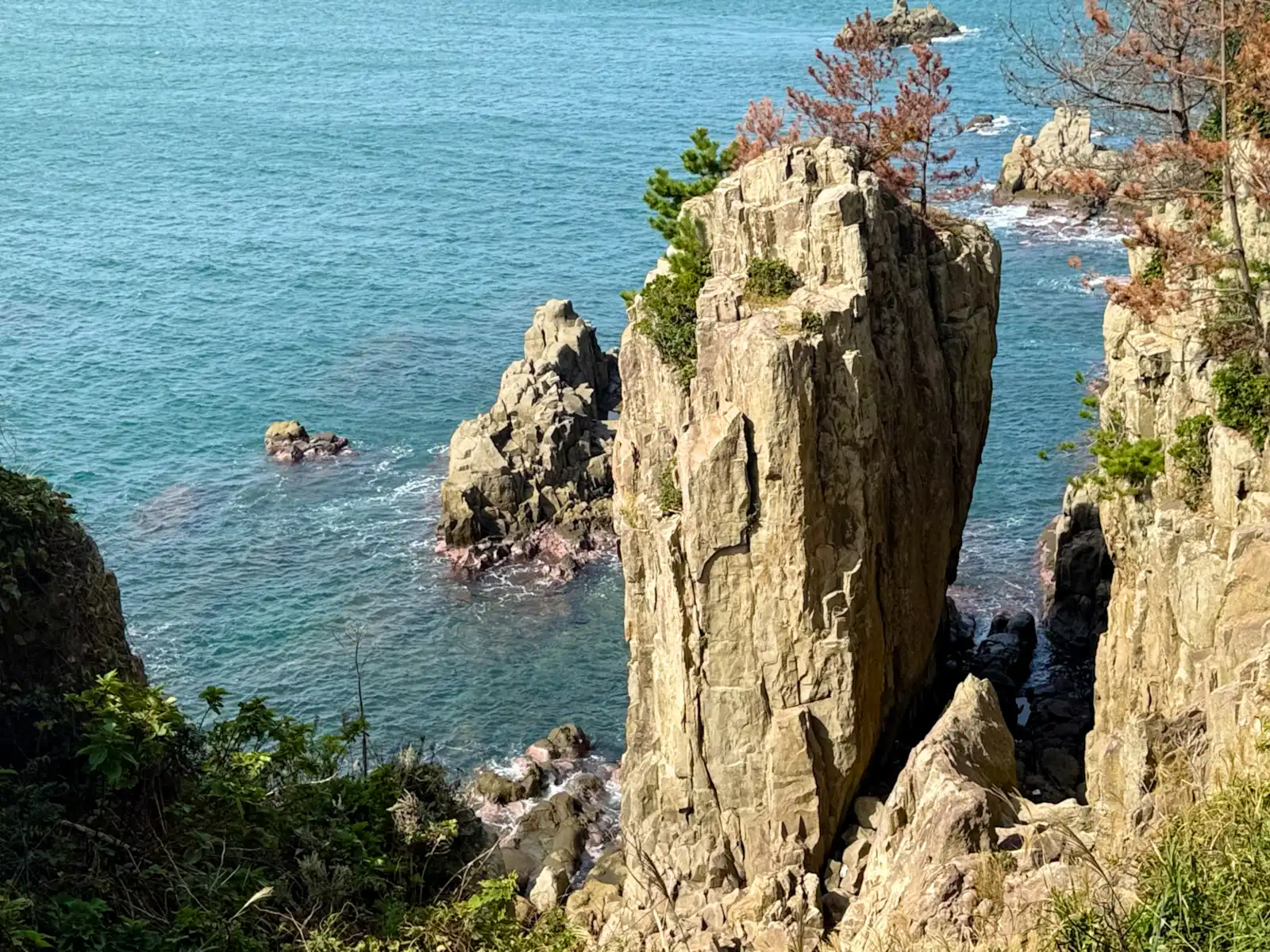
Before leaving I went back for the tower, to properly wrap up the visit. It was completed in September 1964, a couple of weeks before the Tokyo Olympics. It feels like not much has changed inside ever since. The whole tower feels old and a bit worn around the edges, but that’s something I really liked about it. The first floor has a wall of old sepia photographs of the cliffs, each one labeled with the name of a rock. One of them was Candle Rock, which turned out to be the same square pillar with the little garden on top that I had photographed earlier, except in the old picture its top was completely bare. Next to them hang faded pictures of other observation towers around Japan.
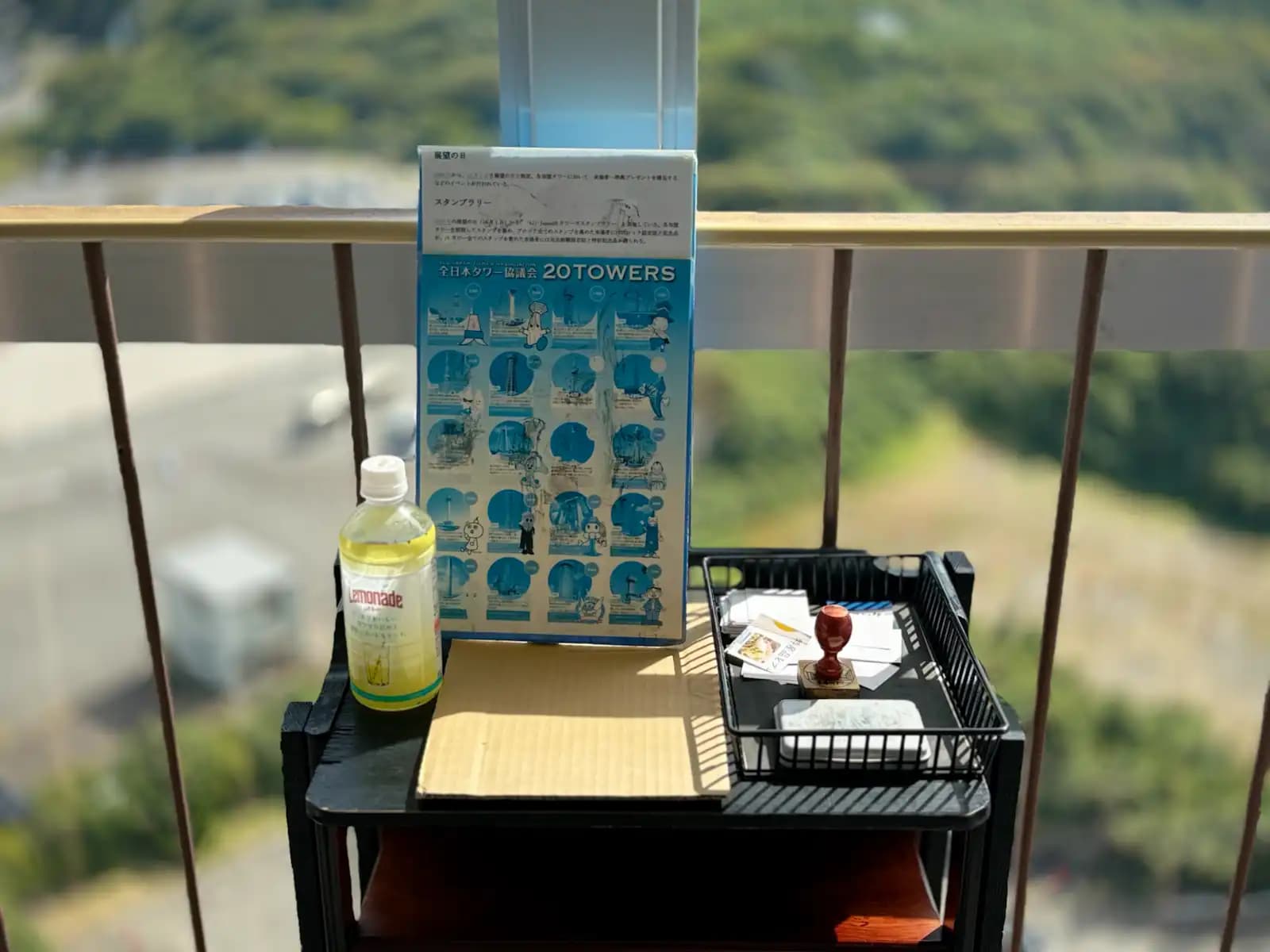
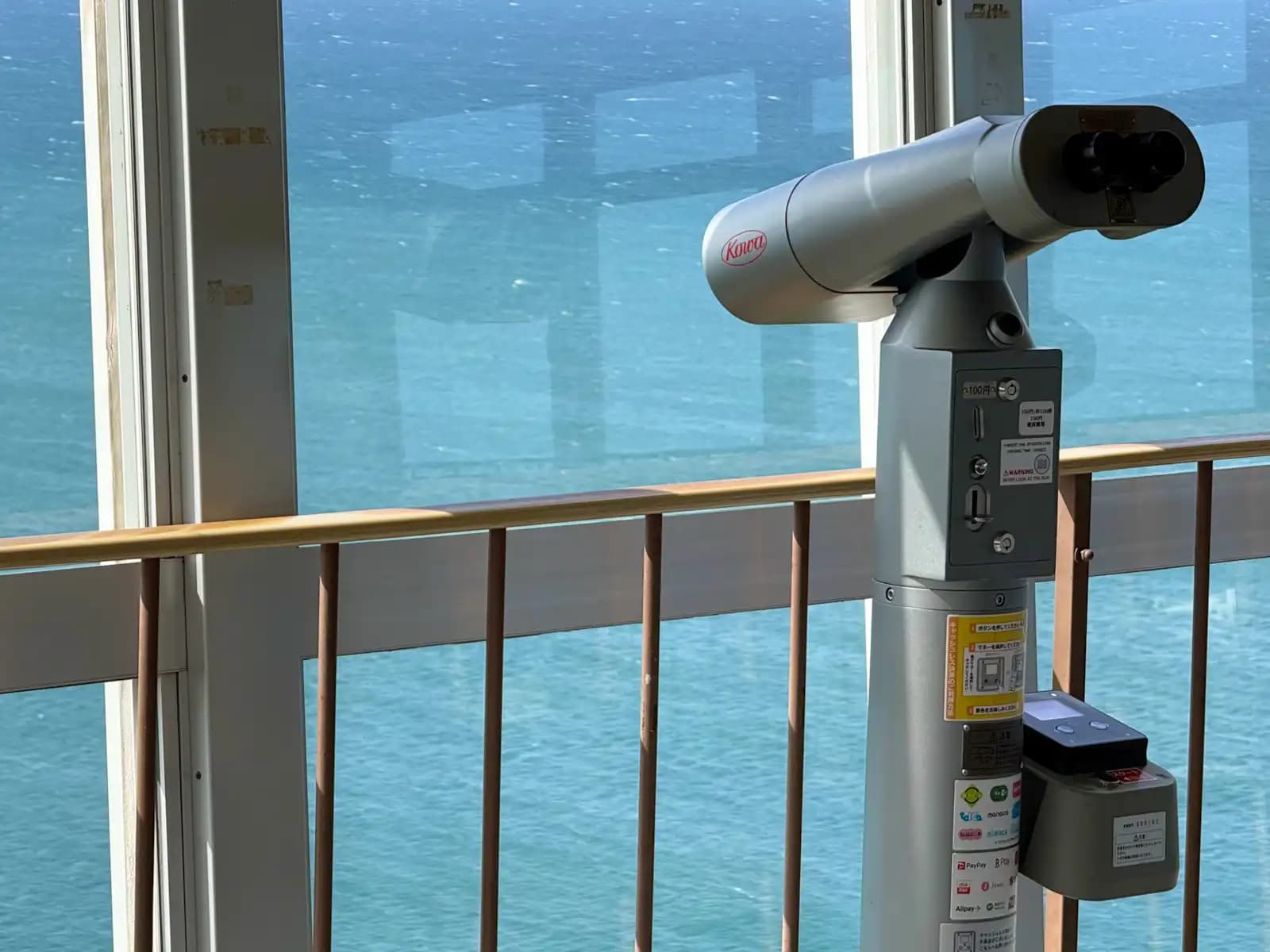
A ticket to go up costs 500 yen. The observation deck is 55 meters above the ground and about 100 above the sea. Up there I found a table with plastic chairs, coin-operated binoculars, a small golden altar with a statue of Kannon, a cheerful Hotei sitting beside it, and a hand-painted poster of the unfortunate Tojinbo falling head first into the waves. There was also a little stand with a souvenir stamp and an ink pad, one of those kinen stamps you find at most tourist spots in Japan. This one is part of a stamp rally for the twenty towers of the All-Japan Tower Association, in case you happen to be collecting them.
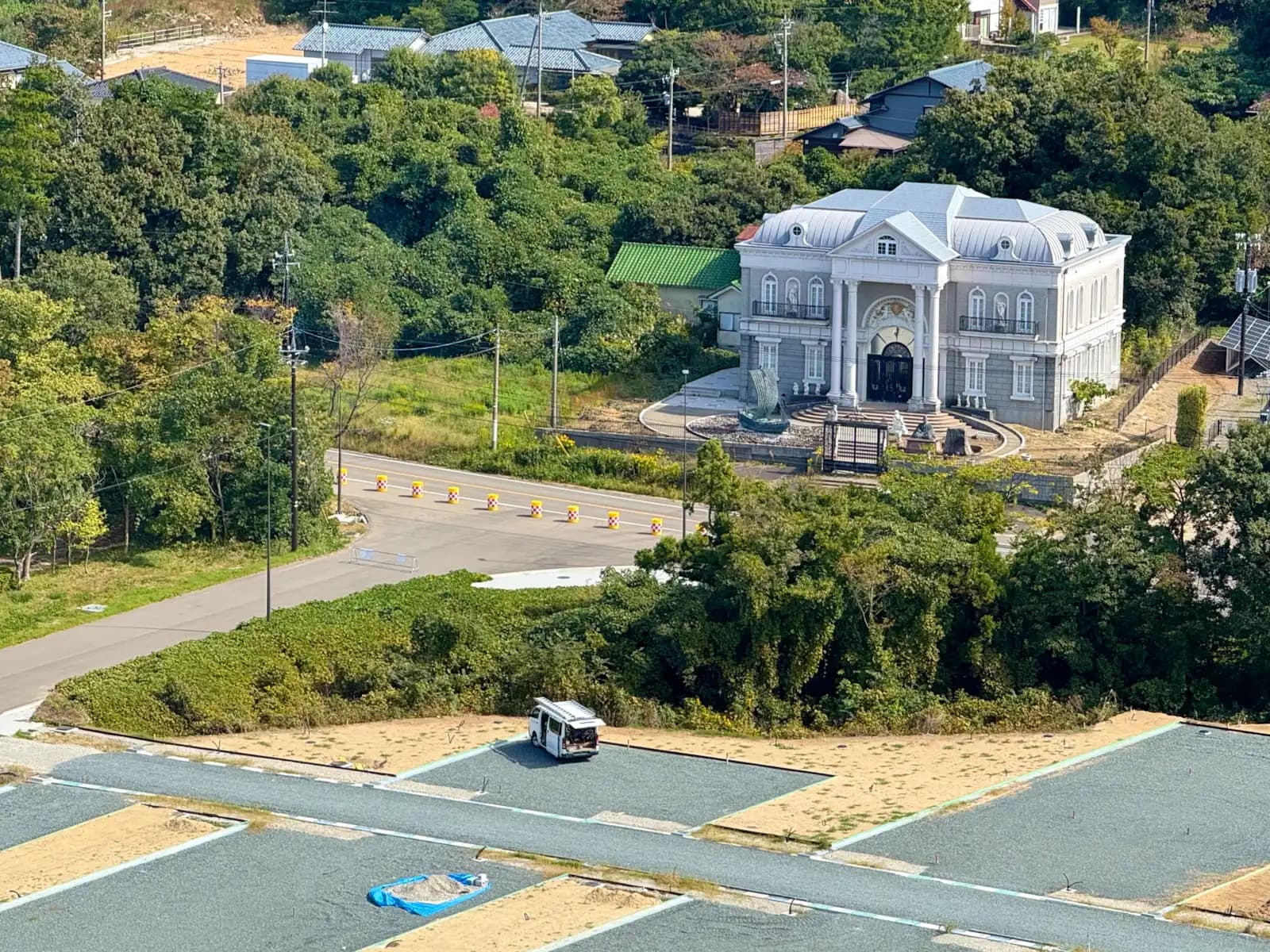
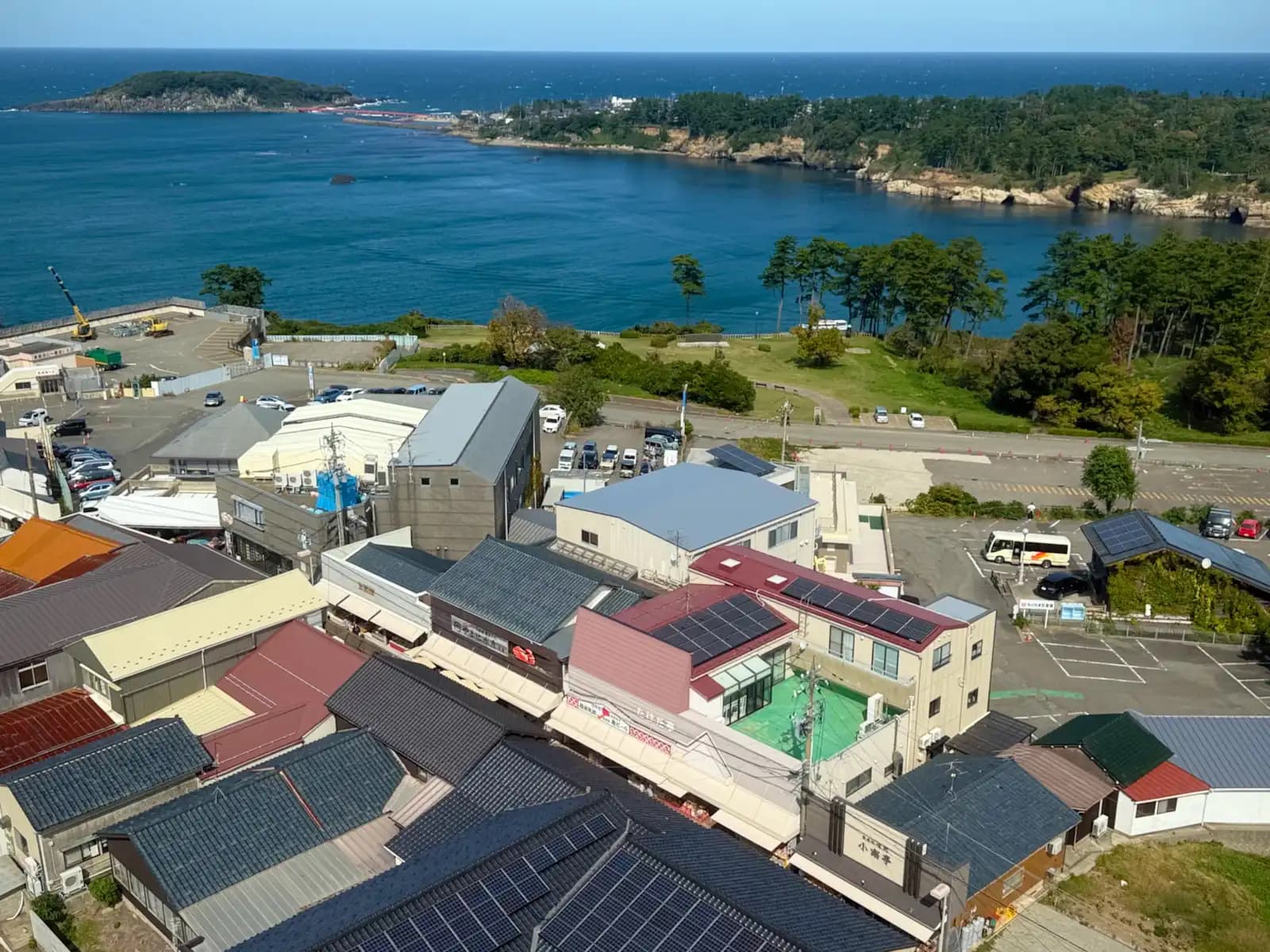
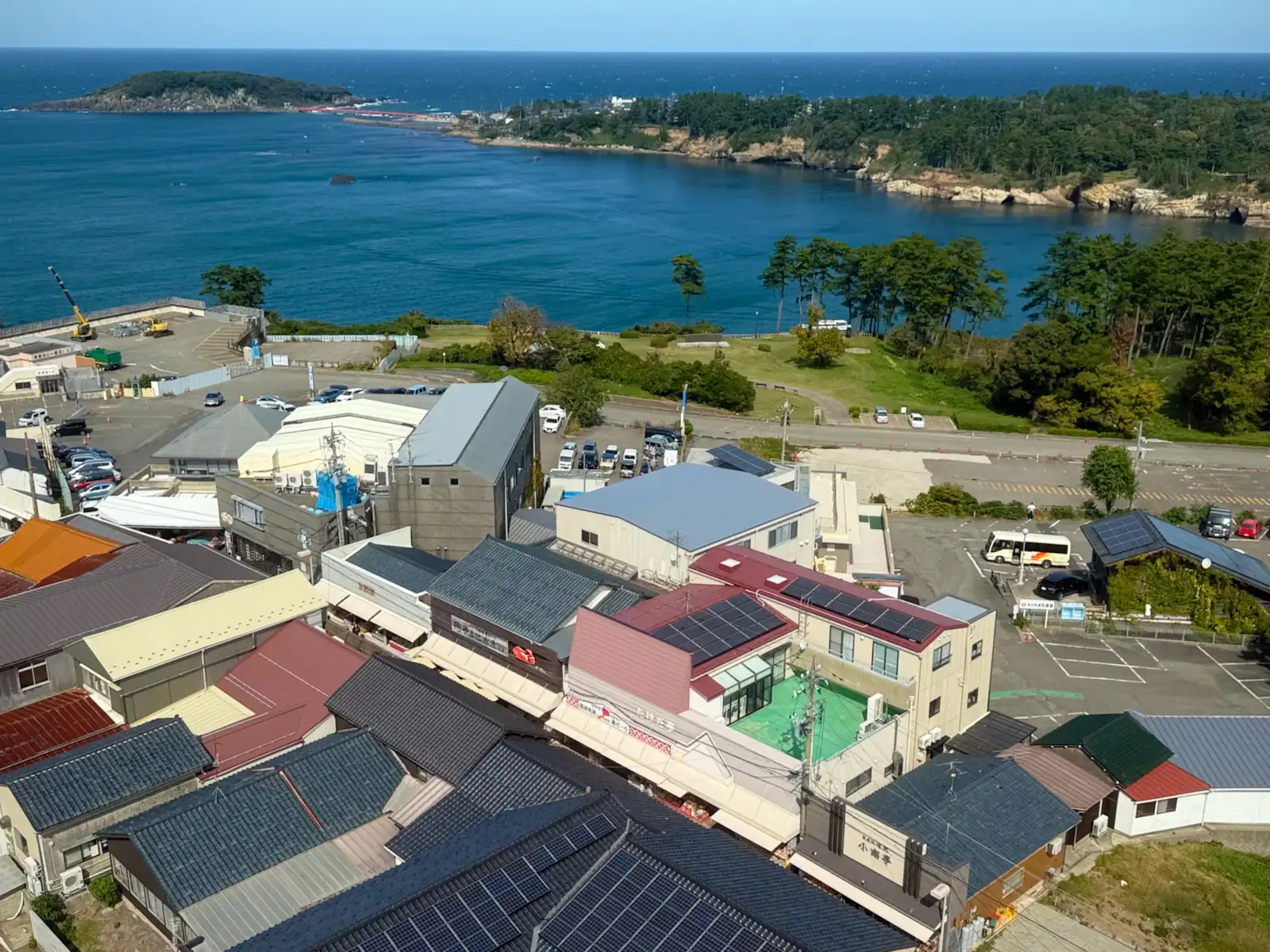
The view from up there was worth the 500 yen, of course. On one side there’s nothing but open sea all the way to the horizon. On the other you look down on the roofs of the shopping street, the pine-covered coast and Oshima with its bridge. I also spotted one more thing down there. Behind a container in a parking lot, tiny but clearly upright, stood the Beast. I had been subconsciously worried about it all morning, so it was a relief to see it still on its wheels.
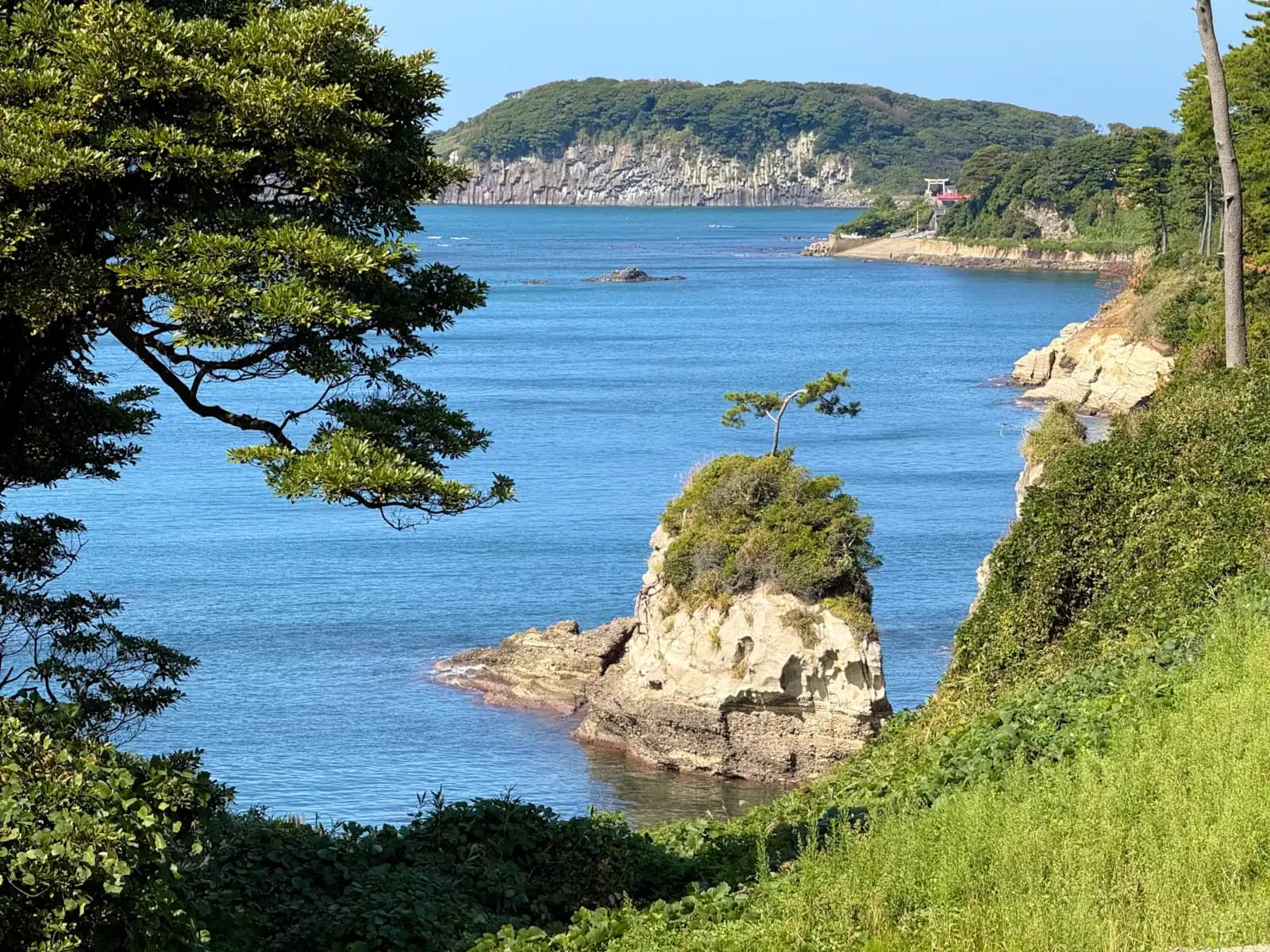
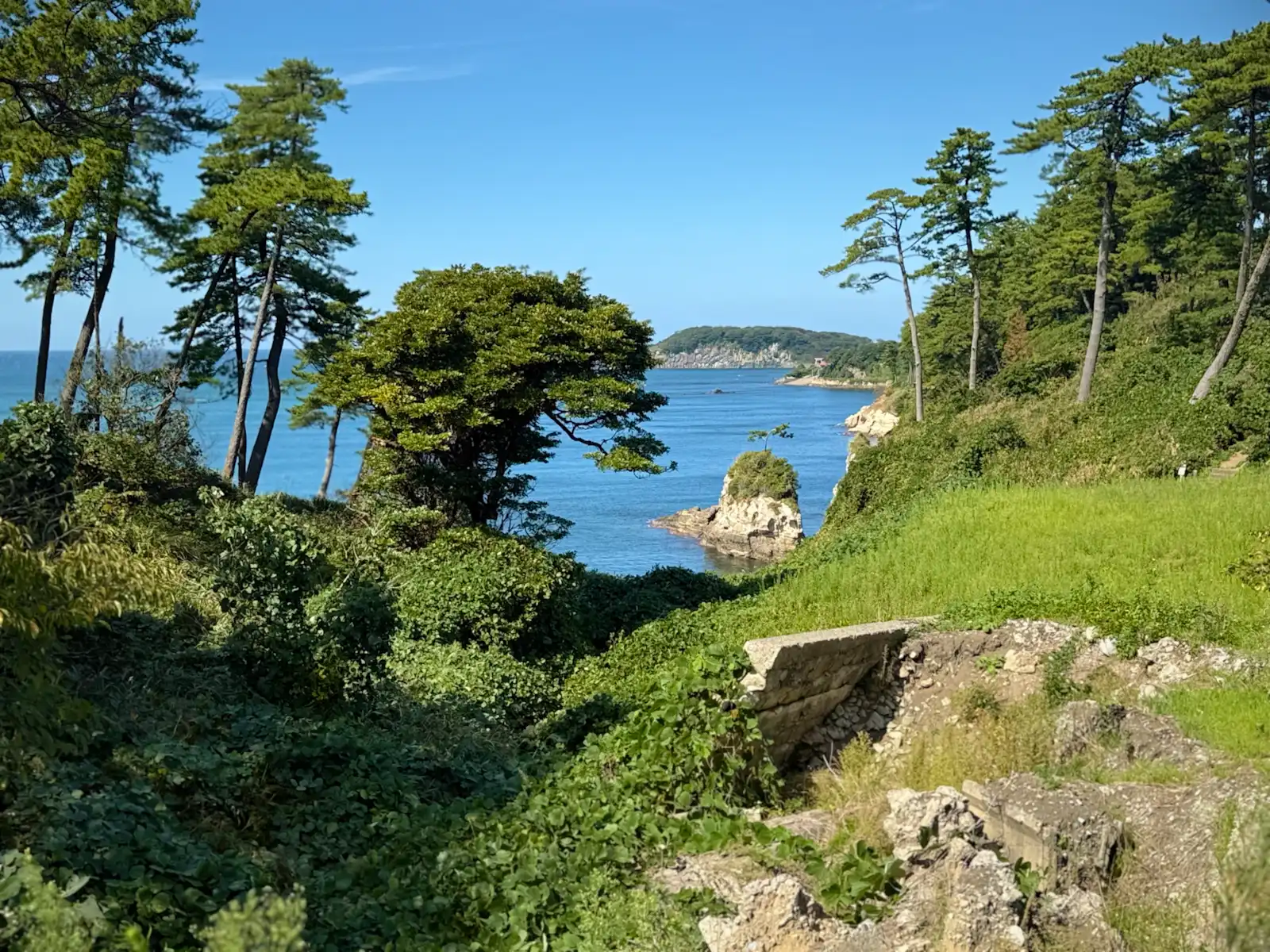
Oshima had been sitting there in the background all this time, so when I finally left Tojinbo I headed north along the coast to go and see it up close. I didn’t get far though, because of course I had to stop again for yet another photoshoot. There was a gap in the trees with a clear view of the island, and a small rock just offshore with a single small pine growing on top, shaped by years of wind like the one that morning. But Oshima deserves a story of its own, so I’ll save that one for the next article.
If you’d like to visit Tojinbo without a bicycle, take the Echizen Railway from Fukui to Mikuni and then a bus for about 15 minutes. Just don’t take the photo at the fence and leave like a tour group that’s already late for the next stop. Walk out to the lawn, say hello to the doctor, and maybe drop a ten-yen coin into that tray.