Tanukidani-san Fudō-in: A Hidden Kyoto Temple of Hermits, Swordsmen, and Raccoon Dogs
Tanukidani-san Fudō-in is a quiet temple in the hills above Kyoto, guarded by a wrathful deity and some three hundred raccoon-dog statues left by visitors over the years. Reached by 250 steps the locals climb for their health.
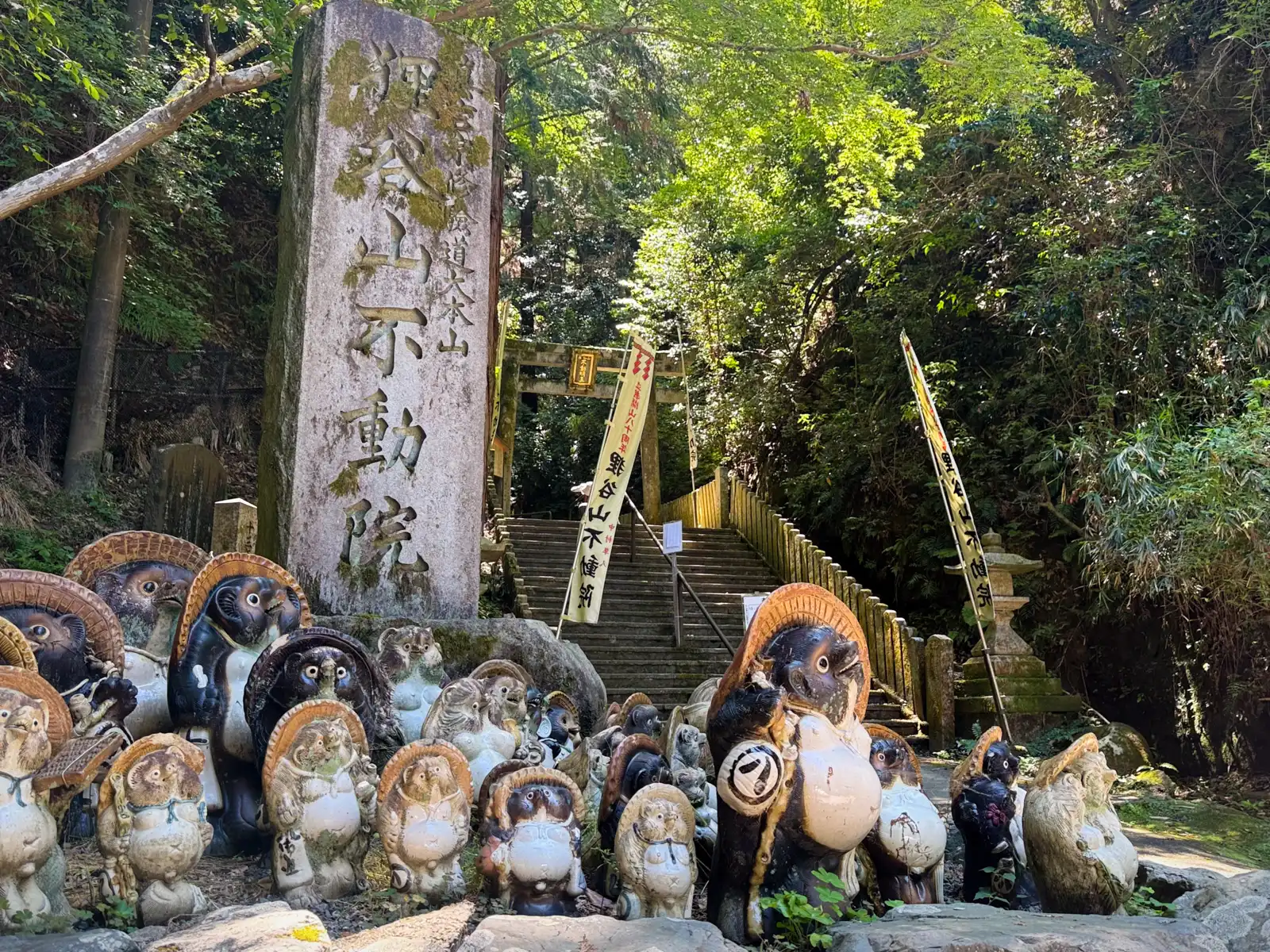
Tanuki figurines, those little (and sometimes quite big) plump raccoon dogs that turn up all over Japan, are dotted along the path. You can find them in ones and twos, tucked against steps and railings, said to number more than 300 across the grounds. Visitors have been leaving them here since about 1970, for no better reason than the name of the place: Tanukidani, “raccoon-dog valley”. So you climb the steps assuming that’s what the temple is named after. But it isn’t. The deity at the top of the 250 steps is written as 咤怒鬼, three characters meaning something closer to “the one who scolds the demons”. He is a Fudō Myō-ō, a fierce Buddhist guardian, with a sword in one hand and flames at his back. The exact opposite of gentle. By legend, one was placed here to guard the northeast corner of Kyoto, the direction bad luck was thought to come from. Those three characters his name is written in read the same as tanuki, but they mean nothing like a raccoon dog: scold, rage, demon. The one who snarls at whatever comes through the gate.
The climb begins at the cluster of figurines, where the steps start. The last of the lane up to it is steep enough that I pushed the bike the final stretch. The forest here is dense, and on a hot day it holds the cold. After the effort of getting up, the chill comes as a kind of reward. Bamboo runs through the trees. Partway up, the steps pass under a short tunnel of red torii, a compressed echo of Fushimi Inari – a few dozen rather than its thousands.
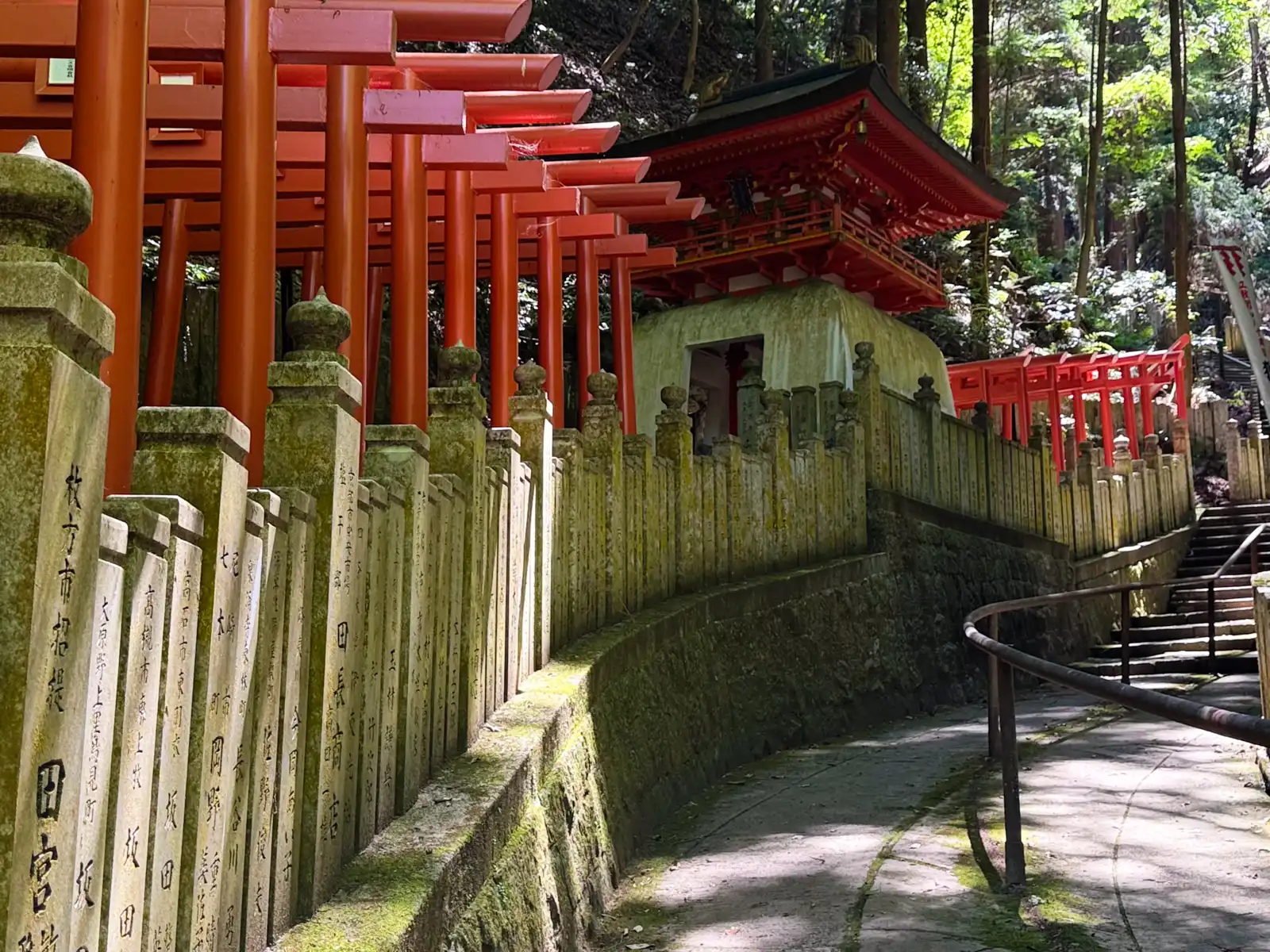
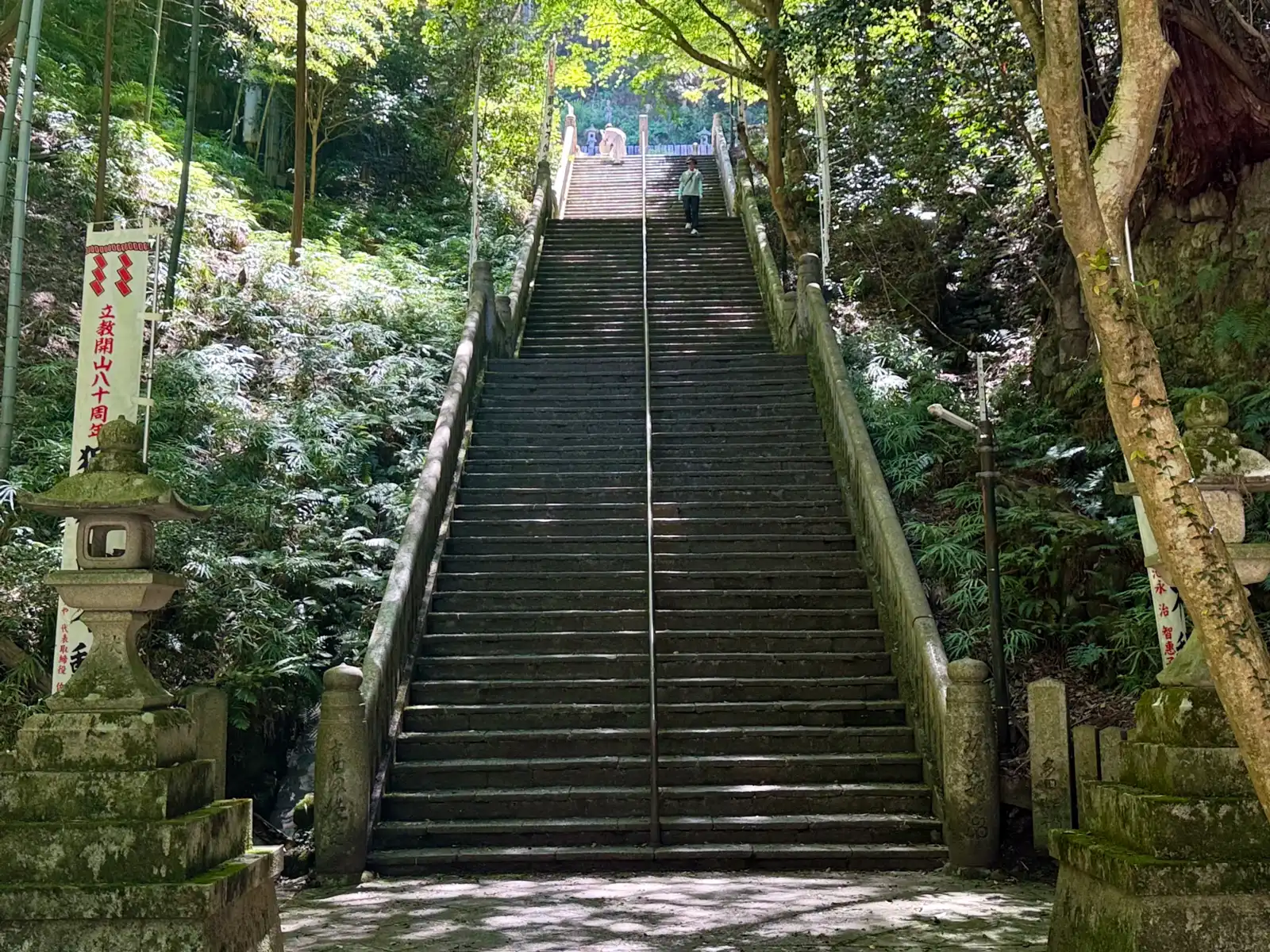
There are 250 steps, according to the signs. They’re known locally as the health stairway: people climb them for exercise, and ten round trips is said to earn a certificate of health from the temple, with your name recorded in the main hall.
The main terrace opens out a little before the top. It is very quiet here. There are no tour groups, just a handful of visitors, none of the crush of the better-known temples. The main hall stands on wooden pillars braced against the slope, plainly modelled on Kiyomizu-dera, and from the right spot Kyoto shows through a gap in the trees, down in the valley below. The sun reaches into the clearing.
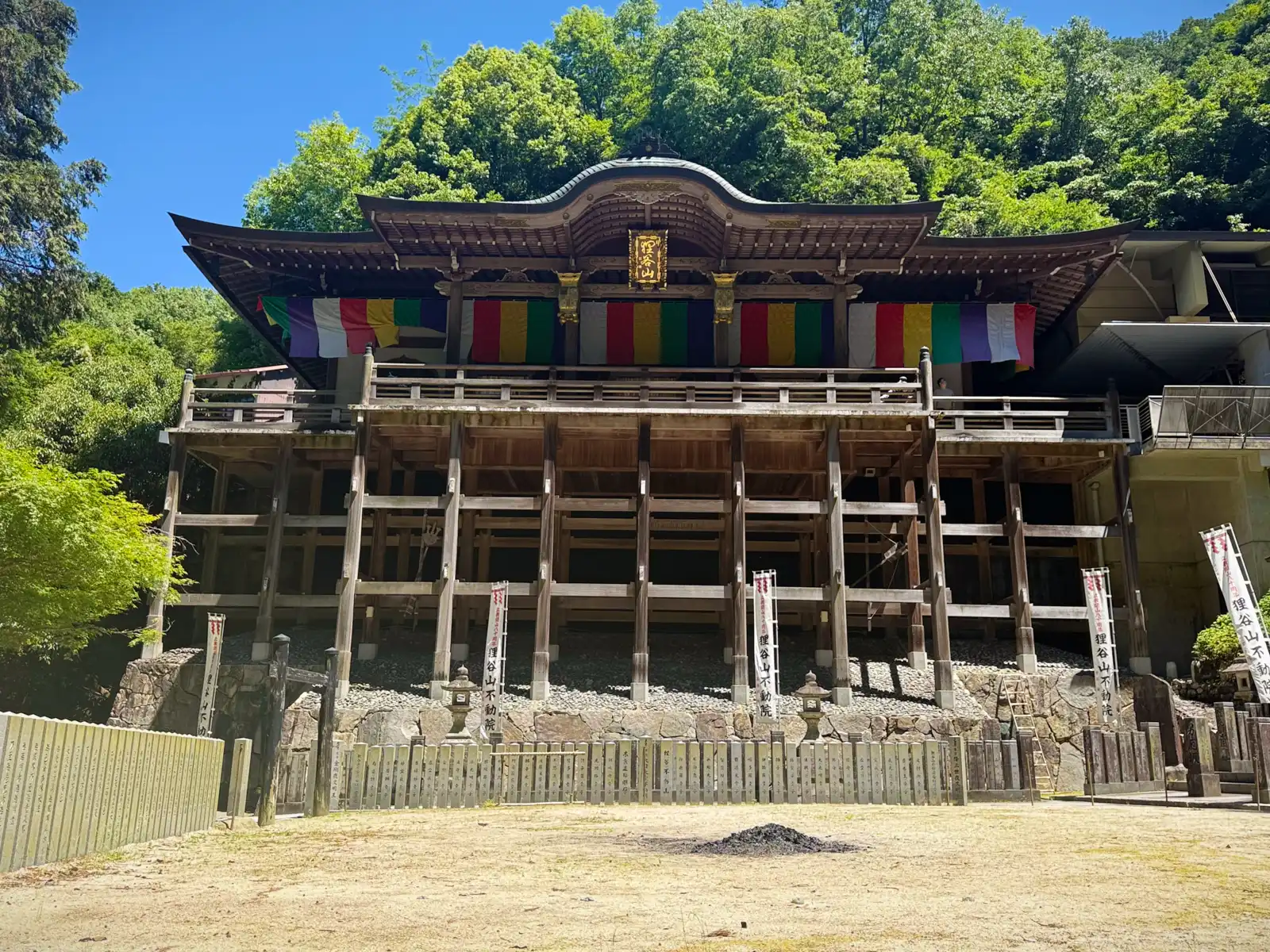
On the ground in front of the hall, a scorched patch – the remains of a fire.
The main hall is newer than it looks. It was built in 1986, though in an old style called kake-zukuri: a wooden frame propped out over the slope on tall pillars. There’s a reason it clings to the hillside like that. It was built over a cave, and the cave is the real point of the place. Behind the altar the mountain is left as bare rock, and set into it stands a stone Fudō about 1.5 meters tall. Someone carved it and brought it up here. Who, and why so far up a mountain?
The answer is one very stubborn monk. His name was Mokujiki Shōzen, and “mokujiki” isn’t really a name – it’s a vow. A mokujiki monk gives up grains and lives on nuts, berries and bark. He had trained at Kōyasan, the great monastery to the south. In 1715 he chose this cave, looking for somewhere hard enough to test himself. What drew him, the temple says, was a story that a swordsman had once come here to steady his nerve before a fight. Shōzen carved the Fudō and settled in. He trained three years, then stayed on, something closer to seventeen in all. In 1718 the temple was re-founded around him. Decades later, at another temple, he is said to have starved himself to death by slow degrees, turning his own body into a preserved “living Buddha” – a relic.
The cave’s story runs back much further, though it grows vaguer the further back you go. By tradition it was chosen in the eighth century, when Emperor Kanmu set a Fudō at the northeast corner of his new capital. That corner mattered: it was the direction bad luck and demons were believed to come from, so it needed a guard. By the 1700s the “Tanukidani stone Fudō” was well known enough to appear in printed guidebooks to the city. Then, in the 1870s, the new Meiji government turned against Buddhism, and temples like this one were abandoned; the forest simply grew back over it. What rescued it wasn’t an emperor or a warlord but ordinary local people, who cleared the path, widened it and laid the 250 steps. The temple came back to life in 1944 as a center of Shugendō, Japan’s tradition of mountain ascetics, whose priests, the yamabushi, still light the fires here.
And that swordsman? Miyamoto Musashi, probably the most famous Japan ever produced. In 1604, facing a fight he wasn’t expected to walk away from, he is said to have climbed to a waterfall on this mountain and stood under the cold water until his mind went completely still. That stillness has a name: fudōshin, the “immovable mind”, taken straight from the deity in the cave. The fight came soon after, at a pine on the road below, and he was badly outnumbered: by the old accounts, more than a hundred men of the rival Yoshioka school, arranged around a boy of twelve who was their figurehead. Musashi cut down the boy first, then fought his way out. The waterfall is still there, and still carries his name.
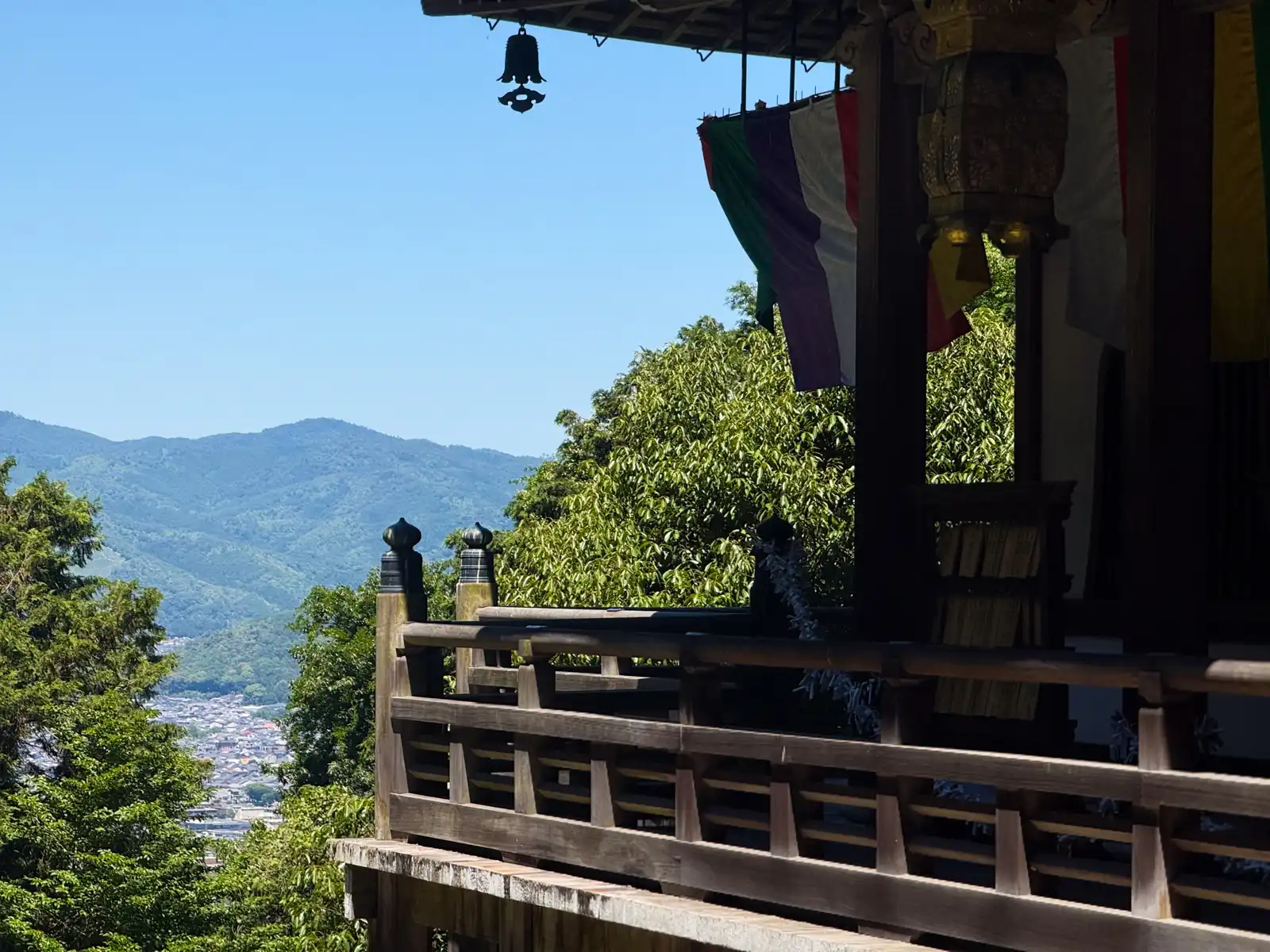
The best thing at the top isn’t the hall or the cave but the gap in the trees beside them, where Kyoto lies spread out in the valley, the city that once put a scowling Fudō at this corner to keep its demons out. From up here you can see almost the whole of what he was set to guard. Then you turn around and climb back down through the cold forest, past three hundred raccoon dogs, to the road.
I’ve put about thirty photographs from Tanukidani in the gallery: the figurines, the torii tunnel, the hall on its stilts, Kyoto through the gap in the trees, and more.