Omihachiman and the Canal Nobody Needed
The man who built this town was dead within ten years, ordered to cut his own belly open by the uncle who gave him the land. His castle didn’t last much longer. It was pulled down, its stones left to the weeds on the hill. What survived was the ditch he’d dug around it. Four centuries on, that ditch is the finest thing in town, and the castle it was meant to protect is a paragraph on a plaque.
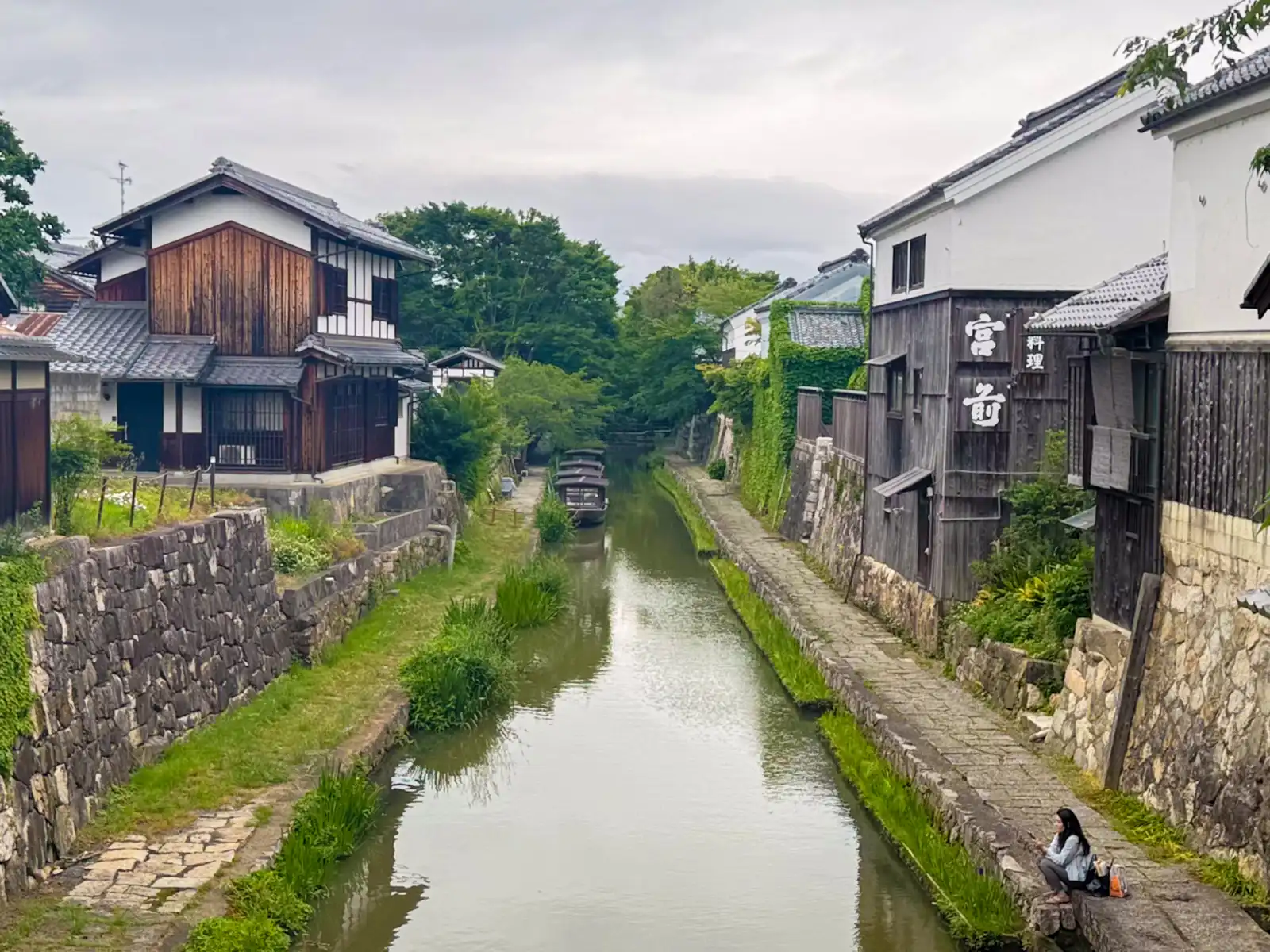
It has a name, Hachiman-bori, and the town that grew along it is Omihachiman, out on the flat eastern shore of Lake Biwa. It outlasted the castle for a plain reason: it stopped being a moat and turned into a canal. In 1585, Toyotomi Hidetsugu had it cut all the way down to Lake Biwa, then required every boat crossing the water to turn into the canal and stop in the town before going on – a checkpoint dressed as a harbor. Within a generation the moat was a trade route, and the families along its banks got rich.
Hidetsugu didn’t live to see much of it. He was the nephew and, for a while, the chosen heir of Toyotomi Hideyoshi, the warlord who would finish unifying the country a few years later, and at eighteen he was handed this corner of Ōmi to govern. The arrangement didn’t last. When Hideyoshi had a son of his own, the nephew went from heir to liability, and in 1595 he was accused of plotting treason and ordered to take his own life. The canal he’d dug barely noticed.
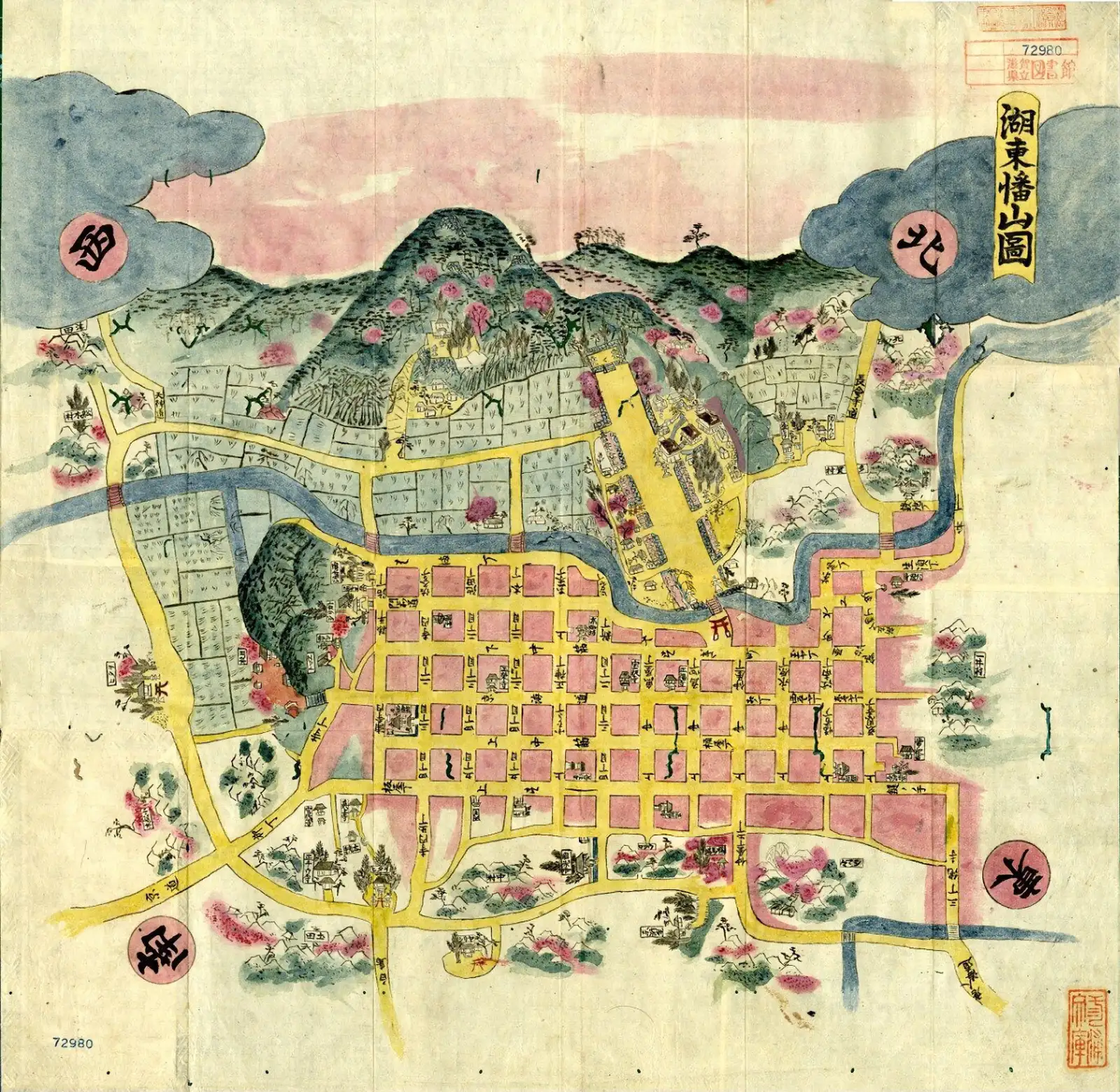
The families along it became the Hachiman merchants, a branch of the Ōmi shōnin. Over the next two centuries, they grew into some of the shrewdest traders Japan ever produced. By the 1700s they were peddling mosquito nets and tatami and hemp cloth from one end of Japan to the other. With them they carried a rule, one that’s still quoted in business schools today: sanpō yoshi – good for the seller, good for the buyer, good for society. Their reputation for fair dealing brought the business in, and the money came home to this canal.
The merchants outlasted the lords, but nothing outlasts the railway. Once the trains came, and the trucks after them, there wasn’t much for a cargo boat to carry anymore, and the canal slowly silted up. By the 1960s it had become a stagnant trench down the middle of town, with mud, reeds, whatever people tossed in, and in summer, by most accounts, the smell made a fairly convincing case for getting rid of it. So the town more or less decided to fill it in, turn it into a park and a parking lot.
It was the young men of the Omihachiman Youth Chamber of Commerce who talked them out of it. Their case wasn’t economic, because there was no economy left in a dead canal. It was that a town that paved over the reason it existed wouldn’t be much of a town. So instead of burying it, they more or less brought it back to life; dredged it, cleared the muck, straightened the banks, let the water run clean again. Nobody needed it. But they kept it anyway, because it was beautiful, and because it belonged to them.
I came down to the water in late afternoon, and the canal was doing none of the things its history would suggest. No boats moving, no merchants, no crowd. A heron standing motionless in the shallows, the tour boats roped up and empty, willows hanging over the green water, the warehouses upside down in the reflection. For a place this photographed, it was almost rude how much of it I had to myself.
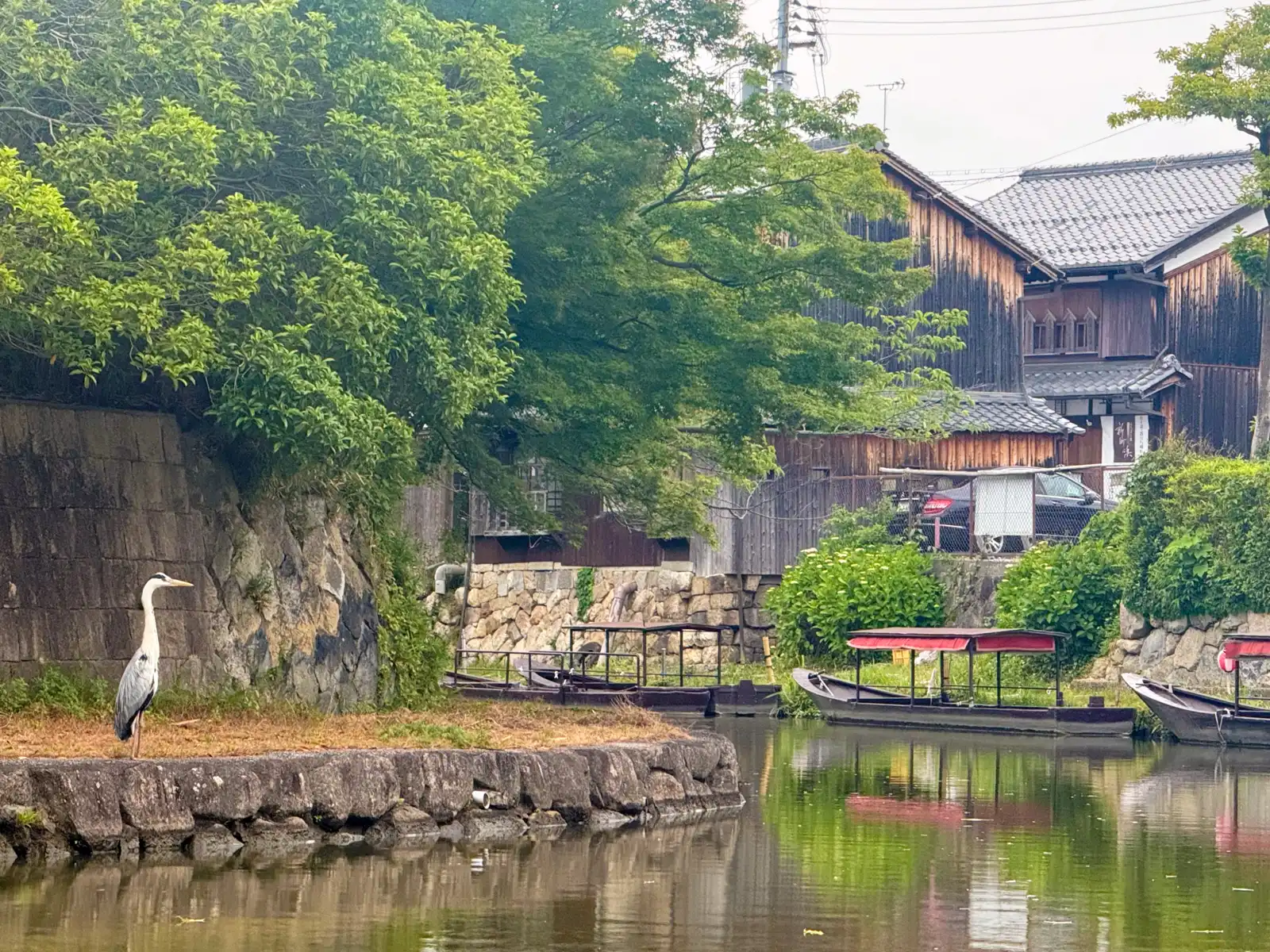
The old town doesn’t show itself all at once. You drop from street level down stone steps to the towpath, cross a bridge, duck and walk under the next one, climb back up between the white-walled storehouses, and the same stretch of canal looks like a different place each time you turn around. The kura – those thick-walled storehouses the merchants built to hold their goods – are still standing along it in black timber and white plaster, with most of them being cafés and galleries now.
It’s not just the canal the town held on to. There was also a man, and he wasn’t even from here.
William Merrell Vories came over from Kansas in 1905, twenty-four years old, hired to teach English at the local commercial school. Teaching wasn’t really the point; he’d come to spread Christianity, and he was good enough at it that the locals turned on him. His Bible classes drew such protest that he lost the job within two years. But he stayed anyway, and turned to architecture to pay for the thing he’d actually come to do. With next to no formal training he set himself up as an architect, and over the next decades his office put up something like 1,600 buildings across Japan, more than twenty of them right here in Omihachiman: the old post office, the YMCA hall he dedicated to a college friend who’d died, the plain clapboard house he lived in to the end. He married into a viscount’s family, took his wife’s name, and in 1941 became Japanese on paper. The missionary the town had once tried to be rid of died as its first honorary citizen.
Architecture wasn’t the main thing that paid the bills. The business that made the real money was a tin of medicated balm called Mentholatum, an American ointment he started selling here in 1920, a product you can now find on every drugstore shelf in the country as Menturm, the company still going as Omi Brotherhood. The balm paid for the rest: a tuberculosis hospital, a string of schools, churches up and down Shiga, most of them drawn by his own hand. He made his money on ointment and gave it back to the town. Good for the buyer, good for the seller, good for the place. The old merchants would have known the principle.
Vories never left the country. He had a stroke in 1957, up at his summer place in Karuizawa. They carried him home to Omihachiman, where he lay bedridden seven years and died in 1964, eighty-three years old. The Japanese given name he chose, Mereru, he wrote with three characters picked as much for meaning as for sound — 米来留, “America, come, stay.” His whole intention, written into a name.
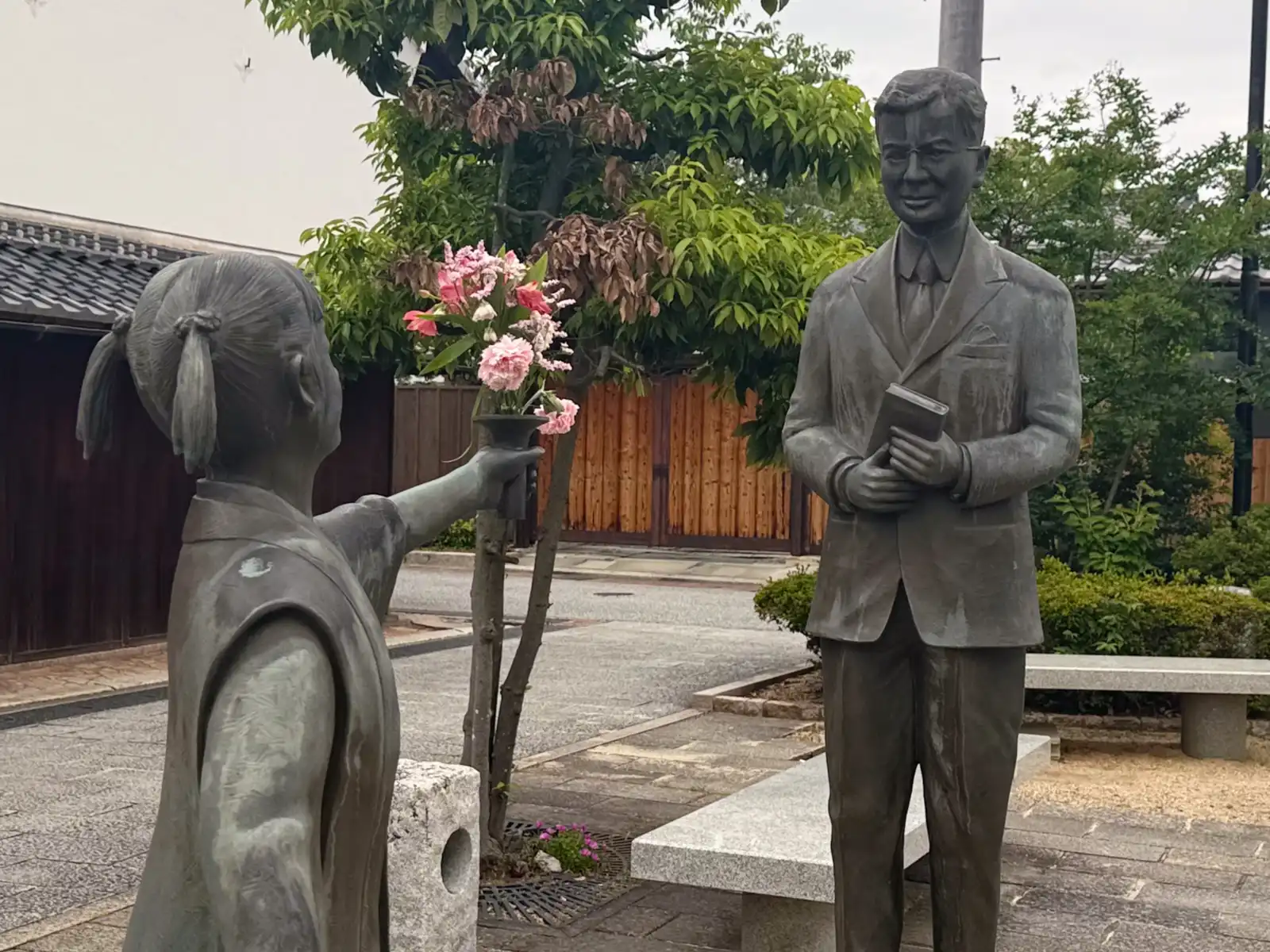
There’s a bronze statue of him behind the houses along the canal, and facing him, a girl in a kimono holding a bouquet out toward him. The flowers in her bronze hand are real and kept fresh by people who never met him. I came across the statue by accident while exploring the back lanes of the old town.
The boats I saw roped up that evening in the canal do run, just not when I came by. Two operators work the canal, one poled from the stern by hand and the other with a small engine. They run most of the year, about half an hour on the canal (as long as you remember to take your shoes off getting in). Spring and autumn are when the crowds come, when the canal is at its best. Cherry blossoms hang over the water in April and maples turn red along the banks in November. Something I didn’t expect is that the boats aren’t a tourist add-on. Apparently, people have been riding this canal for fun since the start: Hidetsugu held poetry parties out here, copying the old imperial court, back when the castle on the hill still stood.
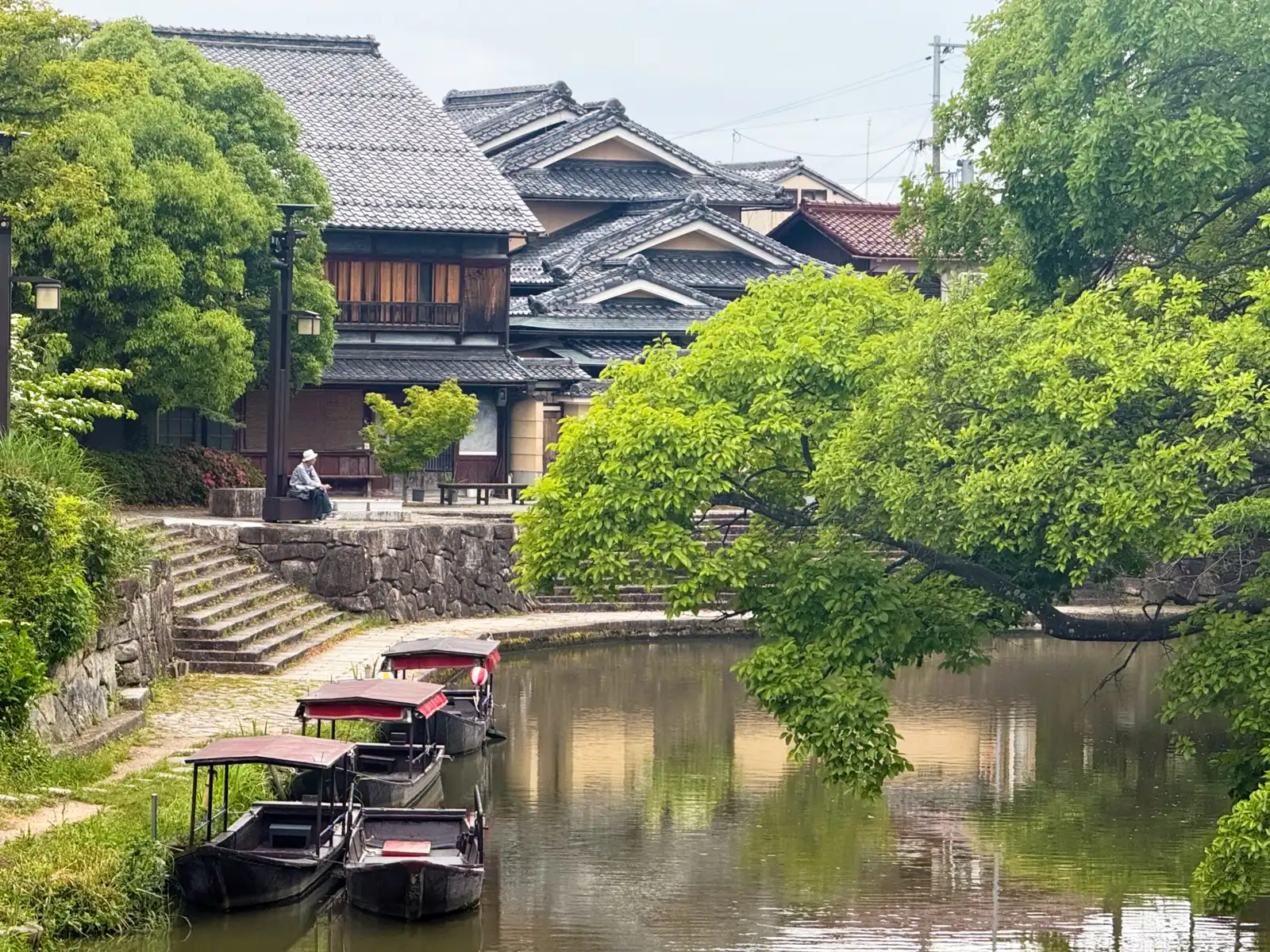
For a place with this much history behind it, Omihachiman asks very little of you – just that you slow down and look at the water, on foot or from a boat. I spent a couple of hours there, late in the day, and took far too many photos. They’re on the Photos page.