Ebumi Shrine and the Night the Village Hid from a Serpent
The guardian shrine of eight villages in Ohara, set apart from them all, out on a forest pass north of Kyoto. Its gods were carried down from three holes in the top of a mountain, and once a year the whole valley used to shut itself inside the hall and sleep on the floor in the dark, hiding from a serpent.
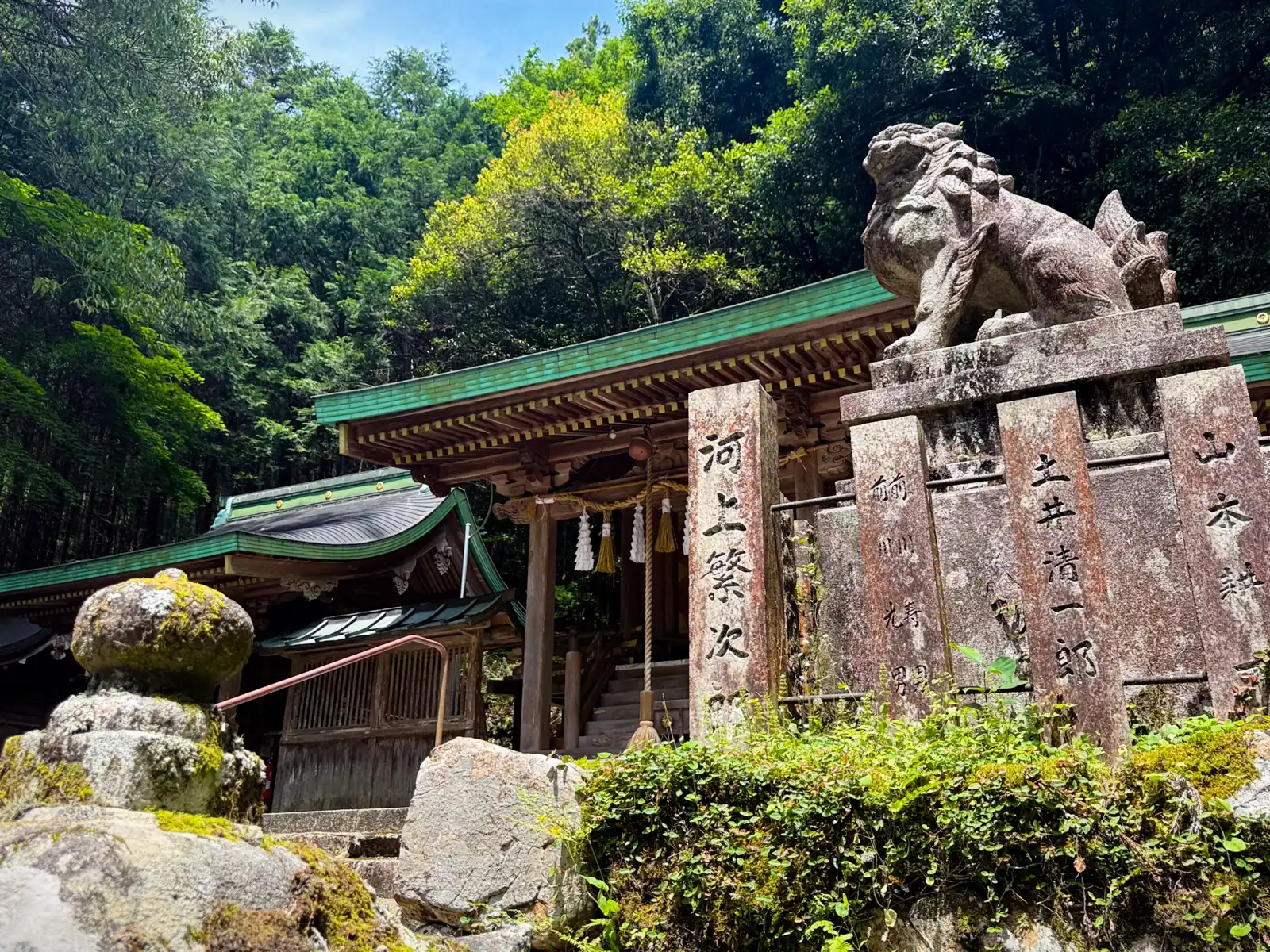
Once a year, on the night of Setsubun, the people of Ohara used to shut themselves inside this shrine and sleep on the floor of the worship hall, men and women side by side in the dark. The custom had a name, ohara zakone, which means something close to sleeping jumbled together like small fish. By the old account they were hiding. A great serpent was said to live in a pond called Obuchi, down the valley at Ide, coming out from time to time to take people. Gathering in the shrine to wait out the dark together is remembered as how the custom began.
None of that is on the sign at the shrine, and there is nothing left to see of it. The vigil is long gone, the pond is only a name now. On the afternoon I rode up I was the only visitor there.
Ohara is farming country in the north of Kyoto, better known for its temples, Sanzen-in and Jakko-in, and for the red shiso that turns the pickles here bright purple. Ebumi Shrine is not in the visited part. It sits off on the road up to the Ebumi Pass, the old crossing over to Shizuhara, a few hundred meters up a lane that follows a small river into the forest. I rode up from the valley floor, and the trees soon close in on both sides. The sound of Ohara drops away behind you until there is only the water and the birds.
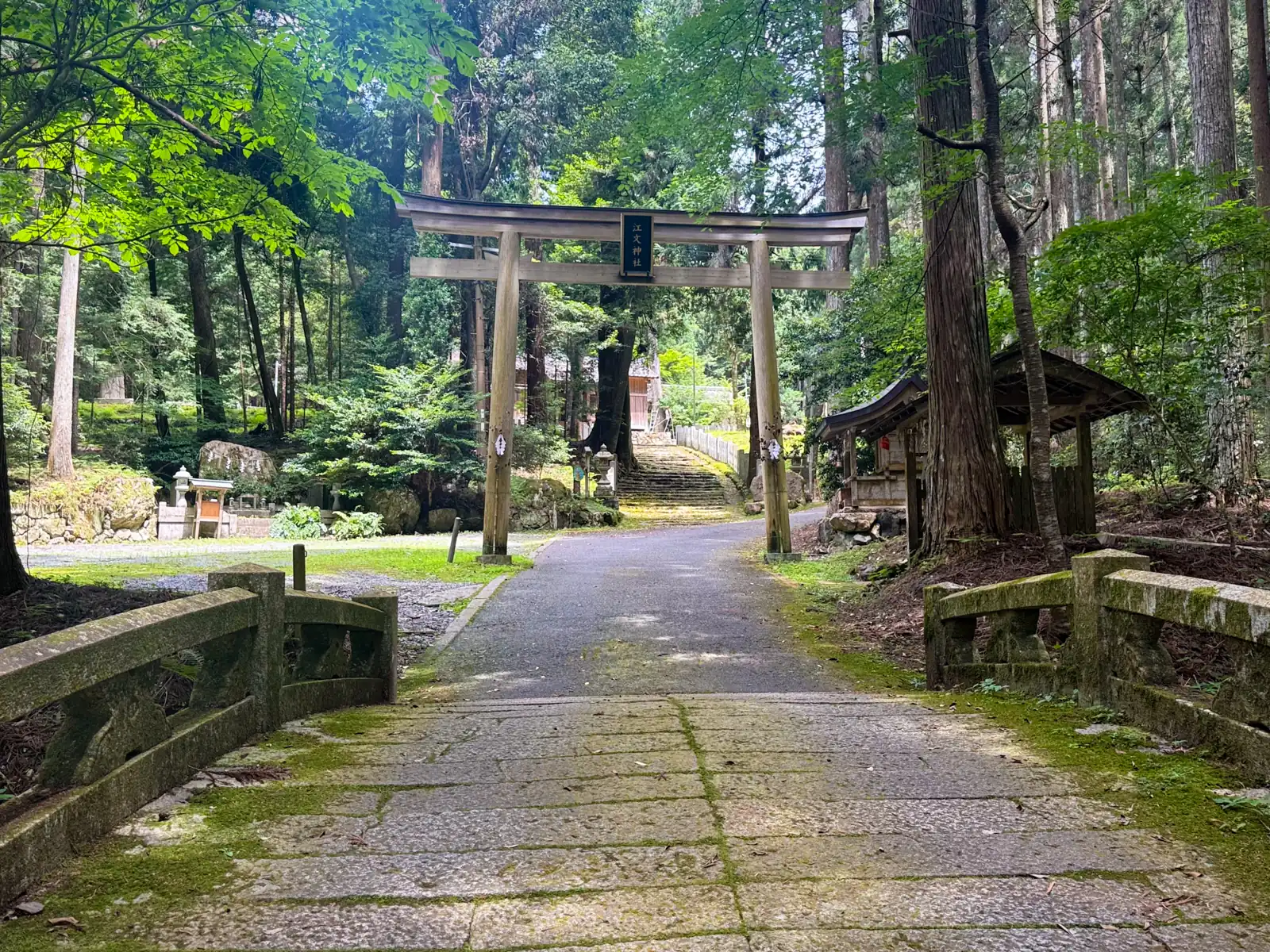
It’s an odd place for a shrine. This is the head shrine of the eight villages of Ohara, the birthplace guardian for all of them, and it sits apart from all of them, up on the pass. Village guardian shrines usually sit among the houses they protect, but this one is out in the forest at the foot of the mountain, nowhere near the houses it watches over.
A stone bridge crosses the stream, then a torii, then a flight of steps up to the halls. At the approach, the first thing you notice isn’t the buildings. It’s two large rocks, each wrapped in a shimenawa, the twisted rice-straw rope that marks something as sacred. Rocks like these are usually iwakura, seats where a god is thought to come down and settle. They are also a clue to what this place really is.
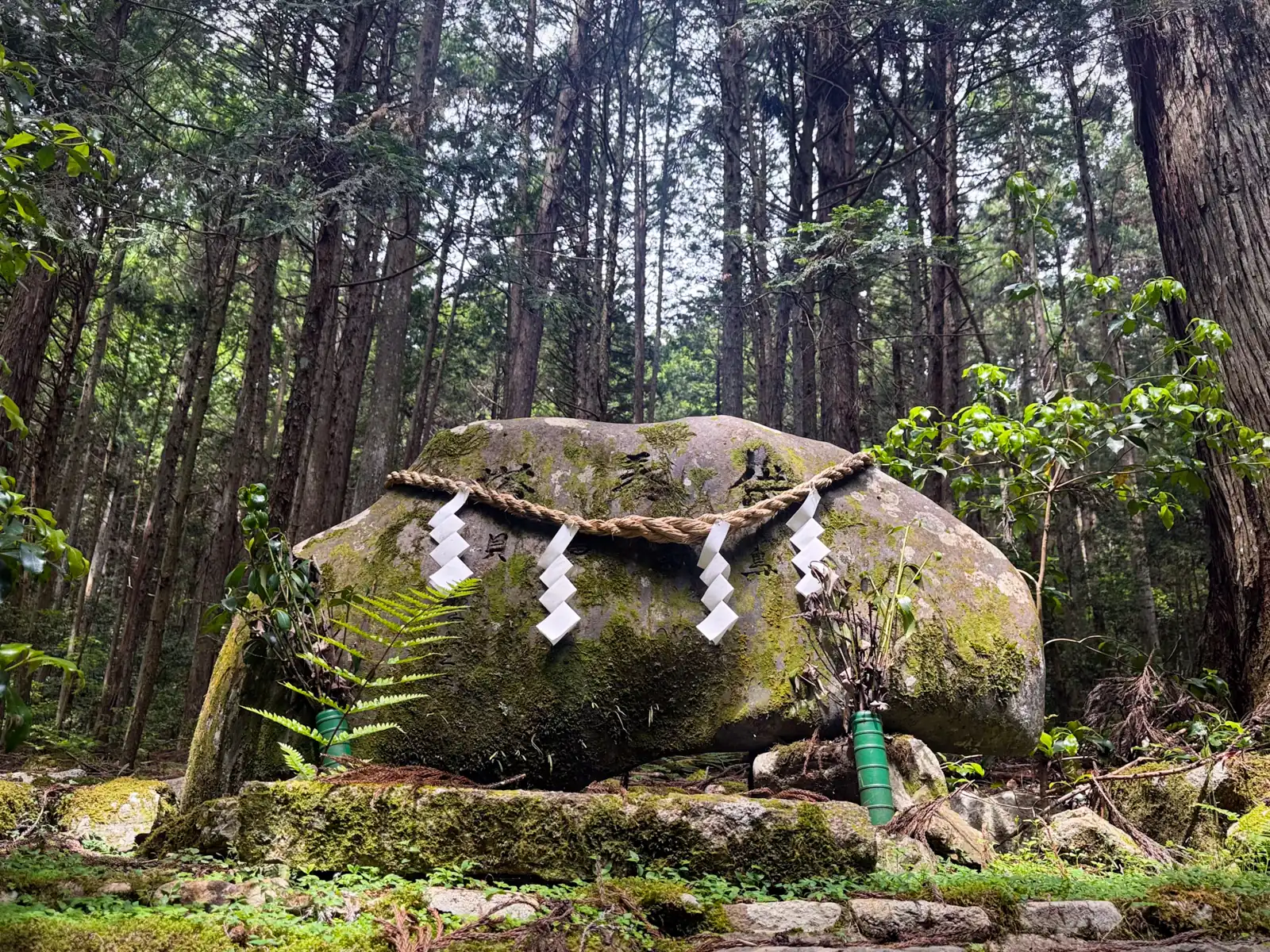
The mountain behind the shrine is called Mt. Konpira today. Its older name was Mt. Ebumi, which is where the shrine takes its own name. Long before there was a hall down here, the summit itself was sacred, a mountain worshipped as the body of the gods. Near the top, an early-1700s gazetteer of the province records three natural holes in the rock called the fire pot, the wind pot, and the rain pot. The gods of fire, wind, and rain were said to live inside them, and people climbed up to pray there for rain in a dry year. In the late Heian period, roughly the twelfth century, those mountain gods were brought down off the summit and a shrine was built for them at the foot. That is the shrine standing here now. The two roped stones at the top of the steps read like an echo of the summit cult, the rock worship of the peak brought down to a place people can actually reach.
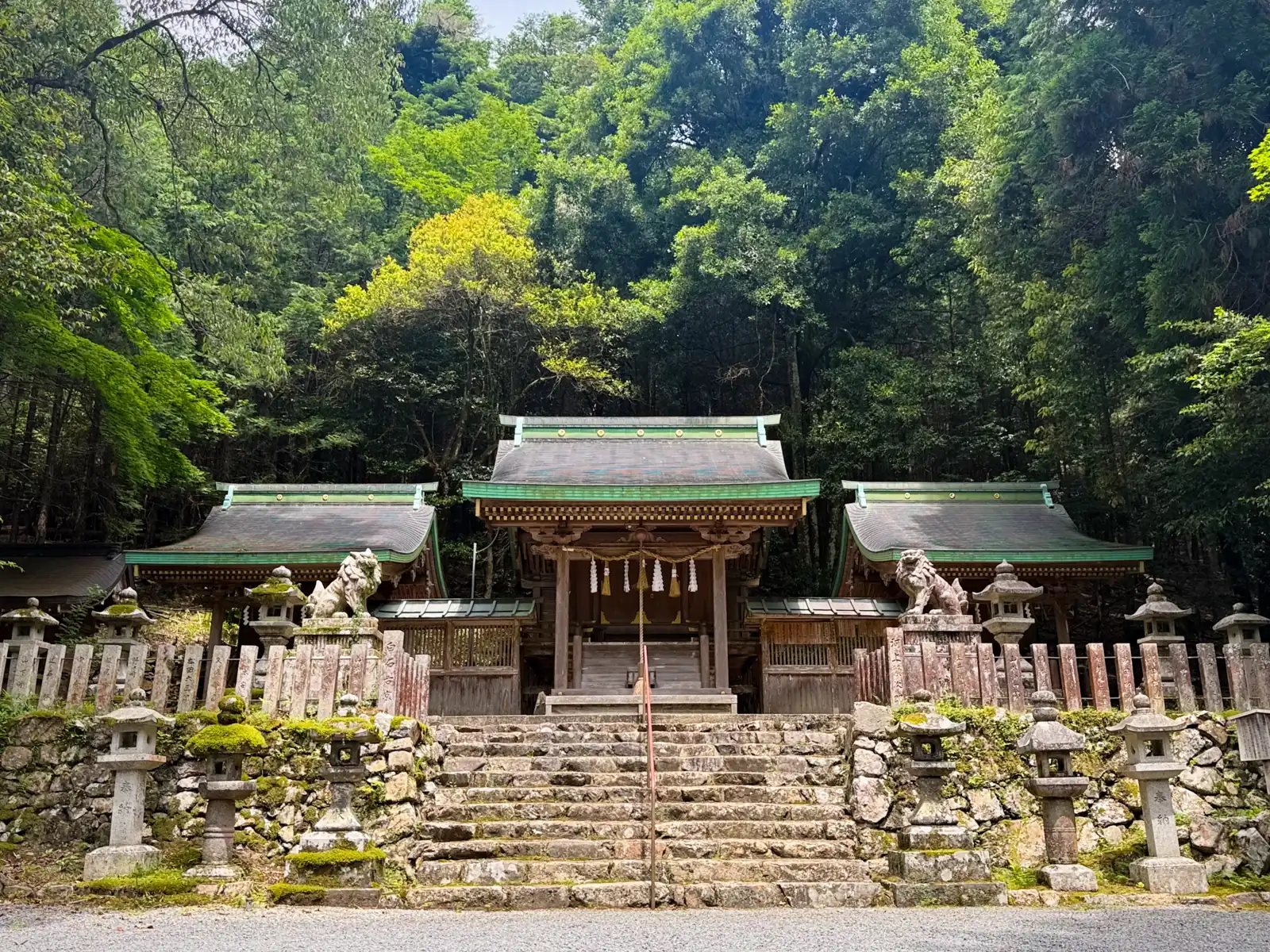
The three halls divide the work between them. The center hall, the largest, holds Uka-no-Mitama, a grain god whose name means roughly the spirit of the rice in the storehouse. The hall to the right holds a wind god, the one to the left a fire god. For a valley that lived on its fields, that is a practical set of gods to keep close: the harvest, and the wind and fire that could take it away.
Which brings me back to the serpent. The story is written down in that same old gazetteer as part of a local tale. A woman from the capital had married a man in Wakasa, up on the Japan Sea coast, and fled back toward Kyoto, but she drowned in the river here and sank to the bottom. Some time later her husband came through on horseback, and a great serpent rose out of the water and tried to drag him under. He struck it with a stone and it fled. Afterward it made its home in a pond down the valley, coming out now and then to harm the villagers. That, the story goes, is why people began to gather in the shrine on Setsubun night. However it started, the zakone became a scandal by reputation. Men and women shut in the dark together made it into old poems and into Ihara Saikaku’s Life of an Amorous Man in the 1680s, which did nothing for the shrine’s name. It was banned in the Meiji period on grounds of public morals, and it was never brought back.
The shrine had a fuller religious life than its quiet atmosphere suggests. It was not always just a shrine. For centuries it was a combined Buddhist temple and shrine, Bishamon-do Ebumi-ji, of a kind common in old Japan, where the Buddhas and the local gods shared the same ground. By tradition it was linked to Sanzen-in and to the Tendai monks of nearby Mt. Hiei, and it did well through the medieval centuries. Then in 1571 Oda Nobunaga burned Mt. Hiei to the ground, and the temples and shrines in Hiei’s shadow, Ebumi among them, went down with it. It never recovered its old size.
The festivals still continue today. On May 4, three portable shrines carry the three gods on a circuit of the old villages. On the Saturday nearest September 1, the villages bring the Ohara hassaku dance up to the shrine, young men in kasuri cotton and sedge hats turning in a slow ring to an unaccompanied chant, a prayer for a good harvest that the city now registers as a folk cultural asset. On an ordinary day, though, you must be lucky to find somebody here.
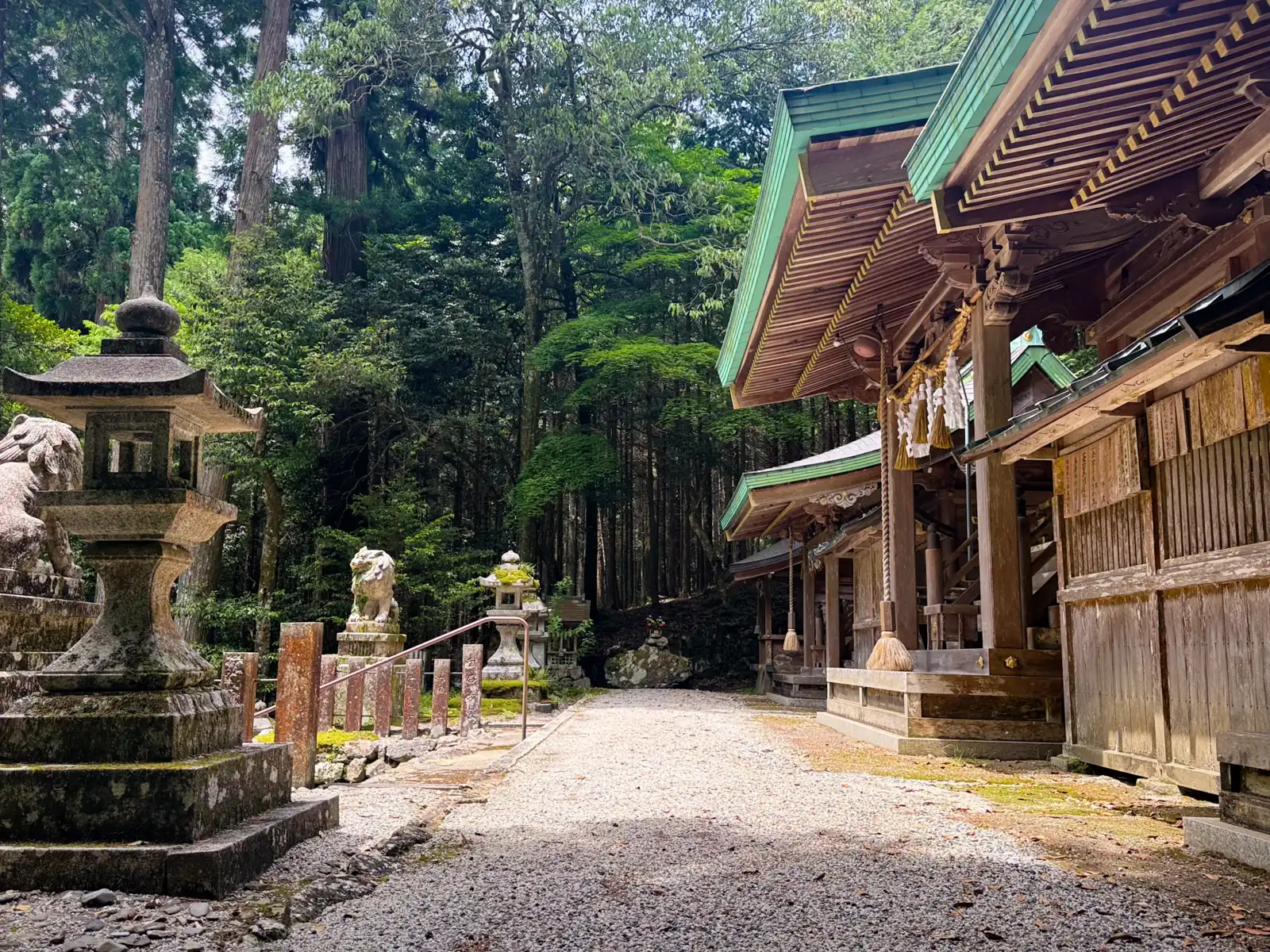
There was one other person when I came. An older man was up a ladder in a tree beside the shrine office, in work clothes, cutting back branches. I explored the grounds, took my photos, and went over to the office window for a goshuin, where a small sign said to ask if you wanted one. So I asked the man in the tree. He climbed down, told me to wait, and went inside. Five minutes later the window slid open and there he was, seated at the desk in the white and pale-blue robes of a priest, having changed out of his work clothes to hand the goshuin across properly. I paid the 300 yen. He asked where I had come from, and when I said Tokyo, by electric bicycle, he looked honestly surprised, then said what I had already worked out for myself: that it is quiet out here, not like the shrines down in the city.
I walked a little way behind the shrine afterward, but not far. There was a sign about bears.