Kanazawa Station and the Gate That Wasn’t in the Plan
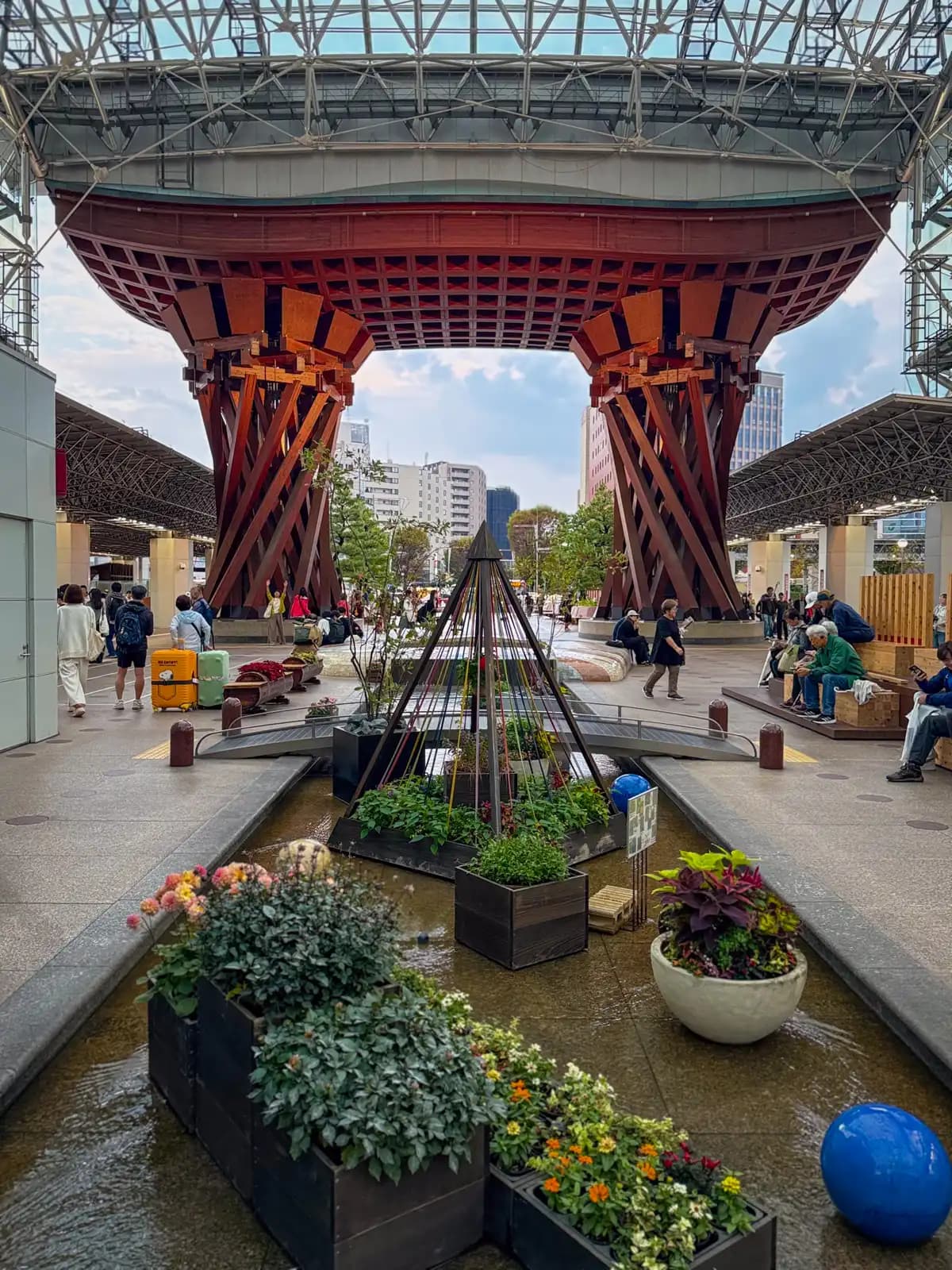
A wooden gate almost fourteen meters tall, shaped like a Noh drum, stands in front of a glass umbrella big enough to shelter the whole plaza. Most train stations are places you rush through, but Kanazawa Station kept me hanging around for hours. As it turns out, the gate everyone photographs is only there because the locals sent the architect back to the drawing board. I had one evening there on my way back from Fukui and I spent most of it looking up.
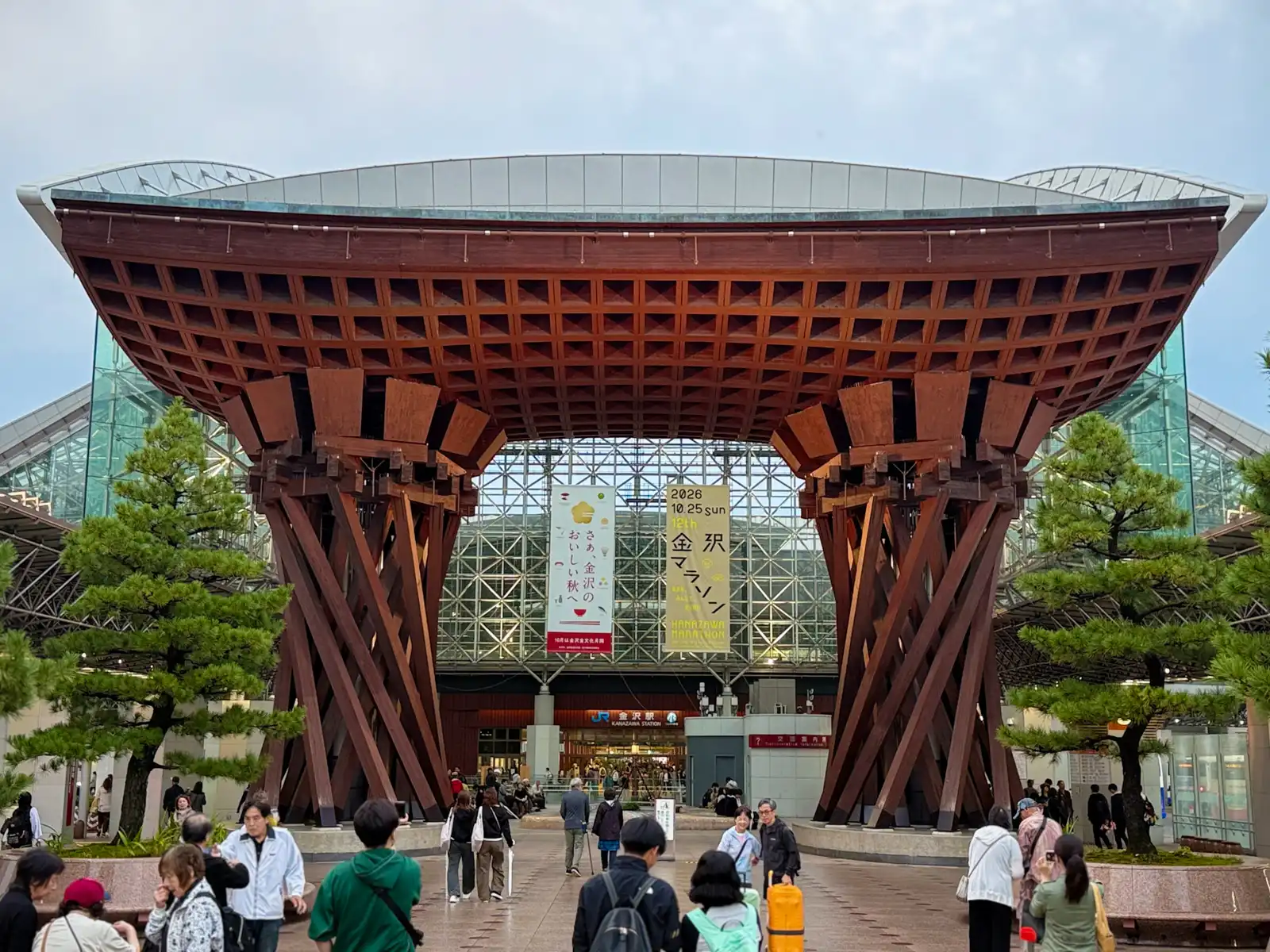
If you’ve ever seen a photo of Kanazawa in Ishikawa Prefecture, there’s a good chance the big wooden gate in front of the station was in it. Funnily enough, it almost didn’t get built. Shirae Ryuzo, the architect who designed the station square, wanted it built only from the standard things a station actually needs, like a roof against the weather, a bus terminal and walkways. He wanted those things to look good because they were well engineered, not because someone stuck decoration on them. There was no gate anywhere in that design. Once the basic plan was done, he presented it to a council that included not just architects but also ordinary local residents. Several of them pretty much told him straight out that it didn’t feel like Kanazawa at all. What the city needed, they said, was wood and black roof tiles. He was a bit thrown by that at first. Eventually, he decided this was the local voice he should be listening to and went back to the drawing board. What came out is the Tsuzumi-mon, the Drum Gate, now one of the best-known and most photogenic symbols of the city.
I ended up in Kanazawa on my way back from Fukui, riding my e-bike. It was a rather short visit, though. I got into the city in the late afternoon and had just one evening to look around. By the next morning I was back on the bike and heading for Toyama. I’ll be posting the whole trip day by day soon, so think of this as a little side quest before the main story. With the little time I had, I did what a lot of people probably end up doing in Kanazawa without planning to, and spent most of it hanging around the station.
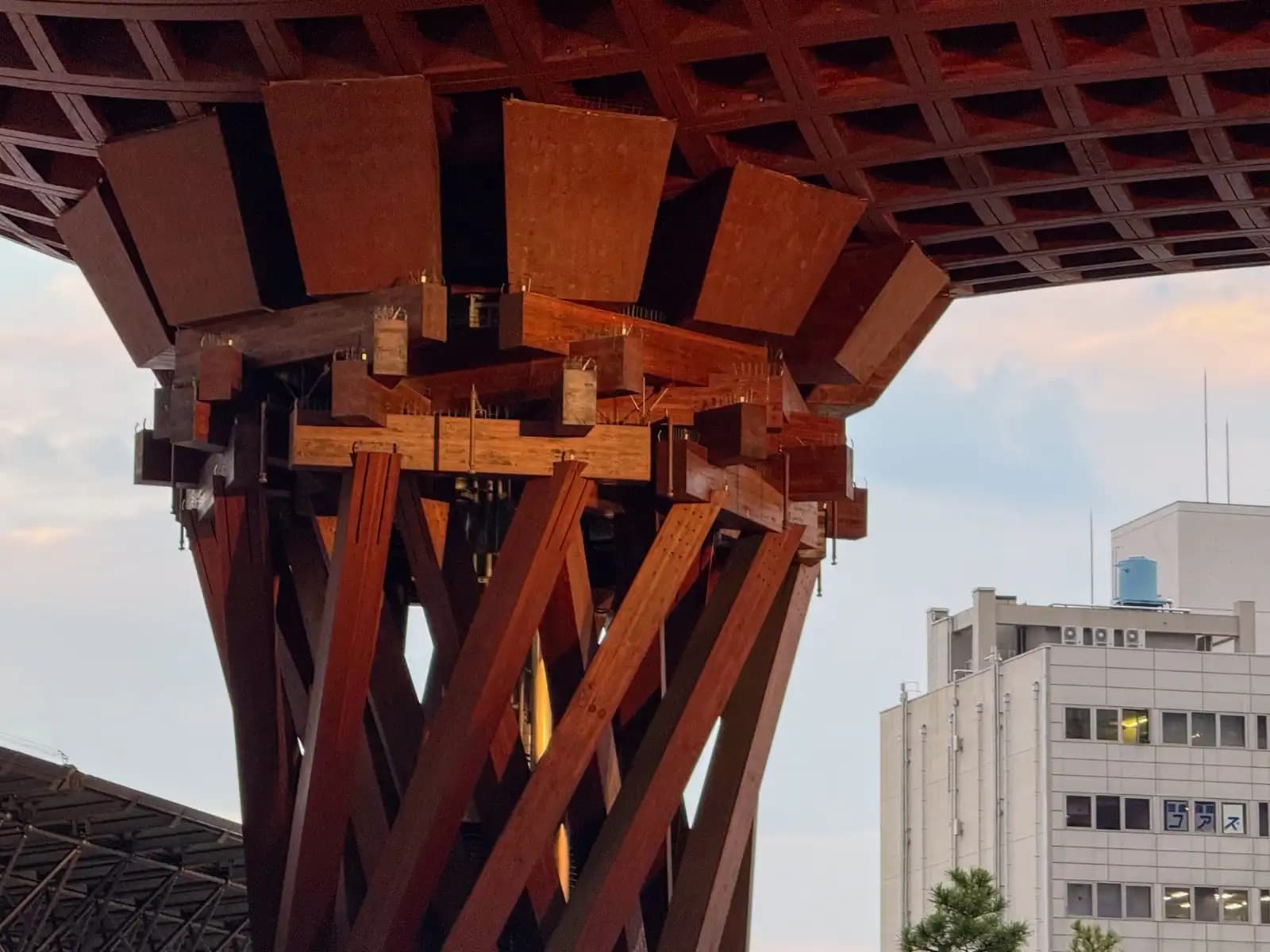
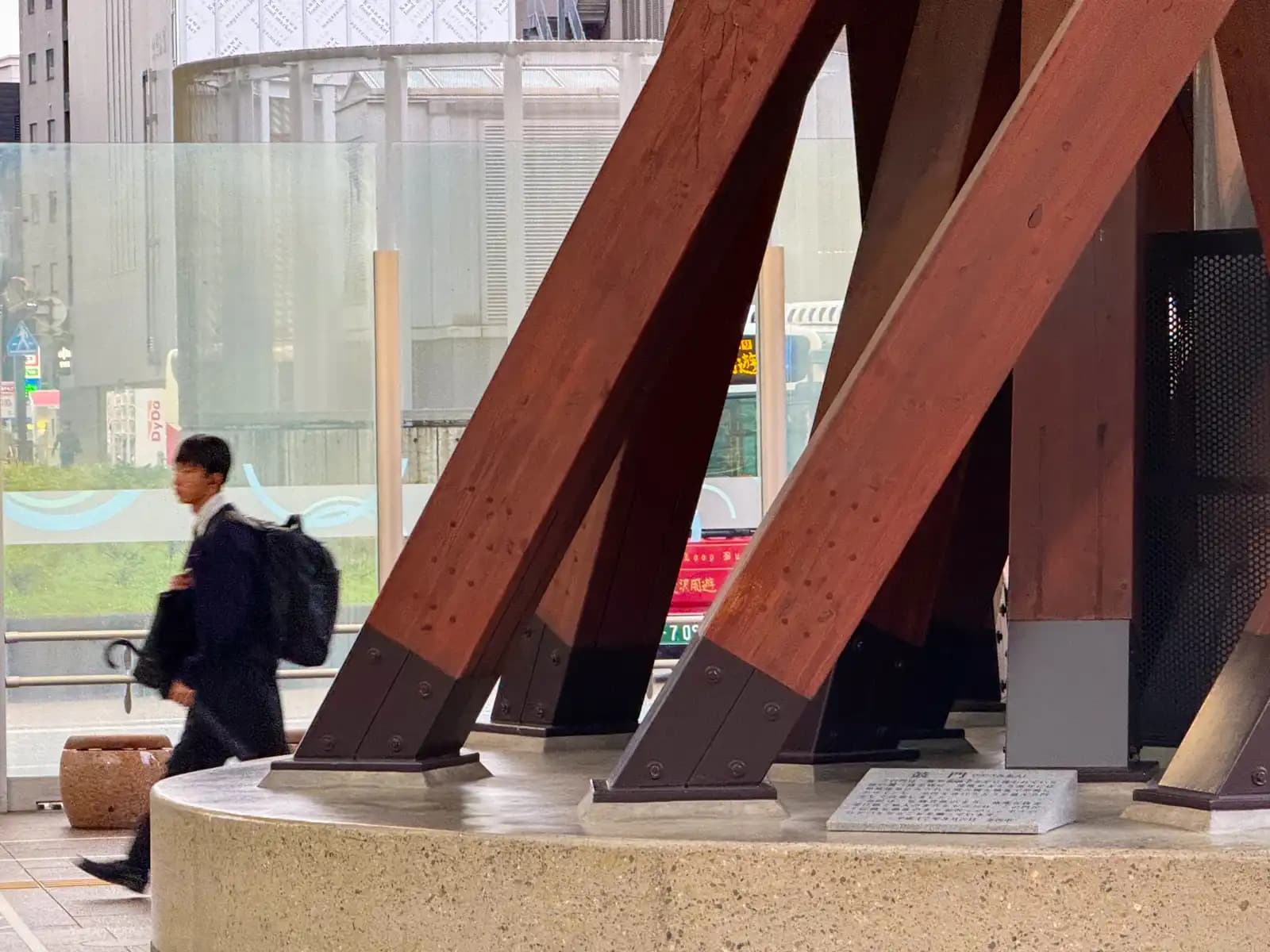
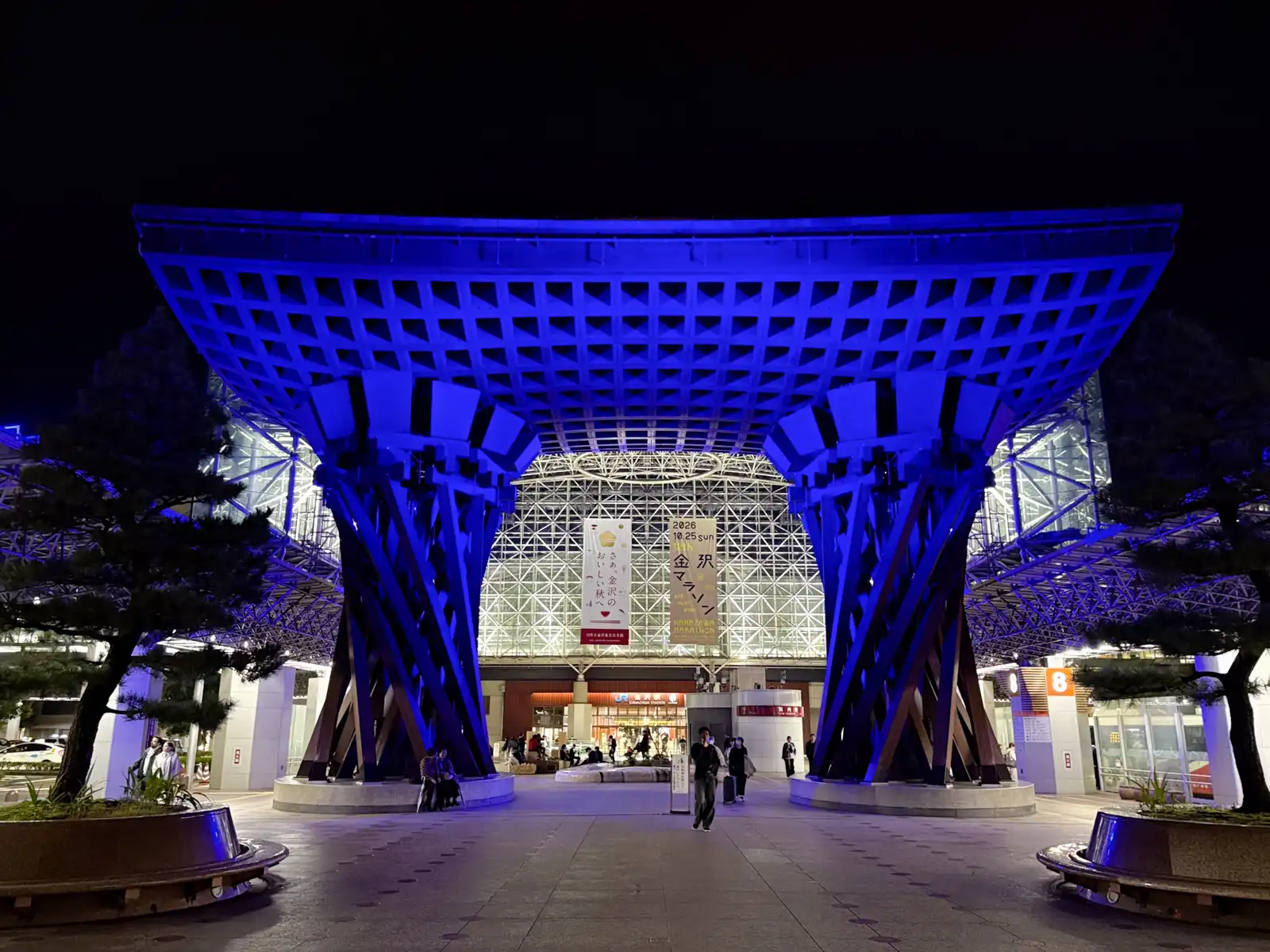
The gate stands right outside the east exit, which is officially called the Kenrokuen exit. There are two massive pillars, 13.7 meters tall, holding up a gently curved lattice roof. The whole thing is built from laminated Douglas fir. The pillars are the part that really caught my eye. They aren’t straight posts but bundles of wooden beams wound around each other in a spiral, and from across the square they look like two giant ropes standing on end. Up close, it’s honestly hard to work out how the thing stays up at all. The design comes from the tsuzumi, the small hourglass-shaped hand drum used in Noh theater, the one that makes that sharp “pon” sound with the drummer’s shouts in between. A tsuzumi has two drum heads tied together with hemp cords called shirabe-o, laced up and down around the body. The player basically squeezes those cords to change the tone. Those twisted pillars are the cords, blown up to the height of a four-story building.
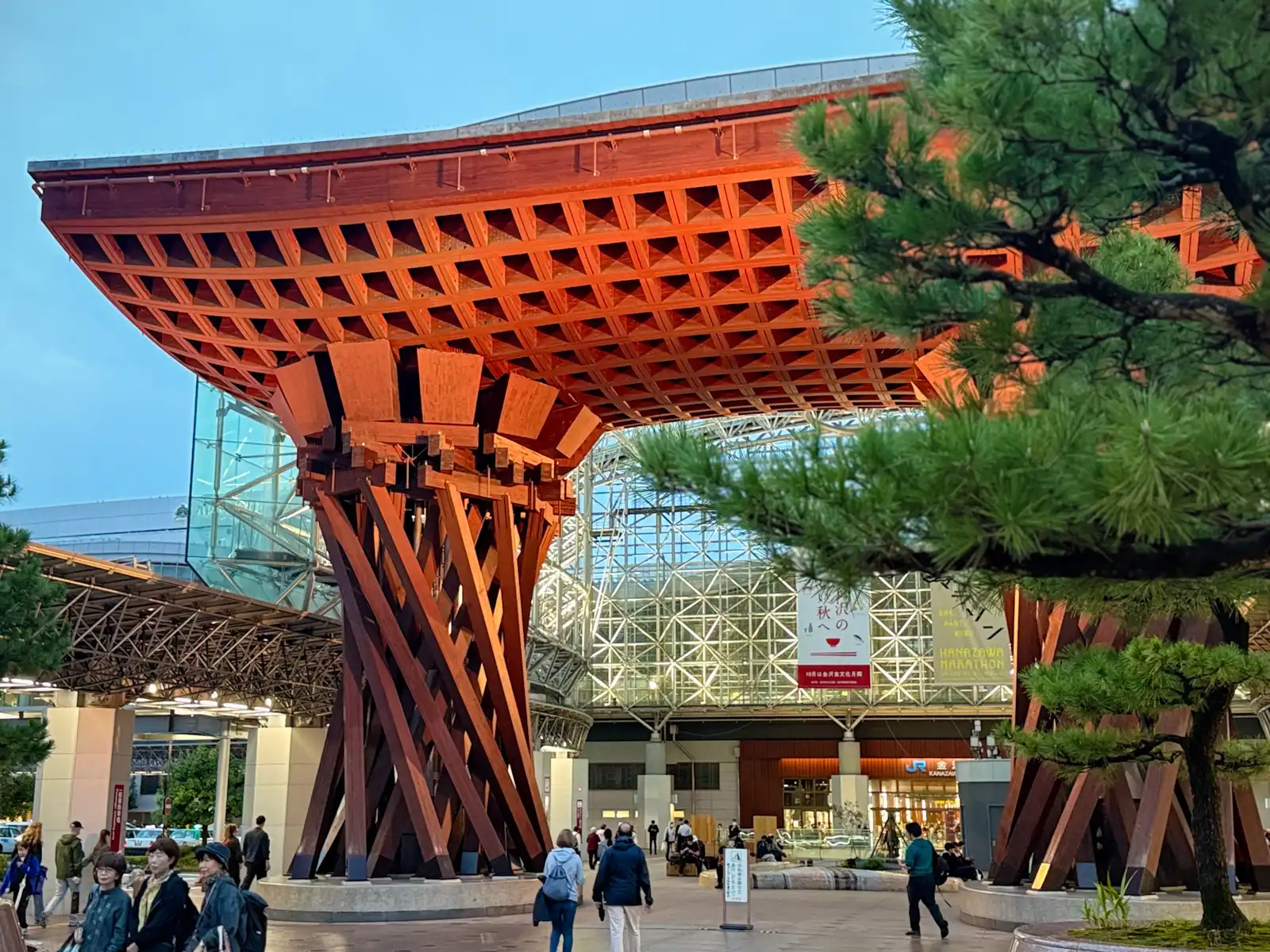
Why a drum? Because Kanazawa has loved Noh for about four hundred years. The Maeda family, who ruled the Kaga domain from Kanazawa through the whole Edo period, were keen fans from the start. The fifth lord, Maeda Tsunanori, took up the Hosho school of Noh after the shogun Tokugawa Tsunayoshi favored it. Under the Maeda, Noh spread from the samurai to ordinary townspeople. An old local saying goes that in Kanazawa, Noh chanting falls from the pine trees, because even the gardeners up in the branches sang it while they pruned. The local style, Kaga Hosho, is still performed today. The city even has a prefectural Noh theater and a whole museum just for Noh. While working on the design, Shirae kept asking people in Kanazawa what the symbol of their city was. The most common answer after the Maeda family’s plum blossom crest was the tsuzumi. So when the locals asked for something that felt more like Kanazawa, the drum was sitting right there waiting for him.
Interestingly, the gate isn’t there just for decoration. It has a day job, too. The station square needed something to collect the rain and melting snow running off the big glass dome behind it, plus something to move air in and out of the underground plaza below. Shirae first tried designing those in a clean, modern style, but it just didn’t feel right to him. In the end, the drum gate took over both jobs. Inside those twisted pillars there are pipes. The rainwater from the dome flows down through them into a storage tank so it can be reused. And so, the most photographed gate in the whole region is also a very fancy drainpipe and an air vent. Great! Somebody managed to design a drainpipe that people travel across the country to take selfies with.
Getting it built was quite a fight. Fire regulations aren’t too keen on big wooden structures sitting in the middle of busy station squares. Shirae has said the legal side was the biggest headache of the whole project. It took legal experts, fire safety experts, a long series of meetings with the authorities and even firefighting tests on the gate before it got the green light. It was finished on March 20, 2005, at a cost of around 350 million yen. There’s a nice little idea behind which way it faces, too. Kanazawa, like many old Japanese cities, got its railway at the edge of the old town, so the castle town sits on one side of the tracks and the newer city spreads out on the other. Shirae treated the whole station square as the boundary between old and new Kanazawa. The wooden gate stands on the side that looks toward the historic city.
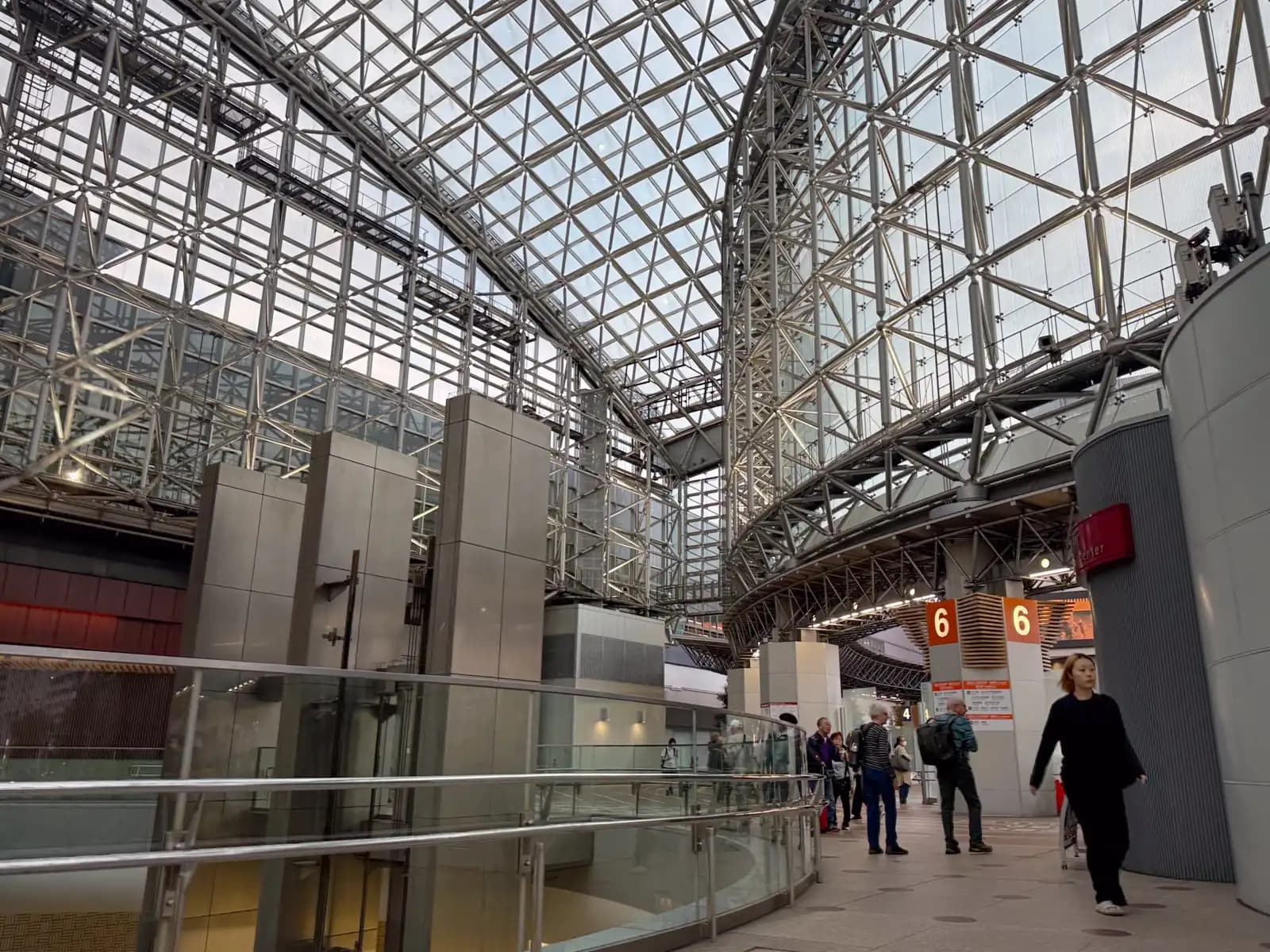
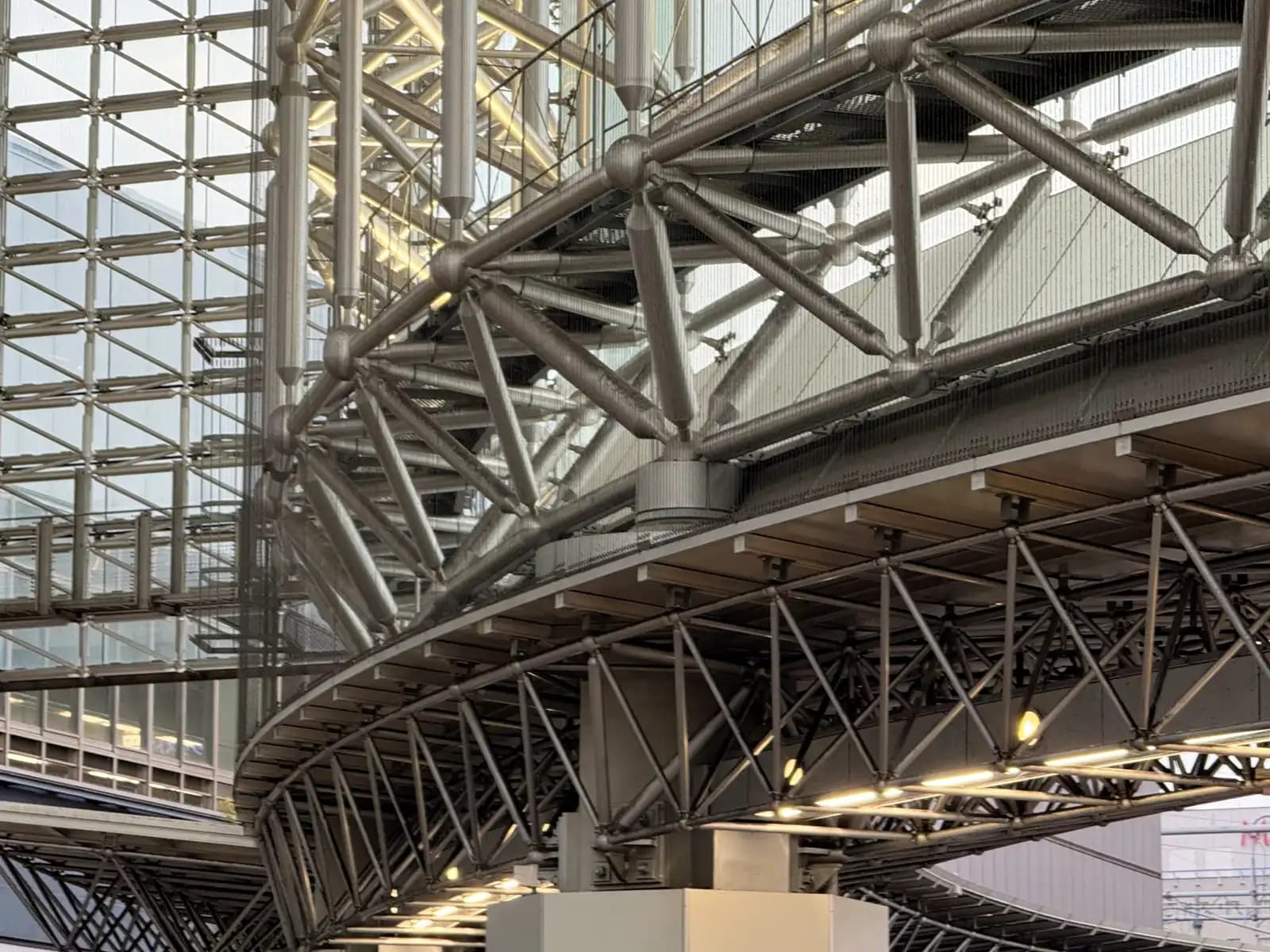
Behind the gate is the Motenashi Dome. The gate gets all the photos, but the dome is what you actually end up standing under. Motenashi means hospitality. The dome is meant to be a huge umbrella held out to everyone stepping off the train. And there’s actually a good reason for that. Locals have a saying, bento wasurete mo, kasa wasureru na, meaning you can forget your lunch, but never forget your umbrella. It rains a lot in Kanazawa and snows a lot in winter, so a giant umbrella over the bus and taxi stops is, I think, a genuinely thoughtful way to say welcome.
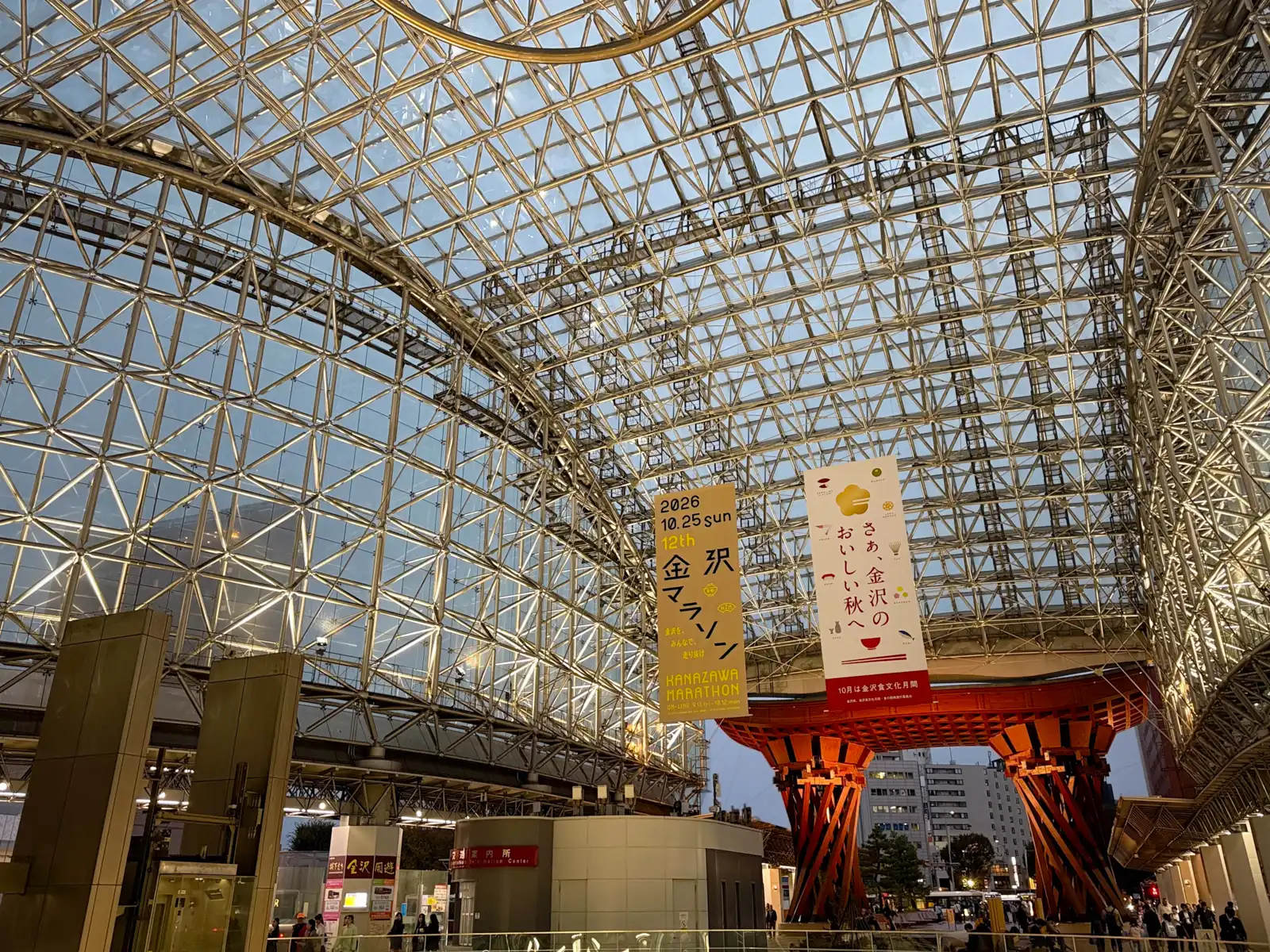
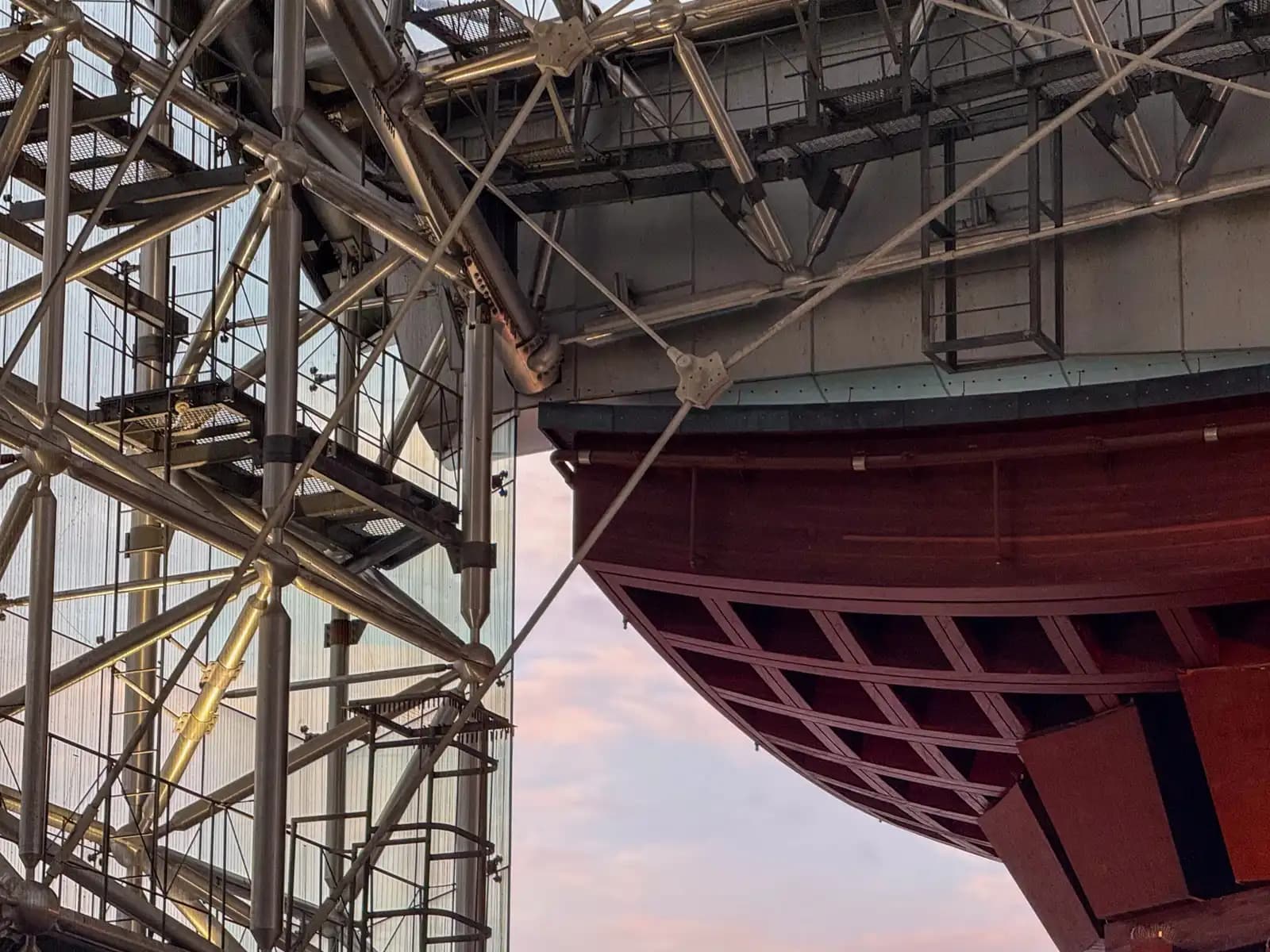
The dome is shaped like a slice cut from an enormous sphere with a radius of 90 meters. Seen from above, its outline is a sort of T-shape, which at least one guide compares to a bachi, the pick used to play the shamisen. Whether that was intentional or not, it puts a drum at the front and a shamisen pick right behind it (in case anyone worried the station wasn’t musical enough). It rises 29.5 meters, about as high as a nine-story building. It’s covered in 3,019 panes of tempered glass set into a web of about 6,000 aluminum members, each around three meters long. It was built to handle 180 centimeters of snow, the deepest snow ever recorded on the ground in Kanazawa. All in all it took about 800 tons of aluminum. As recently as 2023, Japan’s aluminum construction association was still calling it the largest aluminum building in the country.
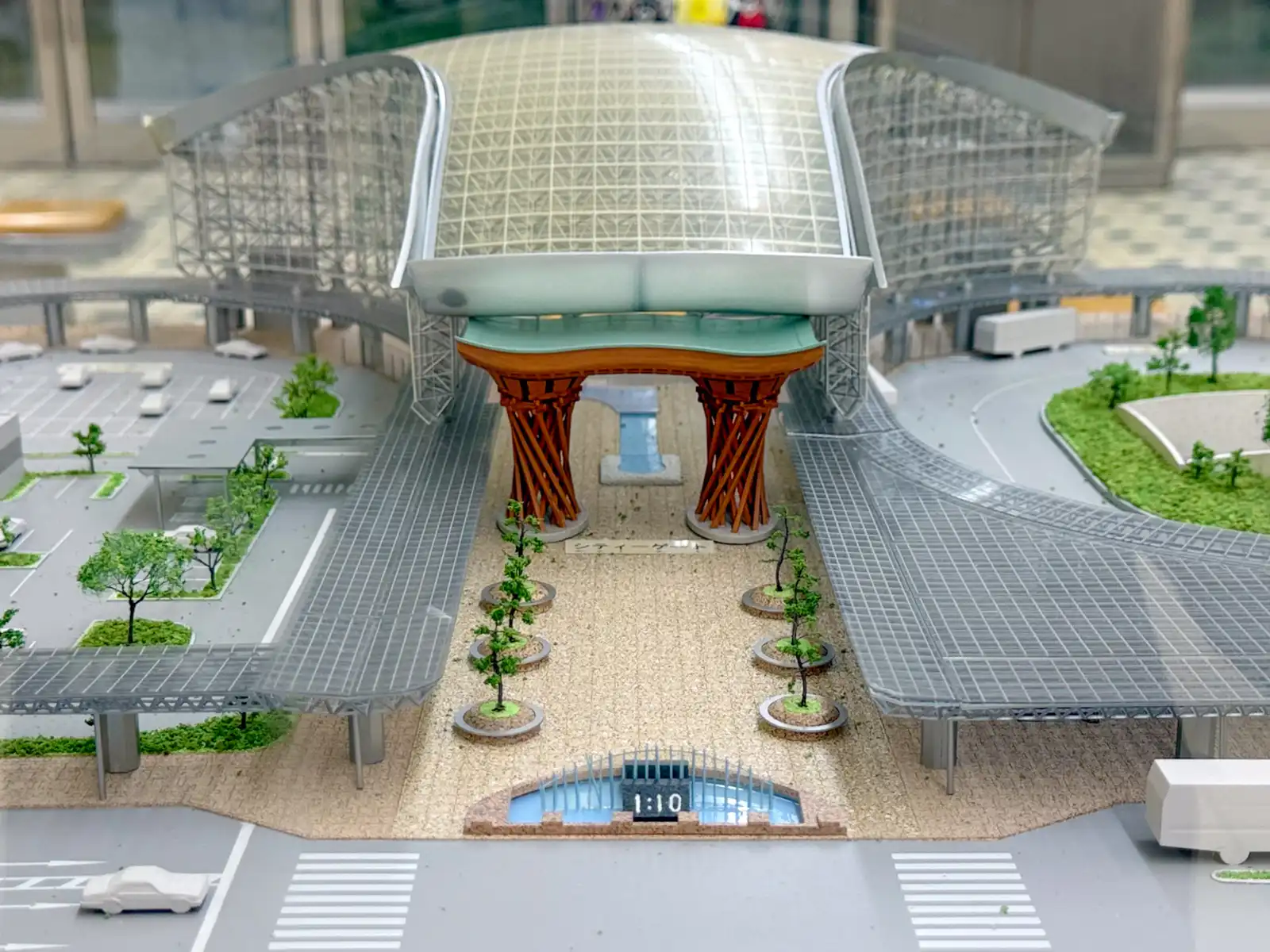
Why aluminum and not steel? Because Shirae was building for the next four hundred years. That was literally his first proposal to the city. Which isn’t all that surprising, since Shirae is known in Japan as an environmental architect, the kind who designs buildings to last a long time, use less material and be easier on nature. Most of what people think of as Kanazawa culture started around four hundred years ago when the Maeda family arrived. The city has been living off that inheritance ever since. In his view, the people of today owed the future a building that would last just as long. Steel slowly rusts over time, which isn’t great news for something that’s supposed to stand for centuries. For a 400-year roof he wanted aluminum and stainless steel, but at the time Japanese building law didn’t allow aluminum as a structural material. On top of that, people grumbled about the cost. The aluminum industry had already been pushing to change that rule, which helped a lot. Some careful number crunching also showed that aluminum would actually come out cheaper in the long run. Work started in May 2002 and finished in March 2004. None of us will be around in 2404 to check on it, but let’s take his word for it.
If you’re at the station after dark, I recommend you stick around. From sunset until midnight, the gate is all lit up. Every hour, on the hour, it switches for two minutes to one of the Kaga gosai, the five traditional colors of Kaga yuzen silk dyeing. Those are crimson, indigo, a deep grassy green, ocher and an old royal purple. Which one you get depends on the day of the week. Watching the wooden gate glow in color against the night sky is worth the wait. But two minutes goes fast, so make sure to get your camera out early.
All this craft work carries on inside the station. Kanazawa makes nearly all of Japan’s gold leaf, so naturally the pillars on the shinkansen platforms are covered in it. The passages are lined with local crafts built right into the walls and gate-shaped pillars, including Kutani porcelain, Suzu ware, Wajima and Kanazawa lacquer, Kaga yuzen silk, tea kettles and Kaga inlay metalwork, much of it by well-known artists. There’s also a huge ceramic wall of Ohi ware, the amber-glazed pottery tied to the tea ceremony, made by Ohi Chozaemon X. Most people just walk straight past all of it on their way to the coin lockers. Even the shinkansen departure melodies are local, written by Yasutaka Nakata, the Kanazawa-born producer behind the pop group Perfume.
It didn’t take long for the rest of the world to catch on. In 2011 the American travel magazine Travel + Leisure put Kanazawa on its online list of the 14 most beautiful train stations in the world, in sixth place. It was the only Japanese station on the list. Antwerp Central took first place and St Pancras in London second. That’s excellent company for a station that, not long before, had been a plain concrete box.
For most of its history, Kanazawa Station was a fairly ordinary building. The first station opened on April 1, 1898, when the railway reached Kanazawa from the south, from the Fukui side, the same direction I rode in from. It was a modest single-story wooden building with a chimney at each end. The land around it was lotus fields from the later Edo period right into the early Showa era. And if you go all the way back to prehistoric times, the whole area was actually a lagoon. Getting there from Tokyo was quite a journey back then. When the station opened, you had to take a night train and change at Maibara. Even after direct trains from Ueno started running in 1913, it was still an overnight trip.
After the war, like many big stations around Japan, it was rebuilt as a minshu-eki, a “people’s station.” Japan National Railways was short of money, so local businesses and governments chipped in part of the construction cost. In return, they got to run shops and restaurants inside. If you’ve ever wondered why so many stations in Japan are basically shopping malls with trains attached, this is pretty much where it all started. Kanazawa got its own people’s station in the early 1950s. It was a four-story block of reinforced concrete with shops and restaurants inside, practical and boxy, a building you look at once and forget. It stayed more or less like that for decades. (Click here to see what it looked like in 1984). The tracks went up onto an elevated line in 1990. From 1998, with the shinkansen in mind, the station went through years of rebuilding that ended with the gate and the dome in 2005.
The shinkansen arrived on March 14, 2015, cutting the trip from Tokyo to around two and a half hours. For nine years, Kanazawa was the end of the line. On March 16, 2024, the Hokuriku Shinkansen was extended south through Fukui to Tsuruga. These days the bullet train covers the stretch I spent most of a day pedaling in well under an hour. I’m… trying… very hard not to think about that.
Oh, and walk through to the other side of the station if you can. The west exit, now called the Kanazawa Port exit, is much quieter and gets far less attention, but it has a little oddity of its own. In the plaza stands a big modern sculpture called Yuyo, made by Kanazawa-born artist Hasuda Shugoro to mark the city’s 100th anniversary. A local TV program once asked people what it was meant to be. The guesses ranged from the shape of the Noto Peninsula to the characters for Ishikawa. It’s actually the word カナザワ, Kanazawa, spelled out in katakana. The last letter, ワ, lies on its side, so you have to tilt your head to read it. Just in case anyone forgets which city they’ve arrived in.
And that was my whole Kanazawa. One evening, one station, one gate and a lot of craning my neck. I didn’t get to Kenrokuen (the famous garden), the castle, the old teahouse districts or the market this time. Anyone who knows Kanazawa is probably shaking their head right now. After a long day on the bike, though, standing in front of that gate in the evening light felt like a real welcome. The next morning I was back on the road to Toyama with that annoying feeling you get when you leave a place too soon. Kanazawa deserves a lot more than one evening. I’m already looking forward to coming back and giving it a proper visit.
I took a lot more photos than I could fit in here, so if you’d like to see the rest, I’ve put them all in the gallery here.